

Reported by: Oahimire Omone Precious | Edited by: Oravbiere Osayomore Promise.
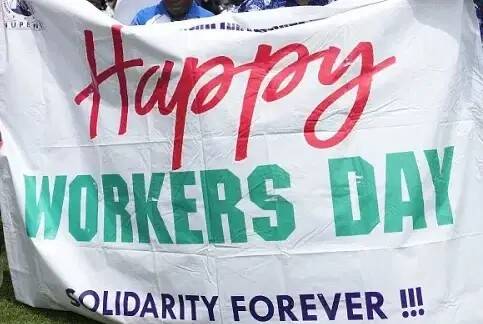
From Federal Capital Territory stadiums to the streets of Bauchi, Ebonyi and Kogi, Nigerian workers on Friday 1 May 2026 repurposed International Workers’ Day from a ceremonial march-past into a coordinated national protest over the non‑implementation of the National Minimum Wage Act. The Nigeria Labour Congress and the Trade Union Congress ordered members in “defaulting states” – those that have not fully implemented the mandatory N70 000‑per‑month floor – to abandon indoor gatherings and instead march through state capitals. At the traditional ceremony in Abuja, labour leaders used the podium, while thousands of workers in other states used their feet and their voices.
“Observe 2026 May Day on the Streets if the National Minimum Wage Act has not been fully implemented in your state”, an NLC circular had instructed weeks earlier. As workers assembled at labour houses and union secretariats by 7 a.m., the shift in tone was unmistakable. In states where governors had continued to hold stadium ceremonies, organised labour directed its members to boycott such events, insisting that no celebration of work was possible where the worker remained impoverished. The NLC also demanded that any further adjustment to the minimum wage be set at N154 000, a figure that labour leaders argue is the only realistic buffer against inflation that has formally eroded the value of the basic national wage.
In the Federal Capital Territory, the main event took place at the Old Parade Ground, where NLC President Joe Ajaero and TUC President Festus Osifo led a large rally. Ajaero said the labour movement was “gradually moving from the streets to the ballots”, a reference to active participation in the 2027 electoral process. He also revealed that nearly 90 per cent of jobs in Nigeria are now in the informal sector, where workers have no pensions, no job security and no decent conditions. The labour leaders presented a list of twenty demands to the government, including an end to insecurity, the creation of decent jobs and the reduction of the cost of governance.
In states that have defaulted on the minimum wage directive, the picture was very different. In at least three states — Bauchi, Ebonyi and Kogi — workers who had been ordered to boycott official stadium events instead turned out on the streets. In Bauchi, according to a first‑hand account, the state‑funded transport buses arrived at the Abubakar Tafawa Balewa Stadium to ferry workers, but the workers themselves did not move. They stood still, refusing to perform a ceremonial march‑past while their real wages had collapsed. Elsewhere, workers took to the streets on foot, carrying placards that read “We are not beggars” and “Pay us a living wage”.
The N70 000 monthly minimum wage, approved in 2024, was already criticised by labour as inadequate before it was even signed into law. Since then, the naira has depreciated further and headline inflation has remained stuck in double digits, effectively reducing the real value of the wage. An analysis of costs shows that the N70 000 wage would cover less than a third of the estimated cost of a basic food basket for a family of six, according to a report released by the NLC. The letter of the law – paying N70 000 – has not been matched by any genuine improvement in living standards, and in many states even that letter has not been honoured.
The Federal Government negotiated the minimum wage with organised labour, and the Act requires state governments to comply. Many states, however, have claimed that they cannot afford to pay the mandatory wage; labour insists that they can, pointing to increased allocations from the Federation Account and internally generated revenues. Some governors have argued that there is no legal mechanism for the Federal Government to force states to comply. The inability to enforce the Act has led to a state‑by‑state patchwork, where workers in some states receive the full N70 000, those in others receive only part of it, and those in still others receive nothing beyond old rates. The NLC’s directive to defaulting states to turn Workers’ Day into a day of protest is an attempt to shake state governments out of inertia.
The Abuja rally was deliberately timed to send a message: labour intends to become a decisive political force in 2027. Ajaero, who has been a vocal critic of economic policies that he says hurt the poor, declared that the labour movement would no longer be a passive observer. He said that workers across the country are being politicised by their own suffering, and that NLC and TUC are planning to mobilise their substantial membership as a political bloc. He did not specify whether labour would field its own candidates or enter coalitions with existing parties, but the threat of a labour‑led political revolt is now part of the national conversation.
The shift from stadium to street also carries symbolic weight. The stadium march‑past, with its neatly arranged columns and state‑funded transportation, has always been a site where the line between celebration and co‑optation is thin. By ordering workers to abandon state‑organised events and instead assemble at labour houses or public squares, organised labour has reclaimed May Day as a day of militancy. In states where governors still held stadium events, the contrast was stark: inside the stadium, a carefully managed ceremony; outside, on the streets, the raw and unmediated anger of a workforce that sees its living standards evaporating.
With the 2026 May Day now over, the labour leadership faces two immediate challenges. The first is to sustain the momentum of the street protests and convert them into enforceable agreements with state governments that have defaulted. The second is to organise the political education of its membership ahead of the 2027 general elections. The NLC has already indicated that it will conduct a review of which political parties and candidates align with the interests of working people. Ajaero said that the movement would not repeat the mistake of the 2023 elections, when labour supported candidates who later abandoned their promises. For labour to translate street power into voting power, it must overcome the fragmentation of its own membership and the deep ethnic and religious divisions that often determine voting behaviour.
The May Day protest of 2026 will be remembered as a turning point in the relationship between Nigerian workers and the state. For decades, May Day was a day of colour, banners and the occasional concession from a governor seeking to appear pro‑worker. This year, it was a day of refusal: refusal to march in stadiums; refusal to pretend that a N70 000 wage is enough; and refusal to accept that poverty has been formalised. The question now is how far the labour movement is prepared to go, and whether the state is prepared to listen. For millions of Nigerians, the answer will determine not only the outcome of the 2027 election, but the shape of their daily lives.
📩 Stone Reporters News | 🌍 stonereportersnews.com
✉️ info@stonereportersnews.com | 📘 Facebook: Stone Reporters News | 🐦 X (Twitter): @StoneReportNew | 📸 Instagram: @stonereportersnews
Add comment
Comments