

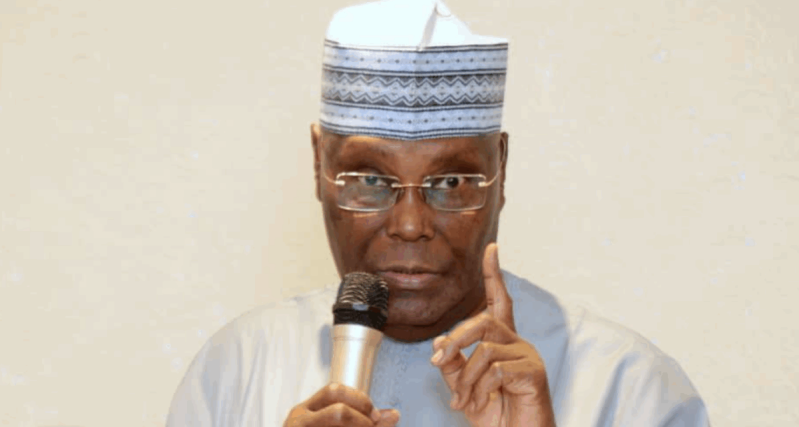
A fresh political dispute has emerged in Nigeria following accusations by former Vice-President Atiku Abubakar that President Bola Tinubu’s administration is exploiting widespread economic hardship through the distribution of food aid and financial palliatives in northern Nigeria.
The controversy follows the recent launch of a major relief initiative led by First Lady Oluremi Tinubu, who flagged off the distribution of 100 trucks of rice alongside ₦1.2 billion in financial support for vulnerable households across the 19 northern states and the Federal Capital Territory. The intervention, timed ahead of the Eid-el-Kabir celebrations, was presented by government officials as a humanitarian effort to ease mounting economic pressures.
However, Atiku, speaking through his spokesman in Abuja, sharply criticised the programme, describing it as a political strategy rather than a genuine solution to Nigeria’s deepening socio-economic crisis. He argued that the initiative reflects what he called the “normalisation of poverty” and accused the government of turning food distribution into a tool for political influence.
According to Atiku, millions of Nigerians are facing worsening hardship driven by rising inflation, declining purchasing power and persistent insecurity, particularly in the north where agricultural productivity has been significantly disrupted. He maintained that distributing food during such conditions, especially in a highly visible and ceremonial manner, risks reducing governance to what he characterised as “optics” rather than addressing structural economic problems.
He further warned that the use of palliatives in politically sensitive regions could undermine democratic principles by influencing citizens’ choices through economic dependence. In his view, sustainable governance should focus on policies that strengthen food security, stabilise the economy and improve livelihoods, rather than short-term interventions.
The federal government and its supporters have defended the programme, framing it as a necessary response to immediate economic realities. Officials point to the sharp increase in food prices and the broader cost-of-living crisis affecting households across Nigeria as justification for targeted relief measures. The First Lady, during the launch event in Kaduna, described the initiative as an act of compassion and solidarity with vulnerable communities, particularly during a major religious period marked by increased household spending.
Government representatives have also stressed that the intervention is part of a broader pattern of social support programmes. They note that similar palliative distributions were carried out for Christian communities in northern Nigeria in late 2025, suggesting that the current rollout is not exclusive or politically targeted but rather based on need and timing.
At the event, Kaduna State Governor Uba Sani praised the initiative as evidence of the administration’s commitment to citizens’ welfare, describing it as a reflection of inclusive governance and national unity. Organisers indicated that distribution would be coordinated through state-level committees to ensure that aid reaches intended beneficiaries.
Despite these assurances, the debate has intensified across political and civil society circles. Critics argue that while palliatives may provide temporary relief, they do little to address the underlying causes of poverty and food insecurity. Concerns have also been raised about transparency in distribution processes and whether such programmes could be influenced by political considerations at local levels.
The dispute highlights broader economic challenges facing Nigeria. Since the start of the Tinubu administration, a series of economic reforms, including the removal of fuel subsidies and currency adjustments, have contributed to rising inflation and increased living costs. While these measures have been defended as necessary for long-term economic stability, they have also triggered immediate hardship for many households.
Food inflation, in particular, has become a critical issue. In several parts of the country, especially in the north, insecurity has disrupted farming activities, leading to reduced food production and strained supply chains. Analysts note that these structural challenges, combined with macroeconomic pressures, have pushed more Nigerians into poverty and heightened reliance on government interventions.
Within this context, palliative programmes have become both more necessary and more controversial. Supporters argue that such interventions serve as a vital safety net during periods of economic transition, helping to cushion the most vulnerable while longer-term reforms take effect. Critics, however, caution that repeated reliance on handouts risks entrenching dependency and diverting attention from systemic solutions.
Atiku’s remarks also draw attention to a recurring theme in Nigerian politics often described as “stomach infrastructure,” where material incentives are used to gain public support. He warned that this approach could weaken democratic accountability by shifting focus away from policy performance toward immediate material benefits.
Public reactions to the latest development have been mixed. While some beneficiaries have expressed appreciation for the relief, others remain sceptical about its sustainability and impact. For many Nigerians, the distribution of rice and financial aid provides short-term assistance but does not resolve the broader challenges of unemployment, rising prices and economic uncertainty.
The timing of the intervention, just days before Eid-el-Kabir, has further amplified its significance. Religious festivals in Nigeria often carry both social and political weight, and government actions during such periods tend to attract heightened public attention.
As the debate continues, calls are growing for greater transparency, accountability and long-term planning in the design of social welfare programmes. Policy experts emphasise the need for comprehensive strategies that address agricultural productivity, security, job creation and economic diversification as more sustainable solutions to poverty.
For now, the clash between the government and opposition figures underscores the deep political divisions shaping Nigeria’s public discourse. It also reflects the complex balance between immediate humanitarian needs and the pursuit of enduring economic reforms in Africa’s most populous nation.
Whether the current palliative initiative will ease hardship or reinforce criticisms of political opportunism remains a subject of intense national conversation, with implications likely to extend beyond the immediate festive period.
📩 Stone Reporters News | 🌍 stonereportersnews.com
✉️ info@stonereportersnews.com | 📘 Facebook: Stone Reporters News | 🐦 X (Twitter): @StoneReportNew | 📸 Instagram: @stonereportersnews
Add comment
Comments