

Reported by: Ijeoma G | Edited by: Oravbiere Osayomore Promise.
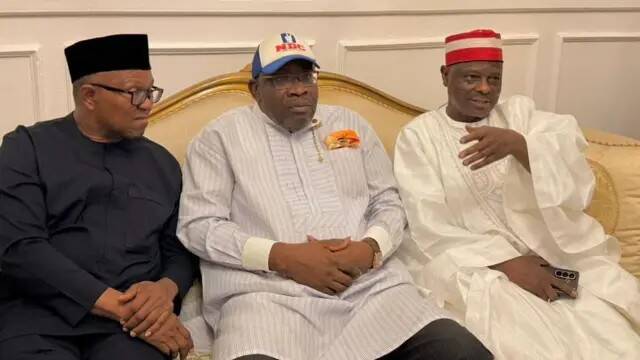
In a dramatic political realignment that reshapes Nigeria’s opposition landscape ahead of the 2027 presidential election, Peter Obi and Rabiu Kwankwaso have formally joined the Nigeria Democratic Congress. The announcement came on Monday, May 4, 2026, just a day after Obi confirmed his resignation from the African Democratic Congress and two days after Buba Galadima told a stakeholders meeting that both leaders had already signed relevant documents with the NDC. The formal defection ends weeks of speculation and makes official the much‑anticipated merger of the so‑called OK Movement, uniting the political structures of two men who collectively secured over nine million votes in the 2023 election. Obi, the former governor of Anambra State and presidential candidate of the Labour Party, and Kwankwaso, a former governor of Kano State and leader of the Kwankwasiyya movement, were received into the NDC at a brief ceremony in Abuja. Sources close to the two politicians confirmed that Senator Seriake Dickson, the former Bayelsa State governor and national leader of the NDC, personally presided over the event.
The joining of Obi and Kwankwaso to the NDC is not merely a change of party membership. It represents the culmination of months of backroom negotiations aimed at creating a single, formidable opposition coalition capable of challenging President Bola Tinubu’s re‑election bid. For Obi, this is his fourth political party in less than a decade. He previously ran for governor on the All Progressives Grand Alliance, served as vice‑presidential candidate on the Peoples Democratic Party ticket in 2019, and then led the Labour Party to a stunning third‑place finish in 2023 with over eight million votes. For Kwankwaso, who previously ran on the New Nigeria People’s Party and won over one million votes, the NDC offers a platform that he hopes will give him and his movement a stronger foothold in the South. The new alliance is expected to produce a joint presidential ticket, though which of the two will lead it remains a subject of intense internal discussion. Early indications suggest that Obi will likely be the presidential candidate, with Kwankwaso accepting the vice‑presidential slot, a concession that his supporters have described as a mature decision to rescue Nigeria.
The NDC itself is a relatively small party with limited electoral history. Founded in 2014, the party has never won a governorship or produced a national legislative majority. Its most prominent figure is Senator Seriake Dickson, who served as governor of Bayelsa State from 2012 to 2020 under the PDP banner before later aligning with the NDC. In recent months, the party has positioned itself as a “Noah’s Ark” for dissatisfied politicians from both the ruling and opposition parties. Its national leadership has been actively courting high‑profile defectors, and the addition of Obi and Kwankwaso instantly elevates the NDC to major opposition status. The party’s deputy national publicity secretary, Abdulmumin Ohiare Abdulsalam, had earlier told reporters that the defection was still “under the realm of probability rather than certainty,” but Monday’s formal announcement removed all ambiguity.
Reactions to the defection have poured in from across the political spectrum. The ruling All Progressives Congress dismissed the move as a mere permutation of losers. “These are politicians who have tried and failed. Joining a small, unknown party does not change the fact that Nigerians are benefiting from President Tinubu’s reforms,” said Felix Morka, the APC’s national publicity secretary. However, opposition figures celebrated the development as the most significant step toward a united front since the 2023 election. The NNPP, which Kwankwaso left to join the ADC and now the NDC, issued a statement expressing disappointment but wishing him well. Labour Party leaders, still grappling with Obi’s departure after the 2023 campaign, called the move predictable and accused Obi of lacking ideological consistency. “He used the Labour Party to gain prominence and then abandoned it when the structure became difficult to manage,” said a Labour Party spokesperson who asked not to be named.
Political analysts see both promise and peril in the merger. The promise lies in arithmetic. Obi’s strength in the South East and parts of the South South combined with Kwankwaso’s formidable base in the North West, particularly Kano State, could theoretically produce a coalition capable of denying the APC a first‑round victory. However, the peril is equally significant. The NDC lacks the grassroots infrastructure of the major parties, and the two leaders have a history of failed negotiations. In 2023, attempts to form a similar Obi‑Kwankwaso ticket collapsed due to disagreements over who would lead it. Many Nigerians remember that bitterness and wonder whether this new alliance will survive contact with the realities of a brutal election cycle. There is also the question of funding. Running a nationwide campaign in Nigeria is extraordinarily expensive, and neither Obi nor Kwankwaso has the deep pockets of the ruling party’s financiers.
The independent National Electoral Commission has yet to officially recognise the NDC as a platform for the merged ticket, though the party is already registered and has fielded candidates in previous elections. The more immediate challenge for Obi and Kwankwaso is to integrate their separate support bases into a cohesive movement. The OK Movement, as their alliance is informally called, has been holding town halls and strategy sessions across the country. At a meeting in Abuja on Saturday, Buba Galadima urged supporters to prepare for the trenches, warning that the establishment would deploy columnists and social media influencers to attack the new alliance. “As from Monday, when our leaders declare on which platform they will run, I want to tell you that the fight will be fierce,” Galadima had said. His words proved prophetic.
For now, the formal defection marks the beginning of a new chapter. Peter Obi, in his statement confirming the move, reiterated that he is not desperate for any particular office but desperate for a functional Nigeria. “I am desperate to see a society where a mother does not lose her child to kidnapping or hunger,” he wrote. Kwankwaso, through a spokesperson, said the alliance was about rescuing the country from “misgovernance and economic collapse.” As the sun set on Abuja on Monday, the political class scrambled to assess the implications. The 2027 election is still more than a year away, but with Obi and Kwankwaso now formally under one roof, the opposition has finally presented a clear alternative. Whether that alternative can survive the months ahead and defeat an incumbent with the full weight of federal power behind him is the defining question of Nigerian politics.
📩 Stone Reporters News | 🌍 stonereportersnews.com
✉️ info@stonereportersnews.com | 📘 Facebook: Stone Reporters News | 🐦 X (Twitter): @StoneReportNew | 📸 Instagram: @stonereportersnews
Add comment
Comments