

Reported by: Ijeoma G | Edited by: Oravbiere Osayomore Promise.
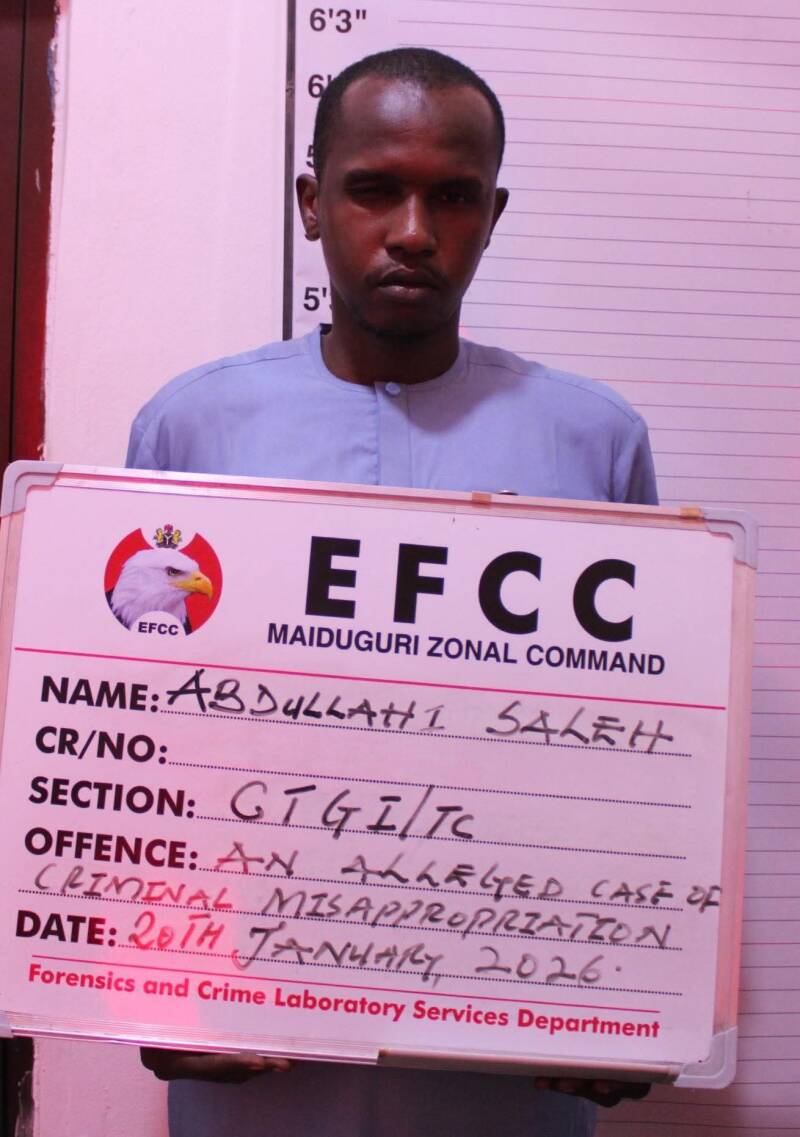
A Borno State High Court sitting in Maiduguri has convicted and sentenced a man, Saleh Isa Abdullahi, to six months imprisonment for criminal misappropriation of N1,340,000 (One Million, Three Hundred and Forty Thousand Naira) belonging to a business partner. Justice Aisha Kumaliya handed down the judgment on Monday, May 4, 2026, after the defendant pleaded guilty to a one‑count charge filed by the Maiduguri Zonal Directorate of the Economic and Financial Crimes Commission. The convict, who also goes by a National Identification Number 83649788566, was accused of dishonestly converting to his personal use funds given to him for the supply of 100 bags of cement. The offence, which occurred sometime in 2024 in Maiduguri, was contrary to Section 296 of the Penal Code Law and punishable under Section 297 of the same law.
The charge, as read in court, stated: "That you, Saleh Isa Abdullahi with National Identification Number 83649788566, sometimes in 2024 at Maiduguri, Borno State within the jurisdiction of this honourable court, dishonestly misappropriated and converted to your own use the aggregate sum of N1,340,000.00 (One Million, Three Hundred and Forty Thousand Naira) money belonging to Faruq Muhammad Ali, being amount given to you for the supply of 100 bags of cement which you converted to your personal use without his consent thereby committed an offence contrary to section 296 of the Penal Code Law and other Matters Connected therewith and punishable under Section 297 of the same law."
When the charge was read to him, Abdullahi did not contest it. He pleaded guilty in clear terms, accepting full responsibility for the diversion of funds. The prosecution counsel, Mukhtar Ali Ahmed, then prayed the court to convict him accordingly, presenting the facts of the case and the defendant's admission as sufficient proof beyond reasonable doubt. However, the defence counsel, A. B. Usman, made a passionate plea for leniency. He informed the court that the convict had already restituted the entire N1,340,000 to the complainant, Faruq Muhammad Ali, and that Abdullahi had shown genuine remorse for his actions. Usman urged the court to temper justice with mercy, noting that the defendant was a first-time offender who had learned his lesson and had taken steps to make the victim whole.
After listening to both sides, Justice Kumaliya handed down her sentence. She convicted Abdullahi as charged and sentenced him to six months imprisonment. However, she gave the convict an option of a fine, allowing him to pay N100,000 (One Hundred Thousand Naira) in lieu of serving the full jail term. The convict was given the choice to either pay the fine or proceed to serve the six months. The court did not specify which option Abdullahi chose, but the ruling ensures that the defendant faces a consequence for his dishonesty, whether through incarceration or a substantial financial penalty.
The case originated from a complaint lodged by Faruq Muhammad Ali, who had entrusted Abdullahi with N1,340,000 to purchase 100 bags of cement on his behalf. The cement was intended for a construction project, but Abdullahi allegedly pocketed the money and never delivered the goods. When the complainant demanded a refund or the cement, the convict failed to produce either, prompting the victim to report the matter to the EFCC. The anti‑graft agency's Maiduguri Zonal Directorate launched an investigation, traced the financial transactions, and established that Abdullahi had indeed diverted the funds for personal uses unrelated to the cement supply. During the investigation, Abdullahi eventually paid back the full sum, but by then, the criminal process had already begun.
The EFCC has intensified its crackdown on fraud and misappropriation in Borno State, which has faced decades of insurgency and economic disruption. The commission’s Maiduguri office has prioritised cases of financial malfeasance, particularly those involving contractual agreements and supply scams, which have become more prevalent as reconstruction efforts attract public and private funds. In a statement after the conviction, an EFCC spokesman described the judgment as a victory for ordinary citizens who fall victim to dishonest dealers. He reminded the public that restitution, while welcome, does not automatically erase criminal liability, and that pleading guilty and returning stolen funds may result in a lesser sentence but not necessarily an acquittal.
Legal observers noted that the sentence, with an option of fine, is relatively lenient and reflects the fact that the convict had repaid the victim and pleaded guilty at the earliest opportunity. Under Section 297 of the Penal Code, criminal misappropriation can attract a prison term of up to two years, or a fine, or both. The court’s discretion to impose a six‑month term with an N100,000 fine falls well within the permissible range. Some commentators, however, have argued that the fine option effectively allows wealthy offenders to buy their way out of jail, undermining deterrence. Others contend that the combination of a criminal conviction on record and the financial penalty serves as a sufficient warning.
The convict’s defence counsel, Usman, expressed gratitude to the court for its leniency, stating that his client had learned a hard lesson and would never repeat such an offence. He also thanked the EFCC for its professionalism in handling the case. Meanwhile, the complainant, Faruq Muhammad Ali, who was present in court, said he was satisfied with the outcome, as he had already recovered his money and the court had affirmed that dishonesty has consequences.
The case serves as a cautionary tale for individuals engaged in procurement and supply arrangements, particularly in informal transactions without written contracts. The EFCC has advised the public to document all agreements, demand receipts, and report any suspicious diversion of funds to the commission immediately. As reconstruction and commercial activity slowly return to Borno State after years of conflict, the anti‑graft agency has pledged to remain vigilant and prosecute all forms of economic crime, no matter the amount.
📩 Stone Reporters News | 🌍 stonereportersnews.com
✉️ info@stonereportersnews.com | 📘 Facebook: Stone Reporters News | 🐦 X (Twitter): @StoneReportNew | 📸 Instagram: @stonereportersnews
Add comment
Comments