

Reported by: Ijeoma G | Edited by: Oravbiere Osayomore Promise.
An American artificial intelligence startup has locked out more than 25,000 Nigerian users after discovering that fraudulent activity from the country had reached industrial scale, forcing the platform to pull its app from the local app store and block access to the entire region. Kled AI, a data marketplace that pays ordinary people to upload photos and videos for training AI models, announced on Monday that it had removed its app from the Nigerian iOS store and imposed a full IP ban after internal reviews showed that approximately 95 per cent of all activity originating from Nigeria was fake. The decision, made public by 22‑year‑old founder Avi Patel, has triggered a furious online backlash, even as many Nigerians acknowledge that abuse of digital earning platforms has become a systemic problem.
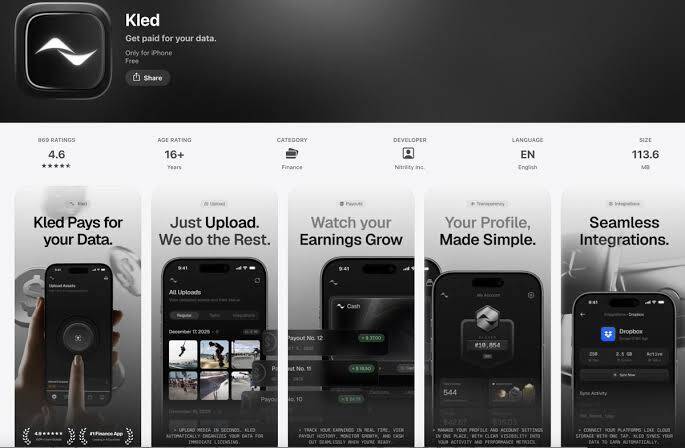
Kled AI operates a deceptively simple business model. Users download the app, submit photos, videos, or other digital content, and get paid via PayPal or cryptocurrency. The company then sells that data to AI labs and robotics firms needing real‑world, non‑public information to train increasingly sophisticated algorithms. The platform launched from beta just four months ago and quickly attracted global attention. Within that short window, Kled says users uploaded over one billion assets worldwide and the company paid out “hundreds of thousands” of contributors. Nigeria quickly emerged as a critical growth market, with more than 25,000 users and the app ranking among the top 100 locally.
But beneath the promising numbers, Patel says a different reality was taking shape. “After several months of uploads we found that Nigeria had a ≈95% fraud rate,” he wrote in a lengthy statement on X. “Instead of real, usable data, users were uploading pictures of black screens, duplicate photos, internet generated images, AI generated images, etc. at an unimaginable scale.” The submissions were not just low‑quality; they were systematically fraudulent. Investigators found users recycling the same files repeatedly, passing off web‑scraped content as original, and even generating entirely synthetic images and passing them off as real‑life data. For a platform whose entire value proposition rests on authenticity, this was existential.
By contrast, Patel noted that markets such as Malaysia, Indonesia and the Philippines recorded fraud rates below 10 per cent despite having user bases roughly ten times larger than Nigeria’s. The comparison was damning. But the tipping point, according to the company, came when the fraud moved beyond content manipulation into outright identity fraud. “This weekend we were flooded with thousands of fake Japanese passports and identity cards with Nigerians photoshopped onto them in our KYC system,” Patel said. “That was the final straw.” The falsified documents were not amateur attempts. The company said the passports were mass‑produced and designed to closely mimic legitimate Japanese identification, featuring Nigerian faces digitally inserted. The scale and sophistication strongly suggested organised abuse, not isolated misconduct.
For a seed‑stage startup operating on venture funding and tight margins, the math became impossible. “As a startup we can’t afford to eat the costs of that data overhead,” Patel explained. The company had already paid out hundreds of thousands of dollars in its first four months, but the rising cost of manually filtering fraudulent submissions, coupled with the risk of erroneous payouts, made continued operations in Nigeria financially untenable. The decision to exit, Patel insisted, was a business survival measure, not a cultural verdict. “The first thing I would like to say is I have nothing against Nigeria. We have a ton of friends from this region and these were some of our earliest app adopters. Genuinely, thank you all for the support.” He added that Kled has not banned any other country. “Kled has only been banned in Nigeria. It is available EVERYWHERE else in Africa.”
The move has sparked fierce reactions on Nigerian social media. Some users conceded that abuse of digital earning platforms is widespread, pointing to similar schemes where participants exploit loopholes for quick payouts. Others dismissed the announcement as a publicity stunt or accused Patel of generalising unfairly. One user questioned, “Nobody in Nigeria knows your app. Nice marketing scheme only a fool will fall for this.” But Patel countered those claims directly, insisting that the post was “very clearly NOT a marketing stunt. Why would we ban a region from the app store and then market to that same region?” He also warned Nigerians about a fake version of the Kled app circulating online, clarifying that the official app is “ONLY available on iOS, not on Android.”
The episode highlights a deeper structural problem that extends far beyond one startup. Nigeria has become a fertile ground for organised digital fraud. From romance scams and credit card fraud to more sophisticated schemes involving AI‑generated identity documents and mass‑produced counterfeits, the country’s reputation in global digital economies has taken repeated hits. Online earning platforms that offer relatively easy payouts often attract users focused on volume rather than quality, and a minority of bad actors can quickly overwhelm systems and drive up costs for everyone. The Kled case is not unique; similar data‑collection platforms have exited other markets for comparable reasons. But Nigeria’s 95 per cent fraud rate stands as an outlier.
Patel has left the door open for a return. “We hope to come back when the time is right,” he said, indicating that the move is temporary while the company develops more robust automated fraud detection tools capable of filtering bad actors at scale. “We love everyone who has genuinely supported Kled from Nigeria, and we hope to return.” For the legitimate Nigerian users who played by the rules, the sudden shutdown is a bitter loss of income and opportunity. For the wider digital ecosystem, the episode serves as a stark warning: trust, once broken at such scale, is not easily restored.
📩 Stone Reporters News | 🌍 stonereportersnews.com
✉️ info@stonereportersnews.com | 📘 Facebook: Stone Reporters News | 🐦 X (Twitter): @StoneReportNew | 📸 Instagram: @stonereportersnews
Add comment
Comments