

Reported by: Oahimire Omone Precious | Edited by: Oravbiere Osayomore Promise.
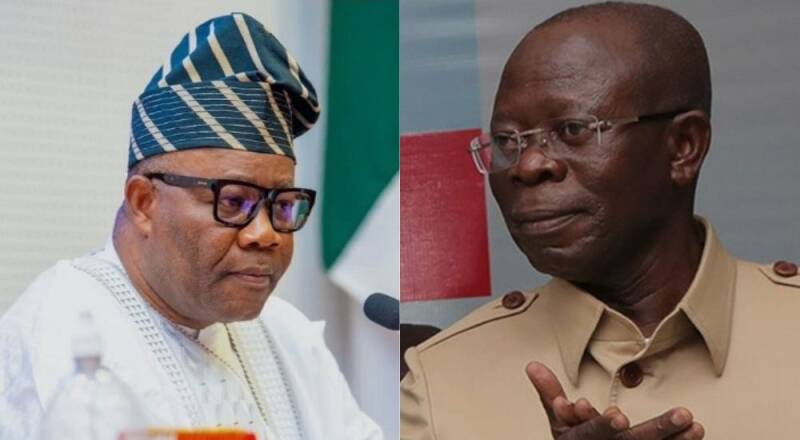
The Senate chamber descended into more than fifteen minutes of raw parliamentary warfare on Wednesday as Senate President Godswill Akpabio threatened to physically eject Senator Adams Oshiomhole from the chamber, just one day after the upper house secretly amended its standing rules in a move that effectively bars the former labour leader from ever contesting for the presidency of the Senate. The dramatic confrontation, which saw Chief Whip Mohammed Tahir Monguno called upon to warn Oshiomhole of his potential expulsion, exposed the explosive fallout from a rule change that has fundamentally reshaped the battle for the 2027 leadership, shutting out dozens of powerful politicians while consolidating Akpabio’s grip on the country’s number three position. What was meant to be a routine reading of the previous day’s minutes descended into chaos the moment Oshiomhole, whose 2027 ambitions were killed by the amendment, raised his voice from the back bench to demand a point of order.
The core of the conflict lies in the amendments to Orders 4 and 5 of the Senate Standing Rules, rushed through during a Tuesday closed-door session after nearly three hours of secret deliberations. The new provisions now require that any senator aspiring to be Senate President or Deputy Senate President must have served at least two consecutive four-year terms (eight years) immediately preceding their nomination, with the final term coming directly before the election. Principal officer posts — including the powerful positions of Senate Leader, Deputy Senate Leader, Chief Whip, and Deputy Whip — are similarly restricted to senators who have served two consecutive terms before their nomination. This technical rewriting of the rulebook deliberately excluded Oshiomhole, a first-term senator who, despite his decades of national prominence, entered the chamber for the first time in 2023 and is therefore constitutionally barred from the 2027 race. The same axe falls on Imo State Governor Hope Uzodimma, a prospective returnee whose break in service for his governorship breaks the required "consecutive" service clause.
The Wednesday meltdown was not a spontaneous outburst of emotion but a calculated political explosion from a politician who watched his future get legislated away without a single bullet being fired. According to a statement by the Senate Agenda, Akpabio had just commenced the reading of the "Votes and Proceedings" when Oshiomhole, speaking from his seat, attempted to raise a point of order. Explosions erupted when Akpabio, refusing to recognise the challenge, declared, citing Order 20, that no point of order could be entertained during the adoption of the minutes. When Oshiomhole continued to protest, the speaker did something unusual: he called on former Abia North Senator Orji Uzor Kalu to "educate" the Edo senator on the rules. Kalu, a wily political bruiser, sided with the presiding officer, telling the chamber that the Edo lawmaker was out of order. As Oshiomhole, described by observers as "seething", refused to sit, Akpabio escalated the threat to an unprecedented personal level. "Oshiomhole, if you become unruly, I will use the rules to take you out of the Senate," Akpabio warned, striking his gavel. The Chief Whip then stepped in, warning the former governor that continuing could lead to his "expulsion for the day".
The exchange was notable for the speed with which Senate leadership closed ranks against the dissenting voice. Under the new rule structure, the 2027 race is no longer a matter of popularity, influence, or political weight; it is a mathematical formula determined purely by the calendar. Senator Oshiomhole was first elected in 2023. By 2027, he will be a four-year senator, a "ranking" member under the old rules. However, the new amendment imposes an eight-year service requirement, meaning the first time he could legally run for the chamber leadership is 2031, when he will be 79 years old. In effect, the political ceiling for the man who once fought General Sani Abacha to a standstill has been welded shut by the stroke of a pen.
The rule change, initially proposed by Deputy Senate Leader Lola Ashiru, has reframed the succession plans for the 11th National Assembly. Under the old ranking system, the race for the leadership of the incoming Senate was expected to be a wide-open brawl between heavyweights like Oshiomhole, Akpabio, and a mix of returning governors making the leap to the upper chamber. But the closed-door session changed all that. Whereas the current Order 6 had previously allowed any senator who had served a single term to contest, the new structure restricts the entire leadership ladder to a small club of senators currently in the 10th Assembly who were also present in the 9th Assembly. This includes Akpabio, who served as Minority Leader in the 9th Senate and is now Senate President; Senator Opeyemi Bamidele, the current Senate Leader; Senator Ali Ndume; Senator Barau Jibrin; and Senator Mohammed Ali Ndume.
The last time the Senate, under Akpabio’s leadership, attempted a similar amendment in August 2023, it was met with a furious backlash and was abandoned. The National Assembly was then a more diverse body, still containing many heavyweights who had returned from the 9th Assembly. As the 10th Assembly heads into its twilight in preparation for the 2027 general elections and the inauguration of the 11th Assembly, Akpabio and his allies have successfully exploited the absence of those obstacles to push the amendment through using a voice vote. Critics, including civil society organisations, have described the move as an "incumbency protection racket" designed to ensure that the 10th Senate, which has enjoyed a mostly harmonious relationship with the executive, is allowed to carry over its leadership into the next electoral cycle without being threatened by the influx of new senators.
The political implication is a Senate that becomes increasingly homogenous, bureaucratic, and resistant to the disruptive political challenge that someone like Oshiomhole represents. For the Nigerian public, the issue is a parliamentary wrangle far removed from the escalating cost of living and the security crises ravaging the nation. But for the political class, the rule change is a powerful signal that the party in power intends to control the composition of the next government irrespective of who the people send to the National Assembly. Oshiomhole, a man famed for his combative labour union struggles, now sits in a chamber where the rules have been designed to contain him.
Despite the fierce altercation on Tuesday and Wednesday, the leadership of the Senate has remained defiant. Akpabio told journalists after the plenary that the rules were for the good of the institution and applied equally to everyone. Oshiomhole refused to speak to reporters as he left the chamber, his face set in a grim expression. The damage, however, appears to have been done. The 2027 Senate presidency race, once considered a wide prospect, has now become a closed contest. And for Senator Adams Oshiomhole, the fight has moved from the campaign trail to a constitutional challenge that could tie up the courts for years to come.
📩 Stone Reporters News | 🌍 stonereportersnews.com
✉️ info@stonereportersnews.com | 📘 Facebook: Stone Reporters News | 🐦 X (Twitter): @StoneReportNew | 📸 Instagram: @stonereportersnews
Add comment
Comments