

Reported by: Ijeoma G | Edited by: Oravbiere Osayomore Promise.
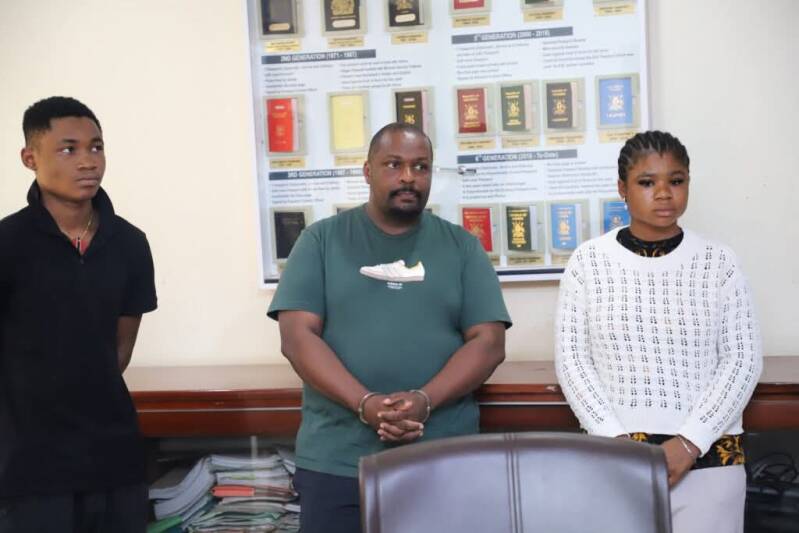
A luxury vehicle with illegal sirens, a signpost boldly declaring “Ambassador’s Residence,” military fatigues, and a wardrobe of forged passports from six countries. This was the bizarre facade behind which Ugandan authorities say a convicted international drug lord and his Nigerian associates ran a sophisticated, cross‑border criminal network specializing in narcotics trafficking and large‑scale identity fraud. The elaborate front collapsed on May 5, 2026, when the Ministry of Internal Affairs, through the National Citizenship and Immigration Control and other security agencies, led an intelligence‑driven operation in Kampala, arresting the Ugandan ringleader and two Nigerian operatives. The ministry announced the dismantling of what it called a “sophisticated drug trafficking network operating internationally based in Kampala” in a statement released on Wednesday, May 6, 2026.
At the heart of the investigation is a Ugandan businessman, Mugisha Keith King, a native of Kisoro District who resides in Kira Municipality, Wakiso District. Authorities describe King as the proprietor of the Keith King Group of Companies, a business empire they allege is a network of shell entities built specifically to facilitate illegal activities. King’s criminal record, however, extends far beyond Uganda. According to the Ministry of Internal Affairs, in 2010 he was arrested at Jomo Kenyatta International Airport (JKIA) in Nairobi with cocaine that had been shipped from Brazil. He subsequently served a full 12‑year prison sentence in Kenya for drug trafficking and remains on international wanted lists.
The operation that finally brought down the network was triggered by an Interpol alert and public information about suspicious activities in the capital, according to Ugandan security sources. The investigation revealed that King was not a solitary criminal but the mastermind of a sprawling web that coordinated with foreign operatives, particularly Nigerian nationals, to traffic hard drugs and produce fraudulent identity documents on an industrial scale. Preliminary findings suggest the group maintained direct operational links to Brazil, a major trans‑shipment point for cocaine entering the African and European markets.
Authorities said King’s operations were built on a sophisticated system of identity fraud and impersonation that extended all the way to the highest levels of government. Investigators discovered that King possesses multiple passports in addition to his Ugandan travel document, including fraudulently obtained passports from the Seychelles, the Kingdom of Eswatini, Belgium, the United Kingdom and Brazil. He was also found with counterfeit national identity cards for Kenya and Nigeria. Most alarmingly, he carried a fake work identification card that identified him as an employee of the Office of the President of Uganda. To complete his disguise, King was observed moving in luxury vehicles, including a Mercedes‑Benz and a Toyota Land Cruiser fitted with illegal sirens that allowed him to bypass routine police checks. King and his personal security guard were found wearing military‑style uniforms, and at his residence a signpost was erected that read “Ambassador’s Residence,” giving the appearance of diplomatic immunity to neighbours and visitors.
King’s Nigerian spouse, identified as Ikemefuna Winner Chekwubechukwu, was also deeply embedded in the document fraud scheme. According to ministry statements, she fraudulently acquired a Ugandan National Identification Card under the alias “Mugisha Winner Chekwubechukwu,” a feat she was able to accomplish with King’s direct assistance. As the dragnet tightened, Ms. Chekwubechukwu fled the country and is currently believed to be hiding in Brazil, where she remains the subject of an ongoing international manhunt.
Two other Nigerian nationals who played a direct role in the network’s daily operations were arrested at the scene and remain in Ugandan custody. They have been identified as Ikemefuna Testimony Udo and Ikemefuna Annointing. Their exact roles in the syndicate are still under investigation, but authorities confirmed they were “Nigerian associates linked to this racket” who worked under King’s coordination.
A search of King’s residence and business premises yielded an arsenal of incriminating material. Security agencies recovered a gun, a pistol, and live ammunition. A trove of fraudulent documents was also seized, including multiple passports, foreign national identity cards, communication gadgets, satellite phones, and military‑grade clothing, including shoes, jackets, headgear, vests, and walkie‑talkies. Perhaps most damning, investigators found forged official papers bearing the letterhead of the Office of the President of Uganda, along with similarly fraudulent documents from other companies, which authorities believe were used to facilitate cross‑border drug shipments and launder proceeds from the narcotics trade.
The Ministry of Internal Affairs stressed that Uganda maintains a zero‑tolerance policy toward drug trafficking, the misuse of military hardware, and the impersonation of government or military officials. The investigation is continuing, and authorities are working with international security partners to apprehend additional suspects, including Ms. Chekwubechukwu, who remain at large. The ministry urged members of the public to report suspicious activities and warned that the country’s borders would not be allowed to serve as a safe haven for transnational organised crime.
The case of Mugisha Keith King and his Nigerian co‑conspirators is a stark illustration of the growing convergence of drug trafficking and document fraud in the region. By using forged identity papers and adopting the outward appearance of a diplomat, King was able to move freely across international borders for years despite his prior drug conviction. His ability to acquire a genuine Ugandan national ID for his Nigerian spouse points to significant vulnerabilities in the country’s civil registration system. The ongoing investigation is likely to widen as security agencies trace the flow of cocaine and other narcotics through the network, and as prosecutors prepare a case that could send the mastermind of this “Ambassador’s Residence” back to prison for a very long time.
📩 Stone Reporters News | 🌍 stonereportersnews.com
✉️ info@stonereportersnews.com | 📘 Facebook: Stone Reporters News | 🐦 X (Twitter): @StoneReportNew | 📸 Instagram: @stonereportersnews
Add comment
Comments