

Reported by: Ijeoma G | Edited by: Oravbiere Osayomore Promise.
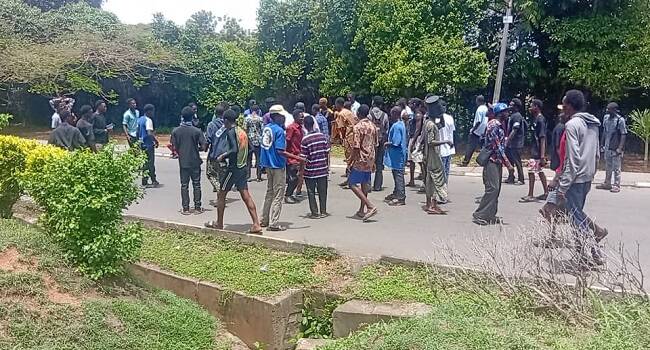
IBADAN, Nigeria – For three days, the University of Ibadan (UI), Nigeria’s premier tertiary institution, has been a dry, dark ghost of itself. The taps ran dry. The lights went out. Phones could not be charged. The University Health Service (Jaja Clinic) was locked, effectively sealing off access to emergency medical care. On Wednesday, May 6, 2026, the students decided they had had enough. In the early hours of the morning, a small group of residents from Independence Hall and Nnamdi Azikiwe Hall of Residence began to gather. By mid‑morning, what started as a pocket of frustration had turned into a full‑scale shutdown of academic activities, reminiscent of the 'No Light, No Class' protests that rattled the institution five summers ago.
The unrest was a direct consequence of the ongoing nationwide strike by the Joint Action Committee (JAC) of the Non-Academic Staff Union of Educational and Associated Institutions (NASU) and the Senior Staff Association of Nigerian Universities (SSANU), which began on May 1, 2026. The unions are demanding the full implementation of the renegotiated 2009 agreement and improved welfare packages, issues that have remained unresolved despite years of back‑and‑forth with the Federal Government. Unlike previous industrial actions where skeletal services were maintained, the unions declared a "total and comprehensive strike". Consequently, the personnel responsible for operating the university’s water treatment plant and managing the power grid simply walked away, leaving the 400‑student body to fend for itself. "We are the ones who provide water. We maintain the lecture rooms. We are the ones who ensure electricity supply," NASU UI Chairman Oluwafemi‑Michael Ogunlade had warned days earlier.
The students’ grievances were visceral. By Wednesday, the campus had been without electricity for over 48 hours. Without pumping machines, the elevated water tanks ran dry. A student who spoke with 'TheCable' on condition of anonymity described the reality of trying to study in the digital age. "We’ve not had water and light since Sunday, yet they expect us to attend tests and classes," the student said. "The dean of students said there would be electricity last night, but there was none. What we are doing now is to shut down classes and ensure tests and other academic activities do not hold".
The protest was visible, loud, and theatrical. Videos circulating online showed students marching with empty buckets and plastic kegs, chanting the slogan “No water, no class” as they barged into lecture halls in the Faculty of Science, demanding that lecturers down their markers. The disruption spread quickly to the faculties of Computing and Social Sciences, halting mid‑semester tests and lectures. The Students’ Union President, Temidayo Adeboye, addressed the crowd not with revolutionary fire but with the weary pragmatism of a man caught in the crossfire of a structural war.
“This is not a protest; it is a demonstration of our frustration,” Adeboye told the gathering. “No light, no water, and with the NASU and SSANU strike, we know they are supposed to close down the lecture halls. The end goal is that they (the management) know that we can no longer continue our academics in this environment”. The union’s position was delicate: it had already declared "firm solidarity" with the striking staff unions, buying into the principle that "an injury to one is an injury to all". But the JAC’s decision to shut down health services and utilities had turned the struggle into a hostage crisis. “The Union supports their struggle for fair treatment and institutional justice," the UISU had stated earlier, "however, students should not be made to suffer the consequences of the dispute".
While the protests raged, university administration scrambled to contain the damage. The Dean of Student Affairs reportedly held an emergency meeting with the protesters, promising to activate a generator to restore basic utilities, though the assurance did little to quell the anger. Meanwhile, the striking unions themselves recorded a significant breakthrough. After a crucial meeting with the Federal Government’s Expanded Renegotiation Committee, led by a former Head of Service Yayale Ahmed, the JAC leadership extracted a commitment that all renegotiation processes would be concluded within two weeks. According to a circular obtained by Punch Online, the unions agreed to suspend the strike based on this new commitment.
At the time of going to press, the strike was officially suspended, raising hopes that electricity, water, and hospital services would be restored immediately across the 10th Assembly campuses. However, the damage to the academic timetable and student morale is already done. The incident has served as a stark reminder that in Nigeria’s university system, the struggle for fair wages for support staff and the right to basic living conditions for students are often two sides of the same tarnished coin. The chants of 'No Light, No Class' have faded, but the underlying reality remains: at the mercy of an archaic power grid and a broken funding model, the next outage is never far away.
📩 Stone Reporters News | 🌍 stonereportersnews.com
✉️ info@stonereportersnews.com | 📘 Facebook: Stone Reporters News | 🐦 X (Twitter): @StoneReportNew | 📸 Instagram: @stonereportersnews
Add comment
Comments