

Reported by: Oahimire Omone Precious | Edited by: Oravbiere Osayomore Promise.
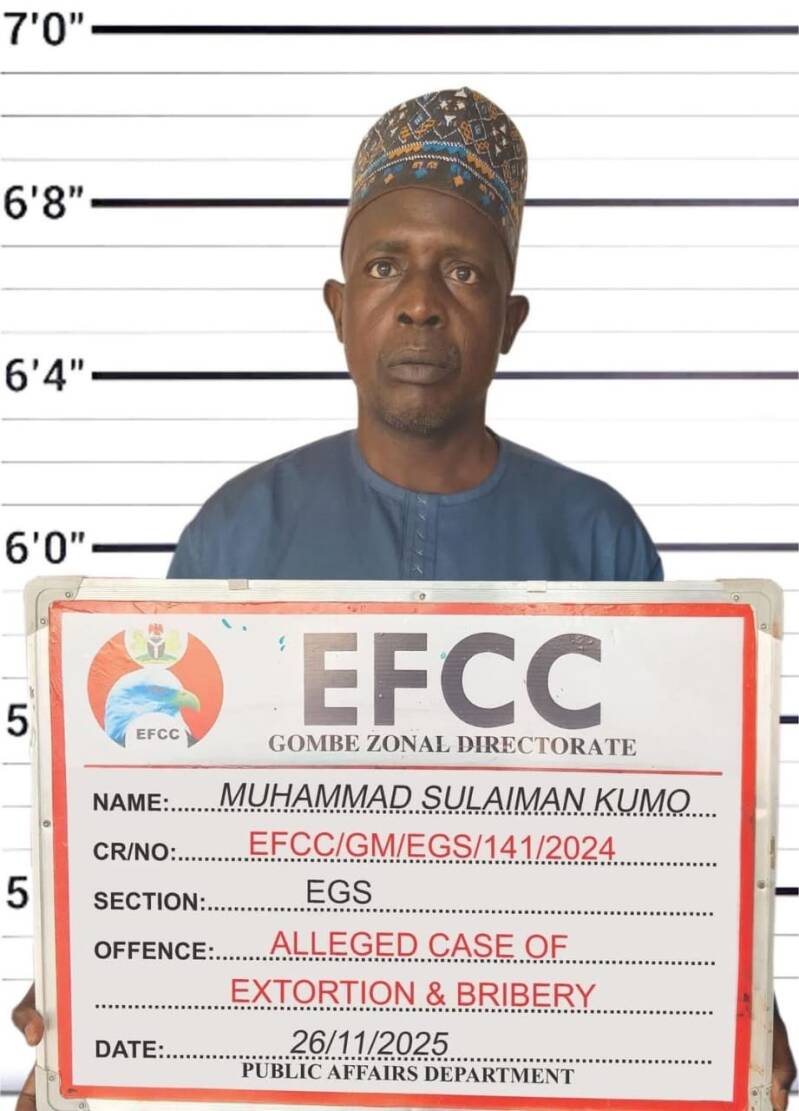
A serving magistrate in Gombe State has been convicted and sentenced to two years and six months imprisonment for demanding and receiving a one million naira bribe through his court registrar. Justice H.H. Kereng of the Gombe State High Court handed down the sentence on Tuesday, May 5, 2026, after Magistrate Mohammad Suleiman Kumo changed his plea from not guilty to guilty at a resumed sitting. Kumo was initially arraigned on December 3, 2025, by the Gombe Zonal Directorate of the Economic and Financial Crimes Commission (EFCC) on three counts of bribery. The conviction marks a rare case of a sitting judicial officer being jailed for corruption, sending a strong signal that even those entrusted with dispensing justice are not above the law.
The case began with a complaint from the Gombe State Ministry of Justice, acting on allegations from two individuals, Abubakar Isa Jauro Kuna and Suleiman Haruna. They accused Magistrate Kumo of soliciting and receiving a bribe in connection with a matter pending before his court. The EFCC investigated and subsequently charged Kumo to court. The defendant initially pleaded not guilty and raised a preliminary objection challenging the jurisdiction of the court. Through his counsel, Adamu Bawa, Kumo argued that as a judicial officer, he should be taken before the Judicial Service Commission (JSC) for any wrongdoing, rather than being tried in a criminal court. However, the EFCC counsel, A. Aliyu, countered that the defendant was a magistrate and not a judicial officer as defined under Section 318(1) of the 1999 Constitution (as amended). Justice Kereng upheld the prosecution's submission in a ruling delivered on February 17, 2026, clearing the way for the trial to proceed.
The specific charge to which Kumo eventually pleaded guilty was count one of the three counts. It read: “That you Muhammad Suleiman Kumo being a magistrate at Chief magistrate Court Pantami in such capacity on or about the 6th day of November 2024 in Gombe, Gombe State within the jurisdiction of this honourable court did receive for yourself, monetary benefit of One Million Naira (N1,000,000) through Zenith bank account number 2273938871 belonging to one Adamu Ahmed, a registrar in your court, thereby committed an offence contrary to and punishable under Section 10(a)(i)(ii) of the Corrupt practices and other Related Offences Act 2000.” By receiving the bribe through his registrar, Kumo had attempted to conceal his direct involvement, but the investigation uncovered the trail.
At the resumed sitting on May 5, 2026, defence counsel informed the court that the defendant wished to change his plea. When the charges were re‑read to him, Kumo pleaded guilty. The prosecution counsel, while not objecting to the change of plea, reminded the court that the prosecution had spent considerable time and resources in the case before the defendant’s change of heart. He urged the court to convict the defendant and also order him to pay the sum of N500,000 as compensation to the EFCC for the cost of investigation and prosecution.
Delivering judgment, Justice Kereng noted the severity of the offence, emphasising that corruption by judicial officers strikes at the very foundation of the rule of law. “I hereby convict you for the offence of corruption under Section 10(a)(i)(ii) of the Corrupt Practices and Other Related Offences Act 2000,” the judge declared. He stated that the N500,000 compensation request was not excessive given the resources expended by the commission. The judge sentenced Kumo to two years and six months imprisonment. However, he gave the convict an option of a N250,000 fine in lieu of the prison term. In addition, Kumo was ordered to pay N500,000 as compensation to the EFCC.
The conviction is significant for several reasons. First, it demonstrates that the EFCC is willing to prosecute judicial officers, a class of individuals often considered difficult to touch due to their constitutional protections. Second, the ruling on jurisdiction established that magistrates are not covered by the same immunity or special disciplinary process as higher judicial officers, and can therefore be tried directly for criminal offences. Third, the case highlights the use of intermediaries (the court registrar) to receive bribes, a common tactic that the EFCC has shown it can penetrate through financial forensics.
Kumo’s journey from the magistrate’s bench to the correctional centre began with a complaint from two concerned citizens. The EFCC traced the N1 million bribe through a Zenith bank account belonging to the registrar, Adamu Ahmed, who was also implicated but whose fate was not detailed in the court records. The conviction of a sitting magistrate is expected to send shockwaves through the judiciary in Gombe State and beyond. Many will see it as a warning that corruption within the temple of justice will no longer be tolerated.
The EFCC has welcomed the judgment. In a statement following the conviction, the commission’s spokesman said the case demonstrated the agency’s commitment to fighting corruption at all levels, regardless of the offender’s status. The commission also called on judicial officers to uphold the highest standards of integrity, warning that any attempt to pervert the course of justice would be met with the full force of the law. For Magistrate Mohammad Suleiman Kumo, the conviction has ended his judicial career. Whether he serves time in prison or pays the fine, his name will now be associated with a disgrace that will follow him for the rest of his life.
📩 Stone Reporters News | 🌍 stonereportersnews.com
✉️ info@stonereportersnews.com | 📘 Facebook: Stone Reporters News | 🐦 X (Twitter): @StoneReportNew | 📸 Instagram: @stonereportersnews
Add comment
Comments