

Reported by: Ijeoma G | Edited by: Oravbiere Osayomore Promise.
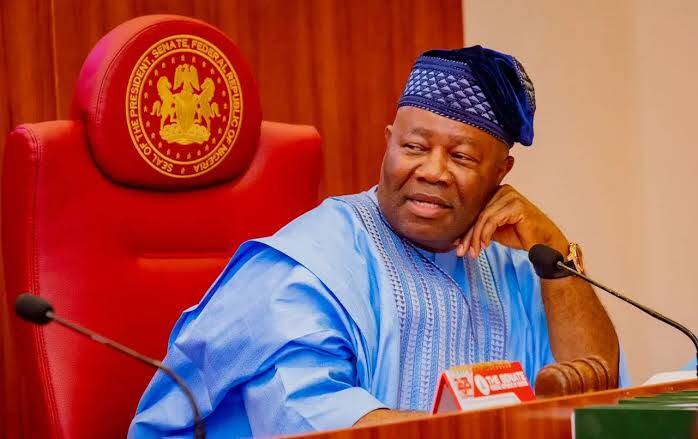
Senate President Godswill Akpabio, speaking in the course of legislative duties this week, declared that Nigerians are experiencing profound hardship across multiple fronts, pointedly directing the Minister of Foreign Affairs to step up as the nation confronts growing economic distress, diplomatic embarrassment and escalating violence against its citizens abroad. In remarks made during the screening of a foreign affairs nominee and in subsequent plenary debates, Akpabio refrained from characterising his observations as a critique of the government, but he made plain that the pain is widespread and that the federal ministry charged with representing Nigeria overseas has fallen short in protecting ordinary Nigerians, including the families of its own diplomats.
“I am not criticizing the government, but Nigerians are suffering everywhere,” Akpabio said during plenary proceedings, as captured in multiple media reports. “The Minister of Foreign Affairs has a lot of work to do. Our children are being sent out of schools, even children of diplomats.” The Senate President’s words laid bare a mounting frustration within Nigeria’s political leadership: that the country’s foreign policy apparatus, even after a recent leadership change, has yet to produce the rigorous, results‑driven protection that citizens demand.
Akpabio’s warning about diplomats’ children being forced out of school was not a hypothetical. During the screening of Ambassador Sola Enikanolaiye for the position of Minister of State for Foreign Affairs, Akpabio disclosed that children of Nigerian diplomats serving in various countries have been withdrawn from school because their parents cannot afford to pay school fees. According to a detailed report by THEWILL, Akpabio attributed the crisis directly to the non‑payment of salaries and allowances by the Federal Government. “These diplomats can’t pay their children’s school fees because their salaries and allowances are not being paid by the Nigerian government,” he added. Enikanolaiye, an experienced diplomat with over three decades in service, subsequently assured the Senate that he would prioritise the welfare of foreign service officers if confirmed. Hours later, the Senate confirmed his nomination, but the underlying problem of unpaid entitlements remained unaddressed.
The Senate President’s anger, however, was not confined to bureaucratic neglect within Nigeria’s foreign missions. It extended to the escalating violence against Nigerians in South Africa, a crisis that has claimed lives and destroyed businesses. On the floor of the Senate, Akpabio delivered a blistering indictment of the South African government’s response. “The lives of Nigerians are very, very important and crucial, and that’s why we are here; we are here to protect the lives, the welfare and the properties of Nigerians,” he said. “This is just not acceptable. This is barbaric, this is crude, this is unheard of, this is stone‑age behaviour.” The Senate president said the absence of decisive action by South African authorities is deeply concerning. “And we are not seeing action from the government of South Africa. That is the aspect that annoys me. We are not seeing action,” he declared.
The Senate responded by condemning the attacks and resolving to constitute a joint ad hoc committee with the House of Representatives to visit South Africa. Lawmakers said the delegation, to be led by Akpabio himself, will undertake a fact‑finding and diplomatic visit aimed at finding lasting solutions to the crisis. The Senate also resolved to write to the speaker of the South African parliament and invite Foreign Minister Bianca Odumegwu‑Ojukwu to brief the chamber on diplomatic efforts.
The convergence of these crises—unpaid diplomats, humiliated citizens abroad, and a foreign minister whose portfolio appears overwhelmed—presents a significant challenge for Odumegwu‑Ojukwu, who was appointed to the substantive position only in late April 2026 following a cabinet shake‑up. Her ministry has confirmed that at least 130 Nigerians have already registered for voluntary repatriation flights from South Africa, a number expected to rise as the xenophobic violence continues. But repatriation is a stopgap, not a strategy. Akpabio’s charge to the foreign ministry is broader: “Our foreign policy must impact the lives of Nigerians. It should create opportunities and also guarantee their safety wherever they are.” That is exactly what Enikanolaiye, now confirmed as minister of state, promised during his screening, vowing that Nigeria would move “beyond routine condemnations.”
Yet Akpabio’s insistence that Nigerians are “suffering everywhere” extends beyond the diplomatic corps and attacks abroad. The Senate President himself has previously raised alarms about domestic hunger. In January 2026, he warned that escalating food prices and the threat of hunger constitute a national emergency, citing a United Nations projection that up to 35 million Nigerians could face hunger that year. He described the situation as a grave challenge to national stability, calling for urgent, coordinated action. But tangible relief has been slow to materialise, and the contrast between the suffering of ordinary citizens and the visible comfort of the political class has become a recurring source of public anger.
One of the most pointed recent episodes was a controversy in March, when a video emerged showing Akpabio announcing during a legislative session that a token had been sent to senators’ bank accounts for weekend enjoyment. The remark, made at a time when inflation had eroded purchasing power to the point that many families could barely afford a meal, ignited a firestorm of criticism. Akpabio did not apologise, and the presidency remained silent. The incident remains a symbol of the disconnect between the ruling class and the citizenry.
For now, the Senate President has handed the foreign minister a heavy to‑do list, one that includes rescuing the children of diplomats, repatriating terrified citizens from xenophobic violence, and somehow convincing Nigerians at home that the government’s foreign policy serves their interests. The minister has not publicly responded to Akpabio’s direct charge, but she has been active in diplomatic talks with South African authorities. The Senate’s fact‑finding delegation is expected to depart soon. Whether it returns with more than condemnations will determine whether Akpabio’s frank warning was a turning point or just another set of words.
📩 Stone Reporters News | 🌍 stonereportersnews.com
✉️ info@stonereportersnews.com | 📘 Facebook: Stone Reporters News | 🐦 X (Twitter): @StoneReportNew | 📸 Instagram: @stonereportersnews
Add comment
Comments