

Reported by: Ijeoma G | Edited by: Oravbiere Osayomore Promise.
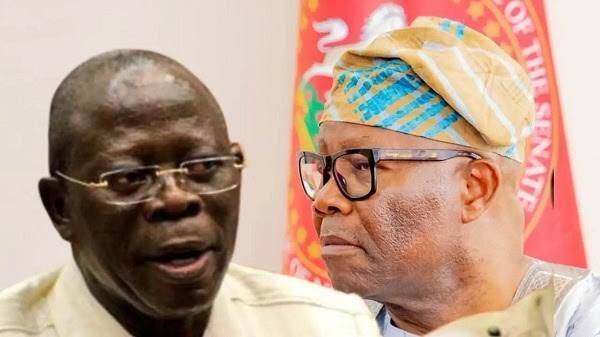
A fresh political firestorm has engulfed the Nigerian Senate as Senator Adams Oshiomhole publicly declared that under the newly amended standing rules of the upper legislative chamber, Senate President Godswill Akpabio is himself not qualified to occupy the position he currently holds. Oshiomhole, speaking at a press conference in Abuja on Thursday, May 7, 2026, demanded that Akpabio should resign immediately, arguing that the same rules the Senate leadership has imposed to restrict future leadership positions now disqualify the Senate President himself. The Edo North senator’s explosive allegation has torn the lid off a simmering power struggle that had been brewing since the Senate amended Orders 4 and 5 of its Standing Rules in a closed-door session on Tuesday, May 5.
The amendment at the centre of the storm introduces a radical change: only senators who have served at least two consecutive terms immediately preceding their nomination are eligible to contest for principal offices, including Senate President and Deputy Senate President. This effectively means that any senator who was not a member of both the 9th and the current 10th Senate is barred from the leadership race in the 11th National Assembly. The rule, which requires a minimum of eight uninterrupted years in the Senate, was widely seen as a tactical move to shut out potential heavyweights planning to enter the Senate in 2027, including the sitting Governor of Imo State, Hope Uzodimma, who is rumoured to be nursing an ambition to become Senate President.
From the moment the amendment was announced, Oshiomhole had been its most vocal opponent. On the floor of the Senate, a dramatic confrontation erupted when he attempted to raise a point of order while the Senate President was confirming the votes and proceedings of the previous day. Akpabio repeatedly ruled him out of order, citing the 2023 Standing Rules which prohibit points of order during that stage of proceedings. The confrontation grew so tense that the Chief Whip, Senator Tahir Monguno, was called upon to caution Oshiomhole, warning him that further disruption could lead to his expulsion for the day. But Oshiomhole refused to back down. In a moment of high political theatre, he challenged the basic legality of the new rules, pointing out the glaring contradiction at their core.
Outside the red chamber, Oshiomhole drove his argument home. He declared that if the new rule were applied retroactively to the current leadership, Senate President Akpabio would be the first to fail the test. Oshiomhole argued that Akpabio has not served in the Senate for eight consecutive years, and therefore does not meet the strict eligibility criteria the leadership has now imposed on everyone else. "The man who is now Senate President occupied that position as a first-term senator, became minority leader in his first term, and you are now telling other people that they cannot even contest for offices if they haven't done two terms?" Oshiomhole asked. He recalled how Akpabio, a first-time senator in 2015, was controversially elected Minority Leader of the 9th Senate despite Senate rules that reserved that position for ranking senators. At the time, his emergence was seen as a masterstroke of political engineering, but it also violated the very principle of seniority that the leadership is now brandishing as a weapon to exclude others.
With the new rules, Akpabio’s own seven-year tenure in the Senate has been thrown into sharp relief. He arrived as a first-term lawmaker in June 2015 and served as Minority Leader until June 2019, a role that technically did not require him to have served two full terms. After a brief hiatus, he returned to the Senate in 2023 and became Senate President. Under the newly adopted Order 5, a senator eyeing the presidency of the Senate would need to have served two consecutive terms immediately before nomination. Akpabio's career, spent in at least two separate batches of service with potential gaps or without a formal two-term consecutive base, suddenly appears vulnerable to the very same yardstick.
Observers have noted that the timing of the amendment suggests an elaborate internal scheming. The rule as passed is not just a seniority protocol; it is a sophisticated mechanism to eliminate challengers. It hands a massive advantage to the current leadership, which already controls the 10th Senate, by effectively denying any senator who won his or her seat for the first time in 2027 from even being nominated. It also locks out experienced hands like Governor Uzodimma who are not yet serving. However, Oshiomhole's strategy has been to turn the weapon on its wielder, forcing Akpabio to defend a rule that he, perhaps, cannot personally satisfy.
As the news spread, the Senate leadership scrambled to contain the damage. Oshiomhole's office released a series of documents to support his claim, including a timeline of Akpabio's legislative service. He also called on the Senate President to "lead by example" and step down immediately if he truly believes in the sanctity of the new rules. "If a first-term senator cannot be Deputy Senate President, how could a first-term senator become Minority Leader? And how could you now preside over us while you yourself would be a victim of your own justice?" Oshiomhole demanded.
The opposition to the rule has not been limited to Oshiomhole. A coalition of civil society groups, under the aegis of the Nigerian Alliance for Legislative Transparency (NALTF), has condemned the amendment as an "incumbent protection racket" designed to shield the current leadership from any challenge in the 11th Senate. Legal experts have also raised constitutional questions, pointing out that the Senate cannot impose eligibility criteria beyond those listed in the 1999 Constitution, which only sets out age, citizenship, education, and party membership as requirements for election as a senator.
The politics behind the rule are deeply tied to the 2027 elections. With President Bola Tinubu eligible for a second term, the ruling All Progressives Congress (APC) is already navigating a maze of succession battles. The Senate leadership wants to lock in a friendly presiding officer for the next four years, but the rule as drafted is so broad that it now threatens to expose the very contradictions in Akpabio's own political trajectory.
Amid the chaos, the Senate leadership retreated to a closed-door session to reconsider the amendment. There were reports of a possible rescission of the new rule, but by the end of the session, no official announcement was made. As the nation watches, Oshiomhole has given Akpabio an ultimatum, and the Senate President now faces the most serious leadership crisis since his assumption of office.
📩 Stone Reporters News | 🌍 stonereportersnews.com
✉️ info@stonereportersnews.com | 📘 Facebook: Stone Reporters News | 🐦 X (Twitter): @StoneReportNew | 📸 Instagram: @stonereportersnews
Add comment
Comments