

Reported by: Ijeoma G | Edited by: Oravbiere Osayomore Promise.
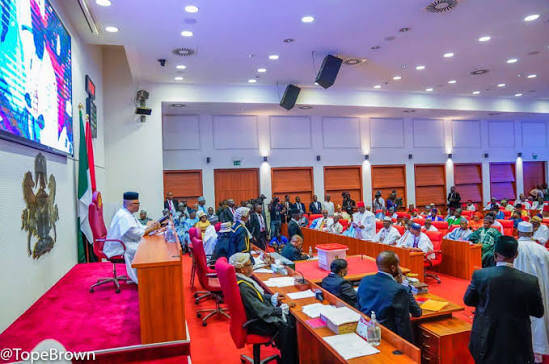
The Nigerian Senate on Thursday, May 7, 2026, passed a landmark amendment to the 2026 Electoral Act, instituting a clear judicial hierarchy for the adjudication of pre‑election disputes. The bill, which now awaits the assent of President Bola Tinubu, is designed to eliminate the persistent confusion, forum shopping and conflicting court rulings that have long plagued the country’s electoral jurisprudence.
The proposed legislation amends Section 29 of the Electoral Act and introduces a new Section 29A to delineate the courts with jurisdiction over pre‑election matters across different levels of elections. The bill was passed following the presentation of a report by the Senate Committee on the Independent National Electoral Commission (INEC), chaired by Senator Simon Lalong (APC‑Plateau).
Leading the debate, Lalong argued that the amendment would address “one of the most persistent procedural and constitutional challenges” in the nation’s electoral system. He explained that despite the provisions of Section 285(14) of the 1999 Constitution, conflicting interpretations by courts had created uncertainty, “forum shopping, contradictory judgments and unnecessary delays”. The new jurisdictional framework, he said, was rooted in constitutional logic and judicial efficiency.
The amendment establishes a structured jurisdictional hierarchy based on the office being contested. Lawmakers said this design reflects the national importance and urgency of presidential elections, while promoting specialisation in lower‑level contests.
National Assembly, Governorship, and State Houses of Assembly: Pre‑election disputes arising from these elections are to originate at the Federal High Court. Appeals from these decisions are to proceed to the Court of Appeal, which will serve as the final arbiter for such cases.
For the highest offices, the bill assigns original jurisdiction to the Court of Appeal. Appeals from the Court of Appeal’s decisions will then lie to the Supreme Court. Senator Lalong explained that the sensitivity and urgency of presidential disputes require their swift determination by a superior court of record with nationwide competence.
To reduce hardship on litigants, the amendment also revises Section 29(5) of the principal act to allow an aspirant to institute legal action either in the Federal Capital Territory (FCT) or in the jurisdiction where the cause of action arose. Lawmakers described this as “both practical and equitable”, as it aligns electoral adjudication with the territorial realities of political primaries and nomination processes.
A key aim of the amendment is to end the “dangerous practice where litigants deliberately institute multiple suits in different judicial divisions in search of favourable orders”. Lalong argued that such practices erode public confidence in the judiciary and undermine electoral stability.
The bill expressly provides that “no court shall entertain pre‑election matters except in accordance with the proposed Section 29A”, a provision that lawmakers said would introduce “certainty and procedural discipline into electoral adjudication”. Lalong added that the reform would reduce delays, enhance judicial efficiency and create a “clear judicial pathway” for the resolution of electoral disputes.
The passage of the bill was praised by senators as a timely and essential reform. Senator Mohammed Monguno seconded the motion for its passage, urging lawmakers to support a bill that would improve electoral litigation outcomes nationwide.
In his remarks after the bill was passed, Senate President Godswill Akpabio commended Lalong and the committee for their detailed work. He expressed optimism that President Tinubu would assent to the bill, stating that the reform would deepen democratic governance, strengthen electoral justice and improve confidence in Nigeria’s electoral system.
If signed into law, the amendment would be a major legislative intervention ahead of the 2027 general elections, providing a long‑awaited solution to the jurisdictional conflicts that have undermined the credibility of pre‑election litigation for years.
📩 Stone Reporters News | 🌍 stonereportersnews.com
✉️ info@stonereportersnews.com | 📘 Facebook: Stone Reporters News | 🐦 X (Twitter): @StoneReportNew | 📸 Instagram: @stonereportersnews
Add comment
Comments