

Reported by: Oahimire Omone Precious | Edited by: Oravbiere Osayomore Promise.
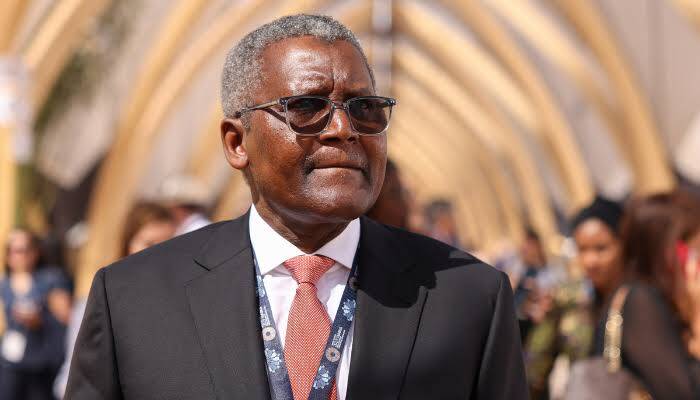
In a move that marks a dramatic shift in the relationship between Nigeria’s largest private investor and its state-owned oil company, Aliko Dangote has revealed that his conglomerate rejected a request by the Nigerian National Petroleum Company Limited (NNPC) to increase its stake in the Dangote Petroleum Refinery. The decision, announced during an interview with Nicolai Tangen, chief executive officer of the Norwegian Sovereign Wealth Fund, came as the billionaire industrialist confirmed that the $20 billion Lekki-based facility is now operating above its nameplate capacity and is being prepared for an initial public offering that could value the business at up to $50 billion.
Dangote disclosed that the national oil company, which currently holds a 7.25 percent stake in the refinery, had made attempts to acquire additional equity. “They are trying to buy more. We are the ones that said no; we want to now spread it and have everybody be part of it,” Dangote said, explaining that the rejection was driven by a deliberate strategy to broaden ownership through a future public listing rather than concentrating equity in the hands of a single investor. The industrialist’s comments signal a fundamental shift in how he intends to govern the crown jewel of his industrial empire, one that prioritises widespread Nigerian participation over deepening ties with the state.
The origins of the current shareholding structure trace back to 2021, when NNPC acquired a 7.25 percent stake in the refinery for $1 billion, with a contractual option to purchase an additional 12.75 percent by June 2024. That option was never exercised. By 2024, Dangote made public what had been a closely guarded secret: the state oil company had not paid the balance required to complete the original agreement, despite being granted an extension. “The agreement was actually 20 per cent, which we had with NNPC, and they did not pay the balance of the money up until last year; then we gave them another extension up until June, and they said that they would remain where they had already paid, which is 7.2 per cent,” Dangote had stated in 2024, surprising many Nigerians who had long assumed the state-owned firm held a 20 percent interest.
Now, with the refinery operating at 661,000 barrels per day, exceeding its 650,000 bpd nameplate capacity, and plans to double that output to 1.4 million bpd within 30 months, the facility has become a transformative asset. It currently supplies over 90 percent of Nigeria’s petrol demand, has exported refined products to Ghana, Cameroon, Togo, and Tanzania, and has generated petrochemical revenues that underpin an unprecedented dividend structure. Dangote has announced that future investors will be able to purchase shares in naira but receive returns in dollars, backed by an estimated $6.4 billion in annual petrochemical export revenues.
The decision to reject NNPC’s stake increase is intertwined with the planned IPO, which Dangote is targeting for later this year. The company could sell up to a 10 percent stake, potentially raising around $5 billion in one of Nigeria’s biggest capital market deals. A consortium of financial advisers has been appointed, with Stanbic IBTC Capital handling international book-building, Vetiva Capital Management managing retail distribution in Nigeria, and FirstCap focusing on placements with Nigerian institutional investors, particularly pension funds. The prospectus has already been submitted for regulatory review, and a subscription window is expected to open by August 2026.
When asked to identify the most serious threats to his businesses, Dangote cited two risks: civil conflict and government policy inconsistency. The latter, he suggested, is the more pressing concern. By taking the refinery public and distributing equity broadly, Dangote appears to be constructing a political and financial firewall against abrupt policy reversals that have historically plagued large infrastructure projects in the country. A dispersed shareholder base creates constituencies with a vested interest in the plant’s success, complicating any government’s ability to arbitrarily alter terms or extract concessions.
For NNPC, the episode is a costly lesson in the price of indecision. The state oil company’s failure to exercise its purchase option by the June 2024 deadline was not an oversight; it reflected a broader pattern of undercapitalisation and shifting priorities. At the time, NNPC’s former spokesman, Olufemi Soneye, defended the decision to reduce the planned stake, saying the funds would instead be directed toward investing in compressed natural gas stations. That choice has now closed a door that may never reopen.
📩 Stone Reporters News | 🌍 stonereportersnews.com
✉️ info@stonereportersnews.com | 📘 Facebook: Stone Reporters News | 🐦 X (Twitter): @StoneReportNew | 📸 Instagram: @stonereportersnews
Add comment
Comments