

Reported by: Oahimire Omone Precious | Edited by: Oravbiere Osayomore Promise.
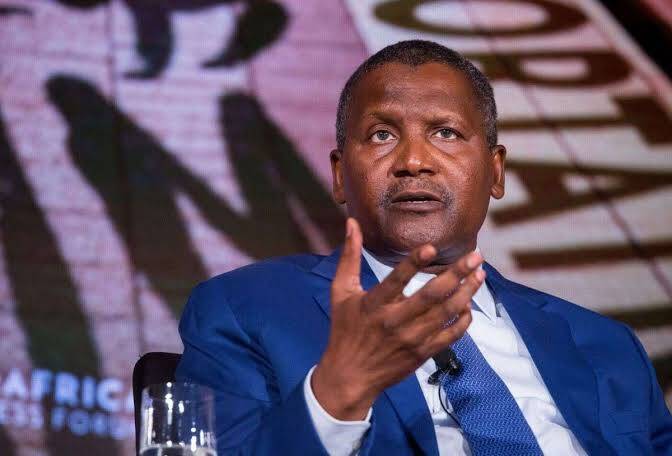
Aliko Dangote, President of the Dangote Group, has disclosed that a powerful network of local and international interests he described as an “oil mafia” fought aggressively to sabotage his $20 billion petroleum refinery project, using economic, financial and physical tactics to protect the multibillion‑dollar fuel import business. Speaking in an interview with Nicolai Tangen, Chief Executive Officer of Norway’s sovereign wealth fund, Africa’s richest man said the entrenched opposition delayed the project for years and created obstacles at every turn, from land acquisition to regulatory approvals. Dangote’s comments offer the most detailed public account yet of the forces that tried to block the 650,000‑barrel‑per‑day Lekki facility, which began production in 2024 and has since reshaped Nigeria’s downstream petroleum landscape.
“We launched the project in 2013. Land acquisition alone delayed us for five years,” Dangote said. “Some of these obstacles were created by entrenched interests in the oil business – what you might call a mafia – trying to stop us from solving these problems. But we stayed focused.” He explained that he was determined to end the prolonged fuel queues that had plagued Nigeria for more than fifty years, describing a situation in which citizens sometimes spent days waiting for petrol in a country that exports crude oil. Government refineries, he said, were not functioning properly, leaving the nation dependent on expensive imports.
According to Dangote, the “oil mafia” was not a single cartel but a coalition of beneficiaries who profited from the old system. It included international shipping companies, commodity traders, and local actors who received fuel allocations under Nigeria’s costly subsidy regime. “The people who are actually benefiting, because Nigeria was giving about $10 billion every year as a subsidy,” he said. “They are shippers who are making a lot of money, and there are traders who are making tons of money, buying the crude.” He added that a small group of local players also made billions of naira from product allocations, and that these vested interests saw the refinery as a direct threat to their business model.
The resistance took many forms. Dangote said securing land for the refinery took five years, with one proposed site delayed for three and a half years and another for one and a half years due to pushback from the same network. Beyond land, the project faced extraordinary currency volatility; the naira traded at N156 per dollar when construction began in 2013 and later depreciated to as high as N1,900, multiplying costs in local currency terms. Because no existing Nigerian port could handle equipment weighing up to 3,000 tonnes per piece, Dangote had to build his own port, along with roads, water infrastructure and a treated water plant. The refinery alone uses 440 million litres of treated water, and its water treatment section covers more than 30 hectares.
Despite the enormous difficulties, the industrialist pressed forward, driven by a vision of energy security for Nigeria and Africa. At its peak, the project employed 67,000 workers – a workforce he compared to the size of his hometown. “About 67,000 people worked on the refinery project. Honestly, we were lucky we didn’t fully understand the enormity of what we were building at the beginning. If I had seen the full scale immediately, I might have chickened out.” He likened the experience to swimming across an ocean: once in the middle, turning back is not an option. “When you get to the middle of the ocean, you realise that the tide was bad. When you go forward, it’s bad. When you go backwards, it’s bad. So you have to work forward,” he said.
The financial architecture of the project reflected its scale. Dangote acknowledged support from the African Export‑Import Bank, the African Finance Corporation, Zenith Bank, Access Bank, the United Bank for Africa, and other Nigerian lenders, as well as from Standard Bank and Standard Chartered. The same financial institutions that backed the refinery also had to weather the political risks that the import cartel exploited, he said.
Dangote made clear that the “oil mafia” was not merely a domestic concern but an international network that had grown around the old import‑export trade. “The people who were actually benefiting because Nigeria was giving almost about $10 billion every year as subsidy… there are shippers who are making tonnes of money, there are traders who are making tonnes of money,” he repeated in the interview, adding that the system enriched a small number of players at the expense of the wider economy. He had previously warned that the oil cartel posed an even greater threat than drug cartels, telling an audience in 2025 that “the oil mafia is more deadly than the one in drugs because, with the oil mafia, there are so many people that are involved.”
The refinery’s completion has fundamentally altered the market structure and reduced the influence of those who depended on imports and subsidy payments. Dangote said the facility currently sources about 56 percent of its crude from Nigeria, while also importing from Angola, Libya and the United States. It buys 21 crude cargoes monthly in Nigeria and plans to more than double its capacity to 1.4 million barrels per day within 30 months. “That’s how big we are,” he added.
Dangote’s revelations come at a moment of heightened geopolitical tension. He noted that the crisis in the Middle East has unexpectedly benefited some of the group’s businesses, particularly fertiliser, petrochemicals and aviation fuel. Urea fertiliser, which sold for about $400 per tonne before the conflict, had risen to about $850 per tonne, while demand also increased.
Looking ahead, Dangote said the refinery has already reduced the influence of import‑dependent operators and is positioning Nigeria to become a net exporter of refined petroleum products. He listed countries such as Uganda, Tanzania, Kenya and Rwanda as potential locations for future investments, adding that a refinery with a capacity of 650,000 barrels per day could serve markets as far as Ethiopia.
The full extent of the “oil mafia” network, including the identities of its key players, remains a subject of ongoing debate. Dangote did not name specific individuals or companies, but his framing of the opposition as a coordinated, multi‑national force has reopened scrutiny of the opaque fuel import and subsidy system that dominated Nigeria’s downstream sector for decades. What is not in dispute is that the $20 billion refinery, once a dream, now operates at full capacity, and the trade flows that once enriched a select few have been permanently disrupted.
📩 Stone Reporters News | 🌍 stonereportersnews.com
✉️ info@stonereportersnews.com | 📘 Facebook: Stone Reporters News | 🐦 X (Twitter): @StoneReportNew | 📸 Instagram: @stonereportersnews
Add comment
Comments