

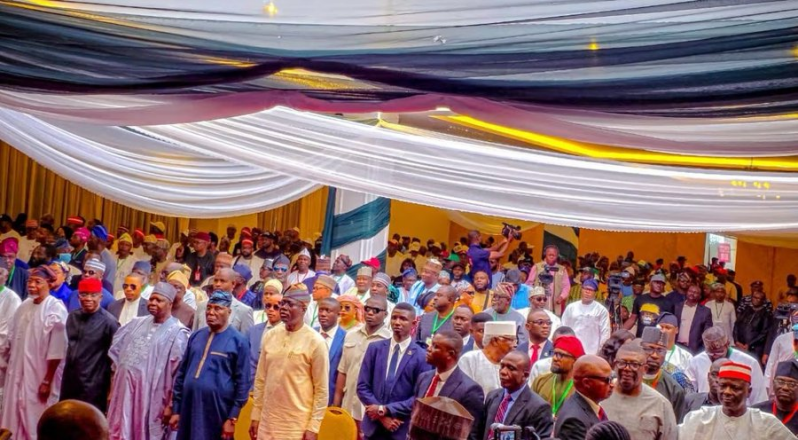
IBADAN, Oyo State — The opposition political realignment hosted in Ibadan earlier this year, intended to forge a united front ahead of the 2027 general elections, is now being widely interpreted within political circles as having triggered deeper fragmentation rather than cohesion among Nigeria’s opposition blocs.
The April 25, 2025 summit, convened by Oyo State Governor Seyi Makinde, brought together a broad coalition of opposition leaders including former Vice President Atiku Abubakar, Labour Party’s Peter Obi, New Nigeria Peoples Party leader Rabiu Kwankwaso, former governors, and senior figures from multiple political parties. The gathering was widely presented as an effort to consolidate opposition forces against the ruling All Progressives Congress (APC) ahead of the next presidential election cycle.
At the time, participants discussed the possibility of presenting a single opposition presidential candidate in 2027, a strategy designed to avoid vote splitting that has historically weakened Nigeria’s opposition parties. The summit was framed as a rare moment of elite convergence in a political environment often defined by rivalry and fragmentation.
However, subsequent developments have sharply altered that initial narrative. Instead of sustained unity, the political landscape emerging from the Ibadan engagement has been marked by shifting alliances, defections, and competing presidential ambitions among the same figures who attended the summit.
Recent political realignments indicate that Governor Makinde has now declared his own presidential ambition, aligning with a new political arrangement involving the African Peoples Movement (APM) alongside factions within the Peoples Democratic Party (PDP). His declaration follows months of speculation over his national political strategy after hosting the opposition summit.
Meanwhile, former Vice President Atiku Abubakar has maintained his long-standing pursuit of the presidency under a separate opposition structure, continuing his efforts to secure another presidential ticket after previous attempts in 2019 and 2023. His position has remained consistent despite internal disputes within emerging coalition platforms.
Peter Obi and Rabiu Kwankwaso, who were both prominently featured in the Ibadan discussions, have also shifted political alignments in ways that reflect the instability of the coalition project. Reports indicate that both politicians have gravitated toward a new opposition formation known as the Nigeria Democratic Congress (NDC), following tensions within earlier coalition arrangements linked to the African Democratic Congress (ADC)-led structure.
The fragmentation has been further complicated by internal disagreements within the ADC-led coalition itself, where disputes over structure, leadership control, and candidate selection processes have reportedly undermined efforts to maintain unity among participating blocs.
Political analysts note that the Ibadan summit, rather than consolidating opposition strength, exposed long-standing contradictions between personal ambitions and collective strategy among Nigeria’s major opposition figures. The presence of multiple presidential aspirants within the same coalition framework created immediate tension over ticket allocation, regional balancing, and leadership hierarchy.
Since the summit, commentary from within political circles has increasingly described the coalition as structurally unstable. Some analysts argue that the inability to reconcile competing ambitions among Atiku Abubakar, Peter Obi, Rabiu Kwankwaso, and emerging contenders like Seyi Makinde reflects deeper ideological and strategic fragmentation within Nigeria’s opposition politics.
A major point of contention has been the failure to establish a binding agreement on a single presidential candidate, which was initially considered the core objective of the Ibadan gathering. Instead, competing blocs have emerged, each pursuing independent political calculations ahead of 2027.
The situation has also been influenced by broader instability within party structures, particularly within the PDP and ADC, both of which have faced internal leadership disputes and legal challenges in recent months. These disputes have further weakened the institutional foundation required for sustaining a unified coalition platform.
Observers describe the current political trajectory as a reversal of the Ibadan summit’s original intent, with alliances dissolving into parallel movements rather than converging into a unified opposition front. The emergence of the NDC-aligned grouping, combined with continued fragmentation within existing parties, has reinforced perceptions that the opposition landscape is now more divided than before the summit.
Within political analysis circles, the Ibadan convention is increasingly characterized not as a coalition breakthrough but as a turning point that accelerated competitive positioning among opposition elites ahead of the 2027 elections.
As preparations for the next general election intensify, attention is now focused on whether any meaningful coalition restructuring can still occur or whether Nigeria is heading toward another multi-polar opposition contest against the ruling APC.
For now, the political outcome of the Ibadan engagement appears to be a fragmented opposition field defined by multiple presidential ambitions rather than a unified electoral strategy.
Stone Reporters News | stonereportersnews.com
info@stonereportersnews.com | Facebook: Stone Reporters News | X (Twitter): @StoneReportNew | Instagram: @stonereportersnews
Add comment
Comments