

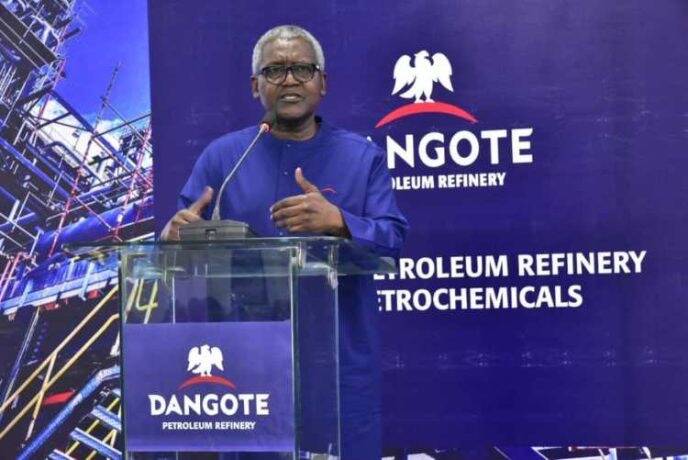
The Dangote Group has commenced preliminary processes for the construction of a proposed deep-sea port covering more than 10,000 hectares within the Olokola Free Trade Zone in Ogun State, in what analysts describe as one of Nigeria’s most ambitious privately driven maritime infrastructure projects in decades.
The project marks a major expansion of the business empire controlled by Nigerian industrialist Aliko Dangote, whose conglomerate already dominates sectors including cement, fertiliser, petrochemicals, sugar refining, and oil refining. The proposed port is expected to support export operations connected to the Dangote refinery, fertiliser plants, and other industrial facilities while also easing pressure on Nigeria’s overstretched port system.
The development has attracted strong reactions and endorsements from several high-ranking government officials and maritime stakeholders, including Ogun State Governor Dapo Abiodun, Nigerian Ports Authority Managing Director Abubakar Dantsoho, and President Bola Ahmed Tinubu.
Governor Abiodun, who has repeatedly spoken about the economic importance of the Olokola corridor, recently confirmed that the Federal Government had revived plans for the long-delayed deep-sea port project. According to the governor, President Tinubu personally approved renewed efforts toward the development of the port, describing it as critical to Nigeria’s future industrial and maritime competitiveness.
Speaking during an official engagement with senior naval officers earlier this year, Abiodun said the Olokola project had moved from years of uncertainty back into active planning discussions. He stated that several strategic meetings had already taken place concerning the seaport and disclosed that the President wanted visible progress on the project within a short timeframe.
The governor also linked the project to broader economic reforms aimed at transforming Ogun State into a major industrial and logistics hub. According to him, the proposed port would significantly reduce congestion at Lagos ports while opening new opportunities for exports, manufacturing, shipping, and job creation across southwestern Nigeria.
The Olokola Free Trade Zone, located near the Ogun-Ondo coastal axis, has long been identified as a strategic location for maritime and industrial expansion because of its Atlantic Ocean access and proximity to major industrial facilities. Dangote had initially shown interest in developing industries in the zone years ago before disagreements with previous state authorities reportedly slowed investment activities.
However, the improved relationship between the current Ogun State administration and the Dangote Group appears to have revived confidence in the project. Governor Abiodun has publicly praised Dangote’s renewed investments in Ogun State, including the expansion of cement production lines in Itori and continued industrial activities in Ibese.
Industry analysts believe the proposed deep-sea port could become an important export gateway for products from the Dangote refinery and fertiliser complex in Lekki, Lagos, which remains one of the largest industrial projects in Africa. Maritime experts say the location could also support regional shipping operations and position Nigeria more competitively within the African Continental Free Trade Area.
The Nigerian Ports Authority has equally intensified discussions around expanding modern port infrastructure across the country. NPA Managing Director Abubakar Dantsoho recently reiterated the agency’s commitment to improving port efficiency and supporting deep-sea port operations capable of handling larger cargo volumes and international transshipment activities.
Dantsoho has repeatedly argued that modern maritime infrastructure is essential for Nigeria’s non-oil export ambitions and broader economic diversification strategy. Under his leadership, the NPA has also emphasized reducing logistics bottlenecks, improving cargo movement, and increasing efficiency within Nigerian ports.
Although the NPA has not yet officially released detailed specifications regarding the Dangote-backed Olokola project, maritime observers believe cooperation between the authority, private investors, and the Federal Government will be central to its eventual implementation.
The project is also expected to complement existing deep-sea port developments, including the Lekki Deep Sea Port in Lagos. Dangote himself has previously stressed the importance of integrated infrastructure linking ports, refineries, industrial parks, and transport corridors to reduce operational costs and improve export competitiveness.
Security agencies have additionally highlighted the strategic significance of the coastal region. During a meeting with Governor Abiodun, senior Nigerian Navy officials described Ogun’s coastline as important to Nigeria’s national security and economic interests. Rear Admiral Abubakar Abdullahi Mustapha reportedly noted that expanding maritime infrastructure in the region would require stronger security coordination, especially around border and coastal operations.
Economic analysts say the scale of the proposed project could generate thousands of jobs directly and indirectly during construction and operation. Experts believe sectors likely to benefit include shipping, logistics, warehousing, manufacturing, transportation, engineering, and export services.
Despite the optimism surrounding the project, analysts also caution that successful implementation will depend on supporting infrastructure such as highways, rail systems, power supply, and environmental compliance. Nigeria’s maritime sector has historically struggled with congestion, poor evacuation systems, and infrastructure delays, challenges observers say must be addressed for the Olokola port to achieve its intended economic impact.
Environmental and community stakeholders are also expected to monitor developments closely as regulatory approvals progress. Large coastal infrastructure projects in Nigeria often attract scrutiny regarding environmental sustainability, fishing activities, and land usage concerns.
Still, supporters of the initiative argue that the project could reshape Nigeria’s maritime economy if executed successfully. Many within the business community see the proposed Dangote-backed deep-sea port as a potential turning point capable of strengthening export capacity, attracting foreign investment, and reducing the heavy dependence on Lagos ports for commercial shipping activities.
For Dangote Group, the project represents another major step in its long-term strategy of building a fully integrated industrial and logistics ecosystem. For Nigeria, it signals renewed momentum in efforts to expand industrialisation, modernise maritime infrastructure, and position the country as a leading trade and manufacturing hub in Africa.
📩 Stone Reporters News | 🌍 stonereportersnews.com
✉️ info@stonereportersnews.com | 📘 Facebook: Stone Reporters News | 🐦 X (Twitter): @StoneReportNew | 📸 Instagram: @stonereportersnews
Add comment
Comments