

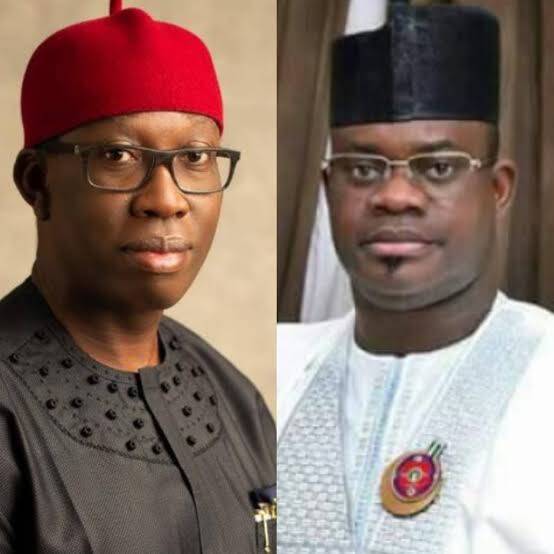
Fresh controversy has erupted across Nigeria following the emergence of former Delta State governor Ifeanyi Okowa and former Kogi State governor Yahaya Bello in major political contests under the ruling All Progressives Congress (APC), despite ongoing corruption investigations and court cases involving both politicians.
The backlash intensified after APC primary activities in Delta and Kogi states appeared to politically strengthen both former governors, prompting criticism from Nigerians, civil society voices, and political observers who questioned the party’s commitment to anti-corruption principles.
In Delta State, Ifeanyi Okowa reportedly secured the APC Delta North Senatorial ticket after defeating Senator Ned Nwoko during party primaries. His emergence triggered strong reactions online because of his ongoing case with the Economic and Financial Crimes Commission over alleged financial misconduct linked to the management of Delta State funds during his tenure as governor.
The EFCC had previously confirmed questioning Okowa over allegations involving the alleged diversion and mismanagement of public funds running into trillions of naira. Although the former governor has not been convicted by any court, critics argued that his political advancement while under investigation sends the wrong signal about accountability and governance in Nigeria.
At the same time, Yahaya Bello emerged as the APC senatorial candidate for Kogi Central despite facing ongoing corruption and money laundering trials before the Federal High Court in Abuja.
According to official results announced by returning officer Sadiq Mohammed, Bello defeated Ibrahim Yakubu Adoke and Momoh Yusuf Obaro in the APC primary election conducted across the five local government areas of Kogi Central.
The development followed days of confusion over Bello’s screening status after reports initially surfaced claiming that he had not been cleared by the APC screening committee because of questions relating to his ongoing criminal trials.
Despite the controversy, APC officials later confirmed that Bello had been cleared to participate in the primary election, ending speculation over his eligibility.
The former Kogi governor is currently facing multiple cases instituted by the EFCC. In one of the major cases before Justice Emeka Nwite of the Federal High Court in Abuja, the anti-graft agency accused him of laundering approximately ₦80.2 billion allegedly diverted from Kogi State funds during his administration.
The commission alleged that the funds were moved through several bank accounts and used to acquire luxury properties in Nigeria and Dubai. Bello has denied all allegations and pleaded not guilty before the court.
In another case, the EFCC accused Bello alongside Umar Oricha and Abdulsalami Hudu of alleged involvement in a ₦110.4 billion fraud and criminal breach of trust case.
The former governor’s legal troubles have generated national attention since 2024, including controversies surrounding attempted EFCC arrests, court proceedings, and political debates over accountability.
Following the APC developments, many Nigerians reacted online, accusing the ruling party of inconsistency in its anti-corruption posture. Critics argued that allowing politically exposed persons facing serious corruption allegations to secure party tickets undermines public trust in anti-corruption institutions and weakens confidence in governance reforms.
Several social media users and commentators described the development as evidence of selective accountability within Nigeria’s political system. Some questioned how politicians facing ongoing criminal proceedings could continue to enjoy strong political backing and influence within major parties.
Others, however, defended the APC position, arguing that under Nigerian law, suspects and defendants remain innocent until proven guilty by a competent court. Supporters of both Okowa and Bello also maintained that ongoing investigations or trials should not automatically disqualify politicians from participating in democratic processes.
Political analysts say the controversy reflects broader public frustration over Nigeria’s anti-corruption fight, particularly concerns about the relationship between political power and accountability.
Nigeria’s anti-corruption campaign has remained a major national issue for years, with successive administrations pledging reforms aimed at strengthening transparency and reducing misuse of public funds. However, critics continue to argue that political interests, legal delays, and inconsistent enforcement have weakened the effectiveness of those efforts.
The APC leadership had not issued a comprehensive official response specifically addressing the public criticism at the time of reporting, while legal proceedings involving both former governors remained ongoing in court. Meanwhile, reactions over the political futures of Ifeanyi Okowa and Yahaya Bello continue to dominate political discussions across Nigeria.
📩 Stone Reporters News | 🌍 stonereportersnews.com
✉️ info@stonereportersnews.com | 📘 Facebook: Stone Reporters News | 🐦 X (Twitter): @StoneReportNew | 📸 Instagram: @stonereportersnews
Add comment
Comments