

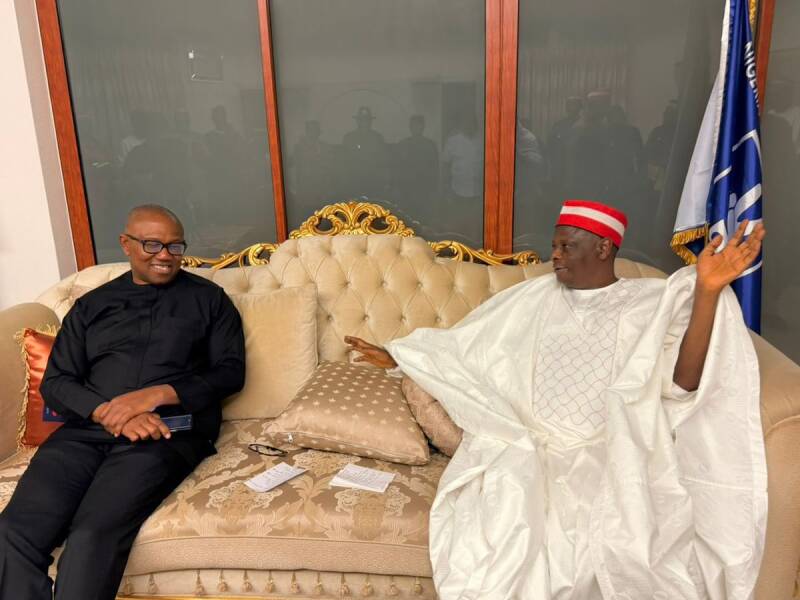
A fresh political development has emerged in Nigeria’s opposition landscape following reports that Peter Obi and Rabiu Kwankwaso held a high-level political consultation in Abuja shortly after Obi’s reported screening and clearance as a presidential aspirant under the Nigeria Democratic Congress (NDC).
The meeting, according to party-linked political sources and corroborated by multiple reports from political correspondence networks, is said to have taken place in mid-May 2026 at a private political venue in Abuja, shortly after Obi appeared before the NDC screening committee, where he was reportedly cleared to contest the party’s presidential ticket. The exact address of the meeting has not been officially disclosed, but it is widely linked to consultations involving senior figures within the emerging NDC political structure.
The NDC, which has recently become a focal point of opposition realignment ahead of the 2027 general elections, is currently hosting several high-profile politicians who previously participated in the dissolved ADC-led coalition. Reports confirm that both Obi and Kwankwaso formally exited the African Democratic Congress (ADC) coalition amid internal disputes, legal tensions, and disagreements over candidate selection processes.
Sources within the political circle say the Abuja meeting was centered on strategic alignment discussions, with emphasis on possible joint electoral arrangements, campaign structure coordination, and the future direction of the opposition platform. However, no official communique has been issued by either Obi or Kwankwaso confirming the exact content of the discussion.
Obi, who remains one of Nigeria’s most influential opposition figures following his strong 2023 presidential performance, is reported to have been screened and cleared by the NDC committee earlier in the week, according to party-linked announcements and circulating media reports. Kwankwaso, a major northern political force with strong grassroots support in Kano and parts of the northwest, is also widely expected to play a key role in the party’s internal power structure.
The reported engagement comes at a time of heightened political repositioning, as opposition blocs attempt to consolidate ahead of what is expected to be a highly competitive 2027 presidential election cycle. Recent developments show that both politicians had previously joined a broader opposition coalition under the ADC before internal disagreements led to their exit and subsequent alignment with the NDC platform.
Political analysts note that the timing of the reported meeting is significant, as it followed Obi’s screening process and coincided with intensified negotiations over leadership structure within the new party framework. While supporters of the arrangement argue that the consultation signals a potential strengthening of opposition unity, others caution that details remain fluid and unverified.
Inside political circles, the meeting is being interpreted in different ways. One view suggests it reflects ongoing efforts to build a coordinated opposition front capable of challenging the ruling party in 2027. Another interpretation is that it represents early-stage negotiations over influence, zoning considerations, and possible ticket-sharing arrangements within the new political platform.
However, no official confirmation has been issued regarding a joint ticket, and neither Obi nor Kwankwaso has publicly addressed the reported Abuja engagement. Party insiders also emphasize that discussions within the NDC remain ongoing and subject to internal screening outcomes, party constitution provisions, and delegate consultations.
The emergence of the NDC as a central opposition platform has further reshaped Nigeria’s political dynamics, especially after the collapse of earlier coalition efforts that included Atiku Abubakar, Obi, and Kwankwaso under a broader alliance structure. That coalition reportedly fractured over leadership disputes and legal disagreements, leading to a breakdown in unity efforts.
Despite these uncertainties, the reported Obi–Kwankwaso engagement has already sparked widespread political debate across Nigeria, particularly among analysts who view both figures as key vote mobilisers with distinct regional and demographic influence.
For now, the Abuja meeting remains unconfirmed at the level of official party documentation, but its timing—immediately following Obi’s reported screening clearance—has intensified speculation about evolving alliances within Nigeria’s opposition politics.
Political observers suggest the reported engagement may signal early groundwork for a structured alliance strategy within the NDC, potentially aimed at balancing southern and northern political influence ahead of the 2027 elections. Others argue it may simply reflect routine consultations among major aspirants within a newly formed party still defining its internal hierarchy.
There is also speculation that both figures are positioning themselves to negotiate stronger influence within the party’s final presidential ticket arrangement, though no formal agreement has been disclosed. Analysts caution that Nigerian pre-election politics often generate intense rumours at early stages, many of which do not materialise into formal alliances.
For now, the situation remains fluid, with confirmation expected only if either politician or the NDC leadership issues an official statement clarifying the nature of the Abuja discussions and the structure of the presidential contest going forward.
📩 Stone Reporters News | 🌍 stonereportersnews.com
✉️ info@stonereportersnews.com | 📘 Facebook: Stone Reporters News | 🐦 X (Twitter): @StoneReportNew | 📸 Instagram: @stonereportersnews
Add comment
Comments