

Reported by: Ijeoma G | Edited by: Oravbiere Osayomore Promise.
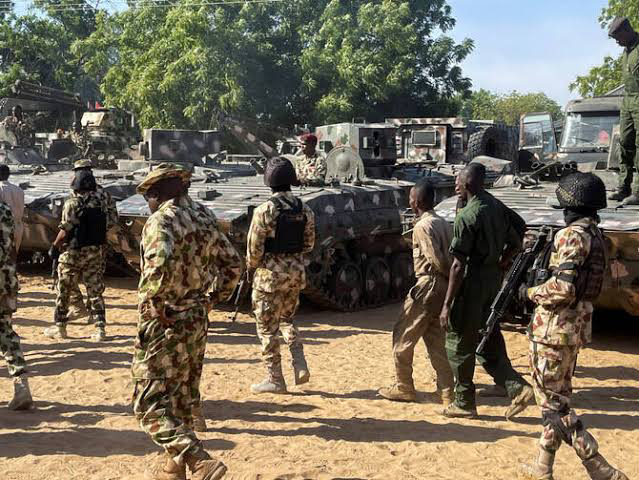
The quiet, agrarian community of Imezi-Owa in Ezeagu Local Government Area of Enugu State has been thrown into mourning and confusion, following a two-day military operation earlier this month that left at least 10 civilian homes reduced to ashes, three young men unaccounted for and a teenage girl labelled an informant after being dumped at a police station. The operation, carried out by the Nigerian Army's 82 Division, occurred on May 5 and May 6, 2026, and was ostensibly aimed at flushing out members of the proscribed Indigenous People of Biafra (IPOB) and its armed wing, the Eastern Security Network (ESN). Yet human rights groups that deployed a six-member investigation team to the area say the real target may have been something else entirely: the decades-long terror of the people of Ezeagu at the hands of jihadist Fulani herdsmen.
The chain of events that culminated in the torching of homes and the disappearance of citizens began, according to eyewitness accounts, with a summons. Personnel of the 82 Division allegedly instructed the Ezeagu Unit of the State Forest Guards to convene a meeting of local vigilantes. The unsuspecting volunteers arrived at the designated venue only to be disarmed on the spot and accused of "collaborating with ESN". Instead of being allowed to return to their families, they were forced at gunpoint to lead the troops into the thick of the Ajali River Forest Valley, more than two kilometres away from any residential dwellings, where a camp belonging to armed non-state actors was believed to be located.
A fierce exchange of fire erupted deep inside the forest. In the melee, three soldiers sustained gunshot wounds, forcing the troops to temporarily retreat to regroup. The army would later describe the confrontation as a foiled IPOB/ESN attack that left its personnel injured, with one building containing improvised explosive devices catching fire in the ensuing chaos. However, the rights groups' investigation paints a different picture of what happened after the soldiers returned to the scene around 2:30 pm.
"Instead of heading back to the scene (Ajali River Forest Valley), they invaded four residential areas of Imezi-Owa's Akwuke-Umudim, Abonuzu, Eziama and Eziowa villages and launched a war-grade attack including wantonly burning and destroying civilian houses," the joint report by the International Society for Civil Liberties and Rule of Law (Intersociety) and the Civil Liberties Organisation (CLO) South‑East alleged. The investigators documented that no fewer than 10 houses were burnt to ashes and other valuables wantonly destroyed. Six of those homes belonged to civil servants, identified as Chukwuka Uwakwe, Ifeanyi Uwakwe, Ezeaka Uwakwe, Dominic Okafor, Onyema Okafor and Okenna Okafor.
For the families of Ndubuisi Chikelu, Thank God Chikelu and Chidi Nosike, all young men in their 20s and indigenes of Akwuke-Umudim, the operation did not end with property loss. The three were taken away by soldiers during the raid, and their whereabouts have remained unknown ever since. The rights groups also documented the abduction of a teenage girl, 15‑to‑17‑year‑old Chisom Okafor, who had been looking after her elderly grandmother. According to the report, she was later dumped at a police station in Enugu and falsely labelled an "IPOB/ESN informant". The attacks, the investigators added, forced hundreds of defenceless indigenous youths in the area, in their 20s and 30s, to flee their family homes and lawful occupations to avoid being killed or abducted under the pretext that they were informants or collaborators.
The Nigerian Army, in its own account of the incident, maintained that troops of Sector 1, Operation UDO KA, were on an intelligence‑led patrol when they came under attack from a building. "While troops were advancing on foot to the community, they were attacked from a building, resulting in injuries to three personnel," the Acting Deputy Director of Army Public Relations, Lieutenant Colonel Olabisi Ayeni, said in a statement. He added that during the exchange of fire, improvised explosive devices stored by the terrorists in a building used as a hideout detonated and triggered a fire that destroyed the hideout, and that a suspected collaborator was arrested and handed over to the police. The army's version did not address the widespread destruction of residential homes or provide any details about the three missing young men.
The Ezeagu Council of Traditional Rulers, while not commenting on the specific allegations of arson and abduction, condemned the attack on military personnel and called for a thorough investigation. The council urged residents to continue supporting security agencies.
The report by the two rights groups, signed by Intersociety's Board Chair Emeka Umeagbalasi and South‑East CLO Coordinator Aloysius Attah, concluded that the army's invasion was conducted "at the instigation of the leaders of the Jihadist Fulani Herdsmen who had since 2010 become a nightmare and an existential threat to the indigenes of most of the 14 autonomous and first class villages across the Ezeagu Local Government Area". The groups have since demanded a full audit and compensation for the families whose homes were destroyed, an end to the false labelling of civilians, and the immediate release of Chisom Okafor, Ndubuisi Chikelu, Thank God Chikelu and Chidi Nosike.
As the sun sets over Imezi-Owa, the community that once thrived as a quiet agricultural settlement now sits in silence. Homes are locked, streets are empty, and families are left to wonder whether their missing sons will ever return.
📩 Stone Reporters News | 🌍 stonereportersnews.com
✉️ info@stonereportersnews.com | 📘 Facebook: Stone Reporters News | 🐦 X (Twitter): @StoneReportNew | 📸 Instagram: @stonereportersnews
Add comment
Comments