

Reported by: Ijeoma G | Edited by: Oravbiere Osayomore Promise.
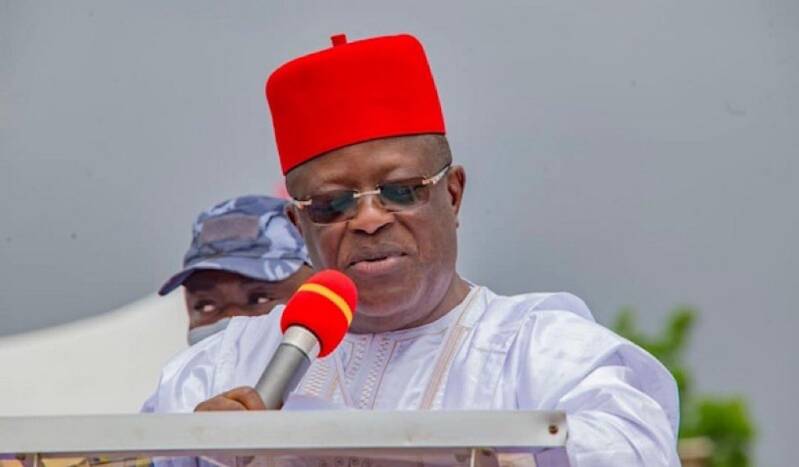
Minister of Works, Senator David Umahi, has issued a blunt warning to the South-East geopolitical zone: support President Bola Ahmed Tinubu's re-election bid in the 2027 general elections or risk losing the momentum of massive federal infrastructure projects currently transforming the region. Umahi made the controversial remarks on Wednesday, May 20, 2026, during an inspection tour of ongoing federal road and bridge projects across Ebonyi State, where he led journalists around strategic highway corridors, flyovers and bridge constructions being executed under the Tinubu administration.
The minister, who previously served as Governor of Ebonyi State, described the projects as unprecedented in the history of the South-East, insisting that no previous administration had committed such a scale of investment to the region. Among the projects he showcased was the ongoing Calabar–Ebonyi–Benue–Nasarawa–Abuja Superhighway, which he identified as the third legacy project of the Tinubu administration. According to Umahi, the section running from Ndibe Beach in Ebonyi State to the boundary between Ebonyi and Benue states spans about 123 kilometres and is being constructed with reinforced concrete pavement and solar-powered street lighting at an estimated cost of N454 billion. The minister disclosed that President Tinubu has already released 50 per cent funding for the project, while additional approvals are being processed for the dualisation of critical segments.
Umahi further explained that Section Two of the project, stretching about 178 kilometres from the Ebonyi-Benue boundary through Benue, Kogi and Nasarawa states to the Oweto Bridge axis, carries a contract value of N685 billion. The entire 465-kilometre Calabar-to-Abuja corridor, which the minister described as one of the administration's signature achievements, has a combined projected cost exceeding N1.1 trillion. He also inspected the Ndibe Beach Bridge project, which he said consists of 19 spans of about 30 metres each and would eventually connect the South-East to the Lagos-Calabar Coastal Highway, employing advanced beam-launching technology never before used in the region. At Onueke, the minister inspected an ongoing flyover project being handled by Age-Link and projected that the entire project could be ready by December.
However, Umahi's strongest comments came when he directly tied continued federal investment to electoral support for the All Progressives Congress (APC) in the South-East. "Last time, Afikpo people did not vote for APC. If they want this bridge completed, I will require 100 per cent of the votes. I am not asking for 99 per cent," he declared. According to him, no senator or individual politician possesses the financial capacity to undertake projects of such magnitude outside federal intervention. "Only President Bola Ahmed Tinubu can build these roads and bridges. Past politicians used this bridge as campaign promises, but this President came and started the work without making noise about it," he added.
The minister argued that the South-East had regained relevance in national politics under the current administration, citing his appointment as Minister of Works and the scale of projects spread across the region. "We shouted marginalisation before, but today no ministry is bigger than the Ministry of Works, and it is being headed by an Igbo man. The President has integrated the South-East into the mainstream of Nigerian politics," Umahi said. He urged political leaders in the region to publicly support the President and sensitise residents about the administration's achievements. "I challenge all leaders supporting the President to speak out openly. Our people need to hear the truth about what this administration is doing in the South-East," he stated.
Umahi also addressed the opposition, dismissing claims that the South-East is being marginalised and appealing to voters to avoid sentiment during the 2027 elections. "This election is not a lottery. Presidency is not won by sentiments but by strategic planning. We must support the President to complete these projects and secure greater opportunities for the South-East," he said. The former Ebonyi governor boasted that his home state would massively support Tinubu in the next election. "We will shock the nation in Ebonyi State because we will deliver 95 per cent of our votes to President Tinubu. The last election outcome was an accident of history, and it will not repeat itself," he declared.
Umahi's remarks come just days after the Minister of Works assured South-East residents during another tour that the Tinubu administration was committed to completing major federal road projects in the region despite funding challenges. Speaking during an inspection of the ongoing Enugu-Port Harcourt Highway, Umahi had stated that Phase 1 of the project would be completed in 2026 and that the President had assured that all contractors owed would be paid. The minister had also previously ordered the opening of a completed 15-kilometre section of the Enugu–Onitsha Expressway to ease transportation challenges in the South-East, and in April 2026 he officially opened that section to motorists. The 107-kilometre expressway, which links Enugu and Anambra states, is being reconstructed under the Federal Government's tax-credit scheme, with MTN Nigeria initially awarded the entire project at a cost of N202 billion.
The timing of Umahi's threat is significant, occurring barely a month after President Bola Tinubu made a similar declaration in Umuahia, Abia State capital, where he warned that the South-East would receive more federal projects only if the zone delivered bloc votes for him in the 2027 presidential election. A video clip captured Tinubu telling a crowd in Umuahia that his government was committed to developing the South-East but that the region needed to "reciprocate" by supporting his re-election. The parallel messaging from both the President and his Works Minister suggests a coordinated political strategy to leverage federal infrastructure spending for electoral gain in a region that has historically been a stronghold of opposition parties.
The South-East has been a political battleground in recent cycles. In the 2023 presidential election, Labour Party candidate Peter Obi, himself a native of Anambra State, won overwhelmingly across the five South-East states, handing the APC just six per cent of the region's votes. The region has also been a hotbed of separatist agitation, with the Indigenous People of Biafra (IPOB) calling for boycotts of past elections and the release of their detained leader, Nnamdi Kanu, as a precondition for participation in future polls. On January 11, 2026, South-East APC governors — Hope Uzodimma of Imo, Peter Mbah of Enugu, and Francis Nwifuru of Ebonyi — along with other stakeholders, formally endorsed President Tinubu for a second term at a stakeholders' meeting tagged "Izu Umunna" in Enugu, vowing to deliver bloc votes across the five states. The endorsement was described as a "pragmatic political realignment" that could help the region reclaim lost influence at the centre.
Meanwhile, the opposition Peoples Democratic Party (PDP), Labour Party (LP), and the African Democratic Congress (ADC) have condemned Umahi's earlier calls for the South-East to back Tinubu, insisting that the region will not be cowed into submission. The Enugu State PDP has also insisted that Governor Peter Mbah will not back Tinubu, despite Umahi's claims that all South-East governors are on board regardless of their political affiliations. The Ohanaeze Youth Council (OYC) has also rejected the reported endorsement of Tinubu by five prominent Southeast political figures, subsequently declaring them persona non grata across Igboland ahead of the 2027 general elections. A faction of Ohanaeze Ndigbo Worldwide has, however, reaffirmed unwavering support for President Tinubu's re-election, projecting that approximately 95 per cent of Igbo votes will rally behind the President.
Other groups have also voiced their opposition. An Ebonyi diaspora group dismissed Umahi's claim that he can deliver South-East votes for President Tinubu as "unfounded and ego-driven," citing abandoned infrastructure and deteriorating road conditions in the region. An Igbo women group also slammed Umahi over his assertion that President Tinubu has been "very fair" to the South-East, accusing the minister of being a sycophant. The Human Rights Writers Association of Nigeria (HURIWA) recently raised the alarm over what it described as a plot to deploy state resources and security agencies to intimidate opposition figures ahead of the 2027 elections, warning that democratic integrity was under threat.
The Umahi threat has also sparked intense debate on social media, with many Nigerians questioning the morality of tying public infrastructure to political loyalty. Critics argue that federal projects are funded by taxpayers across the nation, including the people of the South-East, and should not be contingent on electoral support. Others have pointed out that such statements risk alienating the very voters Umahi hopes to win over. The African Report recently noted that intimidation and threats of violence are growing in Nigeria as politicians gear up to launch their campaigns before the 2027 elections, with a serving minister now openly threatening to withhold public goods unless voters comply.
Umahi projected that substantial portions of the ongoing projects would be completed before the end of the year, but his appeal to South-East voters to avoid sentiment during the 2027 elections has been met with scepticism. "This election is not a lottery," he had said, but for many in the region, the lottery is precisely what democracy becomes when their votes are seen as a commodity to be purchased with their own tax-funded roads. As the 2027 election approaches, the South-East faces a stark choice: comply with the minister's demand and risk validating the transactional politics many have long condemned, or resist and risk the suspension of infrastructure development in a region that has long cried out for federal attention. The Calabar-to-Abuja superhighway and the other legacy projects now hang in the balance, transformed from symbols of national integration into bargaining chips in a high‑stakes political poker game. For the people of Afikpo and communities across the South-East, the question is no longer simply when their roads will be completed, but at what political cost.
📩 Stone Reporters News | 🌍 stonereportersnews.com
✉️ info@stonereportersnews.com | 📘 Facebook: Stone Reporters News | 🐦 X (Twitter): @StoneReportNew | 📸 Instagram: @stonereportersnews
Add comment
Comments