

Reported by: Ijeoma G | Edited by: Oravbiere Osayomore Promise.
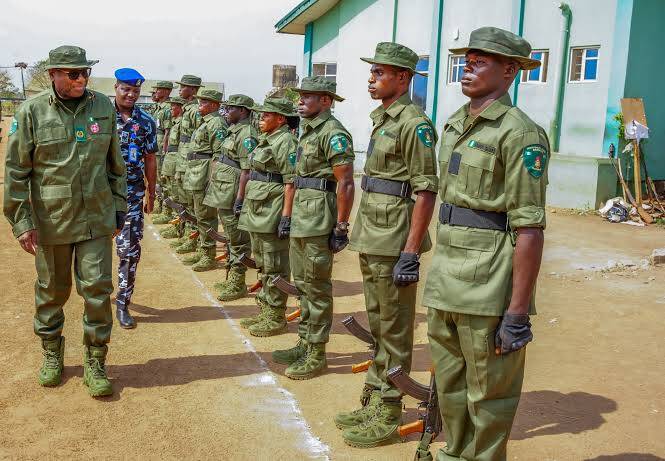
Across the breadth of Nigeria, from the rugged hills of Katsina to the dense woodlands of Oyo, a new layer of security is taking root. In a coordinated push that blends federal ambition with state-level urgency, thousands of forest guards are being recruited, trained and deployed to reclaim the vast, ungoverned forest corridors that have become sanctuaries for bandits, kidnappers and terrorist groups. The scale of the mobilisation is unprecedented: over 7,000 guards have already graduated under a federal pilot programme, while individual states have added thousands more, creating a patchwork of community‑based forces designed to do what conventional troops alone have struggled to achieve – hold ground in Nigeria’s most dangerous terrain.
The initiative traces its origins to December 2025, when the Office of the National Security Adviser graduated more than 7,000 forest guards drawn from seven frontline states: Borno, Sokoto, Yobe, Adamawa, Niger, Kwara and Kebbi. National Security Adviser Nuhu Ribadu described them as “first responders, community protectors, and a critical layer of Nigeria’s security architecture.” Each guard, recruited locally, brings intimate knowledge of the land – the hidden paths, seasonal streams and village networks that external forces often miss. Their mission is not simply to patrol but to gather intelligence, dominate forest ecosystems and support the military, police and civil defence in rooting out criminal enclaves. The federal push was soon followed by a cascade of state‑level actions, particularly after President Bola Tinubu approved the recruitment of 1,000 forest guards for Oyo State on June 1, 2026, a direct response to the mass abduction of schoolchildren and teachers in Oriire Local Government Area on May 15.
The president’s announcement, made via his X handle after a high‑level assessment of the abduction crisis, ordered the deployment of a specialised rescue team alongside the new guards. It marked a significant escalation in the federal government’s embrace of community‑based security. However, implementation has not been uniform. In Plateau State, where the federal government approved 1,000 forest guards following deadly attacks in rural communities, the initiative remains stalled months after the announcement. The Northern Christian Youth Professionals have warned that security policies must move beyond announcements to actual recruitment, training and deployment, noting that delays create opportunities for criminal elements to exploit existing gaps.
The numbers now being assembled across the country are significant. In Kebbi State, 819 newly trained forest guards have completed a nine‑week programme in Kalgo Local Government Area and are being stationed in forest reserves and vulnerable corridors. Gombe State has committed ₦337 million to train approximately 700 recruits at the Mobile Police Training School in Osun State, focusing on surveillance, intelligence gathering and forest security operations. Kwara State has recruited about 3,300 guards under the presidential initiative, with 700 initially deployed across northern and southern senatorial districts and an additional 2,600 operatives approved and trained. Katsina State, which pioneered the community watch model with its Community Watch Corps, has deployed 70 forest guards under its Ministry of Agriculture and Livestock Development. Kano State has recruited 150 guards deployed across six operational zones.
In the South‑West, the response has been shaped by the existence of the Amotekun Corps, the regional security network already operating in Oyo, Osun, Ekiti, Ondo, Ogun and Lagos states. Ekiti State has integrated forest guards into its existing security arrangements, working alongside the military, police and Amotekun to conduct bush‑combing operations and community surveillance. Ondo State, however, has declined to adopt the federal forest guard structure altogether, stating that its existing Amotekun Corps already performs similar duties and recently expanded its recruitment instead. The decision highlights a broader tension: while the federal government pushes a national forest guard framework, several states have opted to strengthen or adapt their own existing security outfits, raising questions about coordination, duplication of effort and the sharing of intelligence across different chains of command.
In the North‑Central, Niger State has pursued an approach that blends modern training with indigenous knowledge. Governor Umar Mohammed Bago has deployed forest guards who include skilled hunters and traditional combatants known as Maidawa, respected for their deep knowledge of terrain and traditional tactics. The hybrid strategy aims to counter bandits using the same rugged environment that criminals currently exploit. Kogi State has recruited nearly 3,000 vigilante members and local hunters, with the vigilante group reorganized, reenergised and now earning above the national minimum wage. The state government has also provided over 300 vehicles and hundreds of motorcycles to security agencies as logistics support.
Kaduna State has commenced training for about 1,000 forest guard recruits drawn from high‑risk communities, while Edo State has initiated preparations for training newly recruited guards following profiling and medical screening. In Imo State, over 400 forest guards and vigilante operatives have been trained and deployed to high‑risk areas, working in coordination with security agencies to dismantle criminal hideouts. Bayelsa State operates a combination of forest security personnel and community rangers focused on both security enforcement and environmental protection, though limited funding remains a challenge. Anambra State has integrated forest guards into its broader homeland security framework, with officials reporting improvements in reclaiming previously unsafe forest areas.
The reclassification of bandits and kidnappers as terrorists, announced by President Tinubu during the presentation of the 2026 Appropriation Bill, has provided the legal framework for these expanded operations. Information Minister Mohammed Idris put it bluntly: “If you terrorise our people, whether you are a group or an individual, you are a terrorist and will be classified as such.” The designation eliminates the grey areas that have long allowed criminal networks to operate with relative impunity, expanding prosecution powers and enabling more aggressive engagement by security forces.
Yet concerns about the initiative’s effectiveness persist. Security experts caution that forest guards are primarily intended for surveillance, intelligence gathering and protection of forest resources, rather than direct combat operations, which remain the responsibility of the military and police. The Nextier public policy think‑tank has warned that without reforms prioritising intelligence integration, community trust and economic stabilisation, Nigeria risks repeating cycles of overstretch and reactive security operations. The sheer numbers, while impressive, raise questions about force density: 7,000 guards spread across seven states with vast forest territories may not constitute sufficient presence to challenge entrenched criminal networks.
Meanwhile, some states including Zamfara, Rivers, Abia, Osun and Lagos are yet to fully implement the forest guard framework. In Lagos, two patrol vehicles belonging to the Nigeria Forest Security Service have been found operating under the control of persons suspected to be members of the NURTW in Mile 2, far from where they are expected to support forest protection, raising questions about asset‑use compliance. For the millions of Nigerians who live in fear of bandit raids, kidnappings and the steady erosion of rural livelihoods, these deployments offer a measure of hope. But the true test will not be measured in the number of guards trained or vehicles deployed. It will be measured in the quiet mornings when farmers return safely to their fields, when children walk to school without looking over their shoulders, and when the forests, long surrendered to the gun, finally become safe again.
📩 Stone Reporters News | 🌍 stonereportersnews.com ✉️ info@stonereportersnews.com | 📘 Facebook: Stone Reporters News | 🐦 X (Twitter): @StoneReportNew | 📸 Instagram: @stonereportersnews
Add comment
Comments