

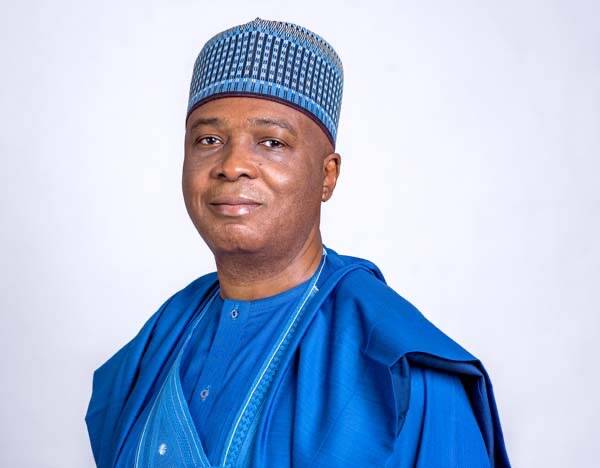
Bukola Saraki has stressed the need for a truly independent legislature in Nigeria, warning that democracy is endangered when lawmakers fail to scrutinize the executive arm of government.
Saraki made the statement on Thursday, June 12, 2026, during the June 12 Democracy Day edition of The Platform, a public lecture organized by The Covenant Nation, in Lagos, Nigeria.
Speaking at the event, the former Senate President said a legislature that merely approves executive proposals without critical examination has failed in its constitutional duty.
“So what I learned in those four years in the National Assembly is that a legislature that cannot say no is not a legislature at all,” Saraki said.
According to him, a parliament that simply receives and approves executive decisions without proper scrutiny becomes ceremonial rather than functional.
“A legislature which simply receives executive proposals, approves them without scrutiny, and goes home has not fulfilled its constitutional mandate. It has merely performed a ceremonial function. It’s an echo. A democracy made only of echoes is only one election away from becoming something else entirely,” he stated.
Saraki, who served as Senate President from 2015 to 2019, explained that the principle of checks and balances remains central to democratic governance. He said the framers of Nigeria’s Constitution intentionally divided power among the executive, legislature, and judiciary to prevent abuse of authority.
He noted that friction between the executive and legislature should not be seen as dysfunction but as a constitutional safeguard designed to protect citizens’ freedoms.
“The greatest danger to a free people is not a weak government but an unchecked government — authority that answers to no one and cannot be questioned,” he said.
Saraki further argued that the legislature serves as a protective shield for democracy by providing a lawful platform for grievances to be debated and resolved before they escalate into social unrest.
Reflecting on Nigeria’s democratic history, he referenced the June 12, 1993 presidential election, widely regarded as Nigeria’s freest election but later annulled by the military regime.
According to Saraki, the failure of institutions to defend the people’s mandate contributed significantly to the collapse of that democratic process.
“On this June 12, the lesson is plain. We did not lose democracy in 1993 because the people failed; we lost it because the institutions that should have defended the people’s verdict were too weak to do so,” he said.
He added that the solution lies not in reducing political engagement but in strengthening institutions, especially the legislature.
To illustrate the importance of legislative oversight, Saraki recounted how the National Assembly uncovered alleged irregularities in Nigeria’s fuel subsidy regime during his time in the Senate. He explained that lawmakers identified cases where payments were allegedly made for petroleum shipments that never arrived in Nigeria.
He said investigations revealed that some vessels listed in subsidy documents were not even within Nigerian waters at the time payments were processed, demonstrating how effective legislative scrutiny can expose corruption.
Saraki’s remarks come amid renewed national conversations about the independence of Nigeria’s democratic institutions, especially concerning the relationship between the executive and the legislature.
His comments have added to broader discussions on whether the National Assembly is sufficiently assertive in carrying out its constitutional oversight responsibilities.
📩 Stone Reporters News | 🌍 stonereportersnews.com ✉️ info@stonereportersnews.com | 📘 Facebook: Stone Reporters News | 🐦 X (Twitter): @StoneReportNew | 📸 Instagram: @stonereportersnews
Add comment
Comments