

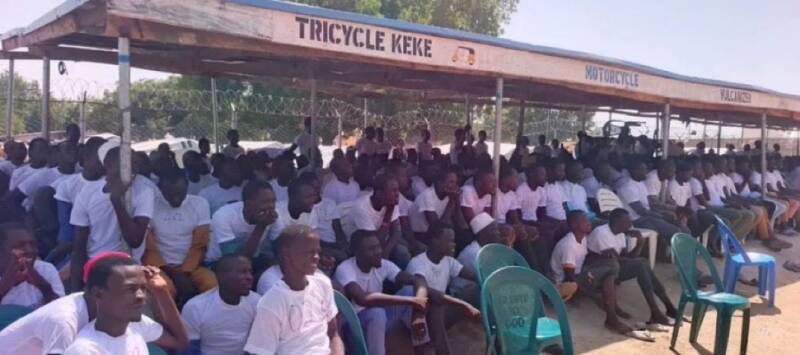
The Borno State Government has confirmed the reintegration of 8,490 repentant former Boko Haram members into society following completion of a structured rehabilitation and deradicalisation programme under the state’s “Borno Model” security initiative.
The announcement was made in Maiduguri, the Borno State capital, during an official rehabilitation and oath-taking exercise led by senior state security and rehabilitation officials, according to multiple verified Nigerian media reports.
State authorities said the exercise forms part of a long-running programme aimed at addressing insurgency through a non-kinetic approach, combining military pressure with rehabilitation, reconciliation, and community reintegration efforts.
Speaking during the event, the State Commissioner for Information and Internal Security, Prof. Usman Tar, explained that the individuals were classified as “low-risk and minors” after undergoing screening by military authorities, intelligence agencies, and traditional rulers.
He stated that the reintegration process followed strict procedures, including disarmament, demobilisation, psychological counselling, and vocational training before beneficiaries were released back into their communities.
Officials further said the programme has been implemented in phases over time, with the latest batch of 560 additional returnees graduating alongside earlier groups, bringing the total reintegrated figures to 8,490 individuals under the Borno Model framework.
The state government maintained that the initiative is designed to support long-term peacebuilding in the North-East, where Boko Haram and ISWAP insurgencies have displaced millions and caused widespread humanitarian crises over the past decade.
Authorities also noted that reintegrated individuals are monitored after release, and community structures are engaged to ensure acceptance and reduce the risk of recidivism.
However, the policy continues to generate public debate in Nigeria, with some residents and victims of insurgent attacks expressing concern over accountability and security risks, while government officials argue that rehabilitation is necessary to weaken insurgent recruitment networks and stabilize affected communities.
Security analysts say the Borno Model remains one of the most extensive state-led reintegration programmes in Africa’s counter-insurgency landscape, reflecting a shift from purely military responses to combined security and social rehabilitation strategies.
Despite ongoing efforts, Borno State remains at the centre of Nigeria’s insurgency crisis, with sporadic attacks and military operations still reported in parts of the region.
The government reaffirmed its commitment to continuing both security operations and rehabilitation programmes as part of a broader strategy to restore lasting peace in the North-East.
📩 Stone Reporters News | 🌍 stonereportersnews.com ✉️ info@stonereportersnews.com | 📘 Facebook: Stone Reporters News | 🐦 X (Twitter): @StoneReportNew | 📸 Instagram: @stonereportersnews
Add comment
Comments