

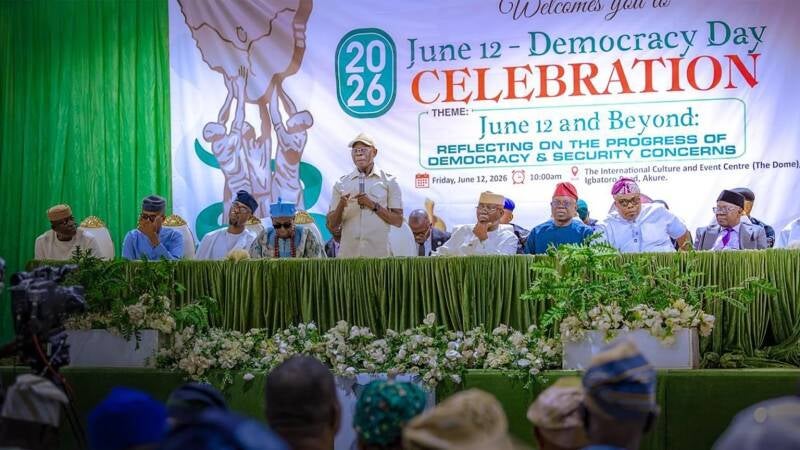
Senator Adams Oshiomhole has renewed concerns over alleged financial discrepancies within the Nigerian National Petroleum Company Limited (NNPCL), restating claims about about ₦210 trillion in unaccounted funds, in remarks made on June 12 during a public lecture in Akure, Ondo State. He said democracy without accountability risks losing public trust, and referenced Senate committee findings relating to audited financial statements covering 2017–2022.
He chairs the Senate Committee on Public Accounts and said the inquiry focused on anomalies identified in two major categories, accrued expenses and receivables, which he said amounted to about ₦103 trillion and ₦107 trillion respectively during the review of NNPCL audited accounts. He described the figures as troubling given their scale and the difficulty in obtaining clear reconciliation from available records.
He added that repeated invitations were issued to NNPCL officials by the Senate committee but that appearances had been limited or insufficient according to legislative records under review. He stressed that parliamentary oversight remains central to democratic governance, particularly in the management of public resources.
The controversy over the alleged discrepancies first gained prominence during Senate hearings on NNPCL financial statements in 2025 when lawmakers examined audited reports and requested detailed reconciliations from the company. At the time the chief financial officer Adedapo Segun told lawmakers that the figures reflected accounting classifications linked to joint venture arrangements and cash call obligations with upstream partners.
He noted that lawmakers have continued to press for full documentation arguing that the scale of the figures requires comprehensive reconciliation and independent verification. The Senate Committee on Public Accounts led by Aliyu Wadada has maintained that further scrutiny is necessary to ensure transparency and accountability in the oil sector.
Civil society organizations including the Socio Economic Rights and Accountability Project have also called for greater openness in the ongoing inquiry urging authorities to publish detailed breakdowns of the disputed figures and ensure public access to information regarding the audit process.
Government officials have responded cautiously to the allegations emphasizing that large financial entries in audited statements may reflect complex accounting practices rather than missing funds and that reconciliation processes are ongoing within the national oil company.
The June 12 lecture in Akure also featured remarks from Ondo State Governor Lucky Aiyedatiwa who emphasized the importance of institutional trust and stability in strengthening Nigeria democracy and called for improved security coordination across levels of government.
Analysts say the ongoing debate reflects broader concerns about fiscal transparency in Nigeria oil sector governance noting that effective oversight remains critical for public confidence and economic stability.
The Nigerian National Petroleum Company Limited underwent structural reforms following the Petroleum Industry Act which transformed its operational framework into a commercially oriented entity tasked with managing national oil assets while maintaining accountability to the federal government and citizens.
Public discourse around the alleged financial discrepancies has intensified amid broader concerns about transparency in the management of Nigeria petroleum revenues which constitute a significant portion of national income and foreign exchange earnings.
The Senate Public Accounts Committee operates as part of the legislature oversight framework responsible for examining government financial records and ensuring compliance with approved budgetary allocations and audit requirements.
Oshiomhole emphasis on accountability reflects ongoing political debate in Nigeria regarding the effectiveness of oversight institutions especially in sectors with high revenue generation potential and complex financial structures.
The development continues to attract attention from stakeholders in governance civil society and the energy sector as discussions over fiscal transparency and institutional accountability remain central to public policy debates in Nigeria.
In recent years Nigeria has continued to rely heavily on crude oil revenue as a key driver of public spending infrastructure development and foreign exchange inflows This dependence has placed increased emphasis on the need for transparent accounting systems and robust institutional oversight mechanisms to ensure that public resources are effectively managed and properly reported in national financial statements.
Legislative scrutiny of state owned enterprises such as NNPCL has increasingly become a focal point in Nigeria democratic process particularly as lawmakers seek to reconcile complex financial reports with public expectations for accountability transparency and efficient resource management.
The ongoing discussions surrounding the NNPCL financial records reflect a wider national conversation about governance reform public accountability and the strengthening of institutional checks and balances within Nigeria economic management framework As debates continue across political and civil society spaces stakeholders have emphasized the importance of ensuring that financial disclosures from major state owned enterprises are accurate timely and independently verifiable in line with global standards of public sector reporting The situation has also highlighted the challenges faced by oversight bodies in interpreting large scale financial data especially when dealing with multi year accounting frameworks that involve multiple subsidiaries joint ventures and complex revenue sharing arrangements across the oil and gas sector In this context lawmakers continue to call for enhanced cooperation between government agencies improved audit transparency and more accessible reporting systems that can help bridge the gap between technical accounting interpretations and public understanding of financial statements
The continued examination of NNPCL accounts is expected to remain a significant focus of legislative activity as lawmakers seek to conclude ongoing reconciliation processes and address outstanding queries raised during previous hearings Officials from the national oil company are anticipated to provide further clarifications in upcoming sessions which may contribute to improved understanding of the financial statements under review The outcome of these proceedings will likely influence public discourse on transparency in the extractive sector and shape future approaches to oversight and reporting practices within government owned enterprises in Nigeria
Overall the debate underscores ongoing tensions between fiscal oversight institutions and public expectations for transparency in Nigeria oil dependent economy highlighting the continued relevance of legislative scrutiny in strengthening governance frameworks and accountability systems Additional hearings are expected in the coming weeks
📩 Stone Reporters News | 🌍 stonereportersnews.com
✉️ info@stonereportersnews.com | 📘 Facebook: Stone Reporters News | 🐦 X (Twitter): @StoneReportNew | 📸 Instagram: @stonereportersnews
Add comment
Comments