

ABUJA, Nigeria — A long-running political and ethnic dispute over representation in the proposed Warri Federal Constituency II has been resolved following federal government mediation led under the administration of President Bola Ahmed Tinubu, with the Ijaw and Itsekiri ethnic nationalities agreeing to a rotational arrangement for the House of Representatives seat.
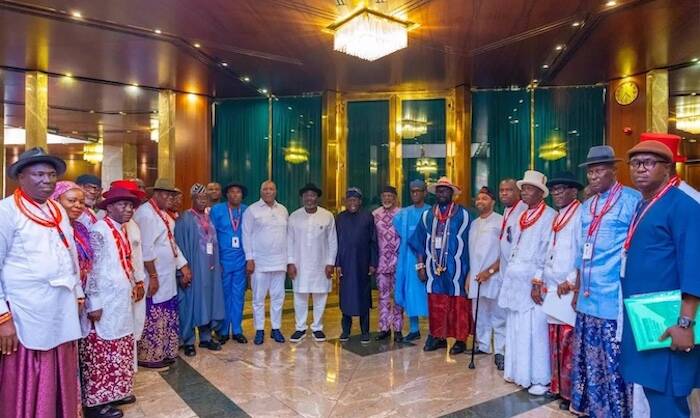
The agreement was reached after a series of high-level meetings involving representatives of the Ijaw, Itsekiri, and Urhobo ethnic groups, with the decisive round of talks held at the Office of the National Security Adviser in Abuja and chaired by NSA Mallam Nuhu Ribadu. The meeting followed earlier consultations at the Presidential Villa on June 11, 2026, where President Tinubu met stakeholders from the affected Warri constituencies in Delta State.
According to the resolution document signed by representatives of both ethnic nationalities, the parties agreed that the proposed Warri Federal Constituency II seat in the House of Representatives will rotate between the Ijaw and Itsekiri groups. Under the arrangement, the Ijaw nation will occupy the seat for two consecutive terms before it shifts to the Itsekiri for a similar tenure.
The agreement was signed after a closed-door session that lasted approximately two hours at the NSA office, with participation from top security officials, including the Director-General of the Department of State Services, Oluwatosin Adeola Ajayi. Federal officials described the process as part of efforts to reduce political tension linked to the Independent National Electoral Commission’s ward delineation exercise in the Warri area, which had previously triggered disputes among local communities.
President Tinubu was reported to have directed that representatives of the three ethnic nationalities engage under federal supervision to establish a mutually acceptable framework for political representation. The directive followed rising tensions linked to the proposed constituency restructuring, which had sparked protests, counter-claims, and disagreements over territorial and electoral boundaries in Delta State.
The agreement was formally signed on behalf of the Ijaw nationality by former Delta State Deputy Governor Kingsley Otuaro and Dr. Eric Omare. For the Itsekiri nationality, Sir A.S. Mene and Chief Robinson Ariyo signed the document. The federal government was represented in the signing process by NSA Mallam Nuhu Ribadu, while Olorogun Victor Okumagba and Chief Westham Adehor served as witnesses.
Stakeholders present at the Abuja meeting described the development as a significant step toward easing ethnic tensions in the Warri region, where disputes over political representation and electoral boundaries have persisted for years. The agreement is expected to guide future electoral arrangements in the proposed constituency and reduce friction ahead of subsequent general elections.
Delta State Governor Sheriff Oborevwori was among officials who attended earlier consultations at the Presidential Villa on June 11, 2026, which set the foundation for the Abuja mediation process. The discussions were part of broader federal efforts to stabilize politically sensitive areas through dialogue involving traditional leaders, political representatives, and security agencies.
The Independent National Electoral Commission (INEC), whose ward delineation exercise initially triggered disagreements, has not issued a separate statement on the final agreement. However, the federal government has consistently maintained that consultations with stakeholders were necessary to ensure fairness and prevent escalation of local disputes into wider unrest.
The resolution has been widely described within government circles as a breakthrough in conflict mediation, particularly in a region where ethnic representation has historically been a source of tension. Officials involved in the process said the arrangement reflects a negotiated balance aimed at ensuring political inclusion while maintaining peace among the communities involved.
As implementation details are expected to be handled in subsequent electoral planning stages, attention now shifts to how the agreement will be integrated into official constituency arrangements by relevant electoral authorities.
The development adds to a series of federal interventions under President Tinubu’s administration aimed at addressing localized conflicts through dialogue and negotiated political settlements involving affected stakeholders and security institutions.
📩 Stone Reporters News | 🌍 stonereportersnews.com
✉️ info@stonereportersnews.com | 📘 Facebook: Stone Reporters News | 🐦 X (Twitter): @StoneReportNew | 📸 Instagram: @stonereportersnews
Add comment
Comments