

Reported by: Oahimire Omone Precious | Edited by: Oravbiere Osayomore Promise.
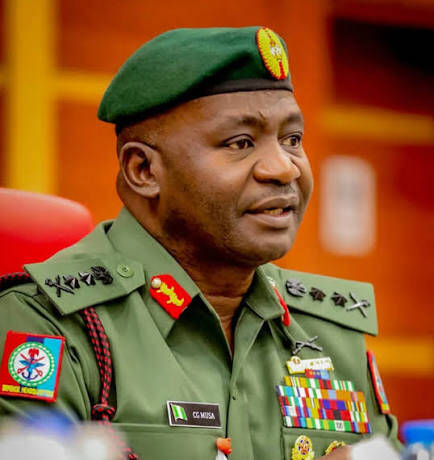
The Minister of Defence, retired General Christopher Gwabin Musa, has issued a stern warning to what he called “social media giants” who are mobilising Nigerians to protest, cautioning that such demonstrations could be hijacked by criminal elements, leading to unintended deaths and injuries. In a video that circulated widely over the weekend, the defence chief also expressed deep dismay over what he described as the growing tendency among citizens to insult soldiers and other security personnel, despite the immense sacrifices they make to protect the nation.
The minister’s remarks come against the backdrop of a week of sustained protests across the country, particularly in the Federal Capital Territory, where demonstrators have taken to the streets for four consecutive days to demand urgent government action against mass abductions, banditry and economic hardship. The protests began on June 12, Democracy Day, when human rights activist and African Action Congress (AAC) 2027 presidential candidate, Omoyele Sowore, collapsed after police fired tear gas canisters to disperse a peaceful march near the Federal Secretariat. By Saturday, June 13, demonstrators had blocked major roads, including the Karu Bridge along the Karu-Nyanya expressway, chanting “APC must go” and “bring back our children”.
In a video statement monitored by POLITICS NIGERIA, General Musa addressed the social media influencers he said were behind the mobilisation. “I’ve seen a lot of social media influencers recently going around trying to mobilise protests. Nobody is stopping anyone from protesting, but we should always remember the unintended consequences. Because if you do that, these things might be hijacked,” the minister said. He warned that in the chaos of a large public demonstration, innocent people could be killed or injured if the event was infiltrated by armed criminals or opportunistic thugs. “Many soldiers continue to bear the consequences of their service to our nation through their sacrifices after they are being insulted by the same people they are protecting,” he added.
The Defence Minister’s caution against protests being hijacked is not a hypothetical one. In 2020, the nationwide #EndSARS demonstrations, which began as a peaceful protest against police brutality, were marred by violence, looting and arson after being infiltrated by criminal elements. The protests also led to a severe breakdown in public trust between civilians and security forces, a fissure that the current administration has struggled to repair. General Musa’s reference to “unintended consequences” is clearly rooted in those painful memories.
General Musa’s statement has drawn sharp reactions from civil society groups and opposition figures. The human rights lawyer and activist, Femi Falana (SAN), who led a separate protest in Lagos on Democracy Day, has consistently argued that the right to peaceful assembly is guaranteed by the Constitution and should not be curtailed by vague threats of violence. However, the Defence Minister’s warning appears to be aimed less at halting protests and more at emphasising the responsibility of organisers to ensure that demonstrations remain peaceful and secure.
The minister also used the opportunity to announce plans to embed social media influencers and media practitioners with troops operating in conflict zones, particularly in the Northeast, Northwest and North Central regions, where military operations against Boko Haram, ISWAP and bandits are ongoing. He explained that the initiative is designed to give influencers firsthand insight into the realities, risks and sacrifices of military operations, with the goal of fostering a more informed public discourse and countering misinformation. “So that they can have a feel of what the troops go through, the challenges they face, and perhaps develop a better understanding,” he said. “As a commander, I had the privilege of leading Operation Hadin Kai in the Northeast. The worst thing that can happen to you is losing your men and having to face their families to explain why their loved ones are no longer alive,” he added, his voice laced with the weight of those memories.
The Defence Minister’s reference to soldiers being insulted by the very people they protect touches on a deep and festering wound within the military establishment. In recent months, the Nigerian Army has publicly expressed outrage over what it described as the “senseless and unacceptable” criticisms of its personnel on social media. In May 2026, the Army Headquarters issued a statement condemning “unsubstantiated and malicious” posts that painted soldiers as indifferent to civilian suffering or complicit in banditry. The Defence Headquarters has also repeatedly warned that disinformation, especially old videos of violence being recirculated as fresh incidents, is deliberately weaponised to undermine public confidence in the armed forces. General Musa, who previously served as the Theatre Commander of Operation Hadin Kai before his appointment as Chief of Defence Staff and later as Minister of Defence, has been at the forefront of a campaign to restore the battered image of the military.
General Musa’s appeal for public support for the armed forces was delivered with an emotional plea for national unity. “We must understand the sacrifice that is being made. No matter the challenges we are going through, we must remain dogged, supportive, and prayerful in support of our security forces so they can continue to have the morale to fight,” he said. He recalled the heavy toll of war, speaking of the brigadier general and other personnel buried just two months ago, all of whom left behind families and young children. “These are people with families. They are sacrificing their lives, and as the Good Book says, there is no greater love than for a man to lay down his life for his friends,” he said.
He also questioned the timing and motivation behind the social media-led protests, pointing to an emerging pattern where insecurity appears to intensify during politically sensitive periods. “Why is it that any time we have elections, probably in an escalationary year, we tend to have so much happening, so much insecurity? And it is almost becoming a trend,” he said. “And the question is, why? Is it because you want the government to look weak? Or is it because you just enjoy that people should be killed? What is the intent? And that is very critical for us,” he added.
Despite his concerns, the Defence Minister was careful to affirm that the government respects the right to peaceful assembly. “Nobody is stopping anyone from protesting,” he reiterated. However, the subtext of his warning was clear: in a country awash with illegal firearms and criminal networks, any large public gathering carries inherent risks. The question, he seemed to suggest, is not whether citizens have the right to protest, but whether the nation can afford another descent into the chaos that followed the #EndSARS protests.
As the protests continued through the weekend and the social media giants he referenced continued to post content calling for more action, General Musa’s words served as a stark reminder of the delicate balance between democratic expression and national stability. For the soldiers stationed in the forests of the Northeast, who have watched their comrades fall and their sacrifices publicly mocked, the Defence Minister’s message was a welcome defence. For the protesters demanding action on insecurity, his warning was a challenge to ensure their movement does not become the very tragedy they seek to prevent.
📩 Stone Reporters News | 🌍 stonereportersnews.com ✉️ info@stonereportersnews.com | 📘 Facebook: Stone Reporters News | 🐦 X (Twitter): @StoneReportNew | 📸 Instagram: @stonereportersnews
Add comment
Comments