

Reported by: Oahimire Omone Precious | Edited by: Oravbiere Osayomore Promise.
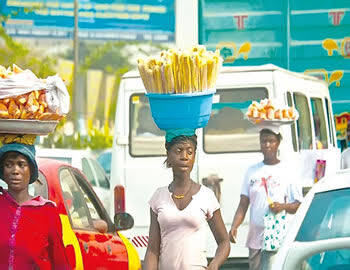
It is 1:45 p.m. on Herbert Macaulay Way, one of the busiest roads in the Federal Capital Territory. Top-range vehicles stream past the NNPC Towers, while men in suits pace about, shouting into phones. Across the road, cars crawl into a Total filling station, horns blaring ceaselessly. But beside the station, a different scene unfolds. Nylon sheets are spread on the ground, displaying sachet drinks, groundnuts, cucumber, roasted yam, boiled cassava and roasted corn in neat rows. Umbrellas and old campaign posters with faded faces provide shade for traders and customers. This makeshift market, created by hawkers to make a living under the soaring sun, is a daily reality that exists in direct defiance of the Federal Capital Territory Administration's ban on street hawking.
The routine is familiar to both traders and authorities. Suddenly, two white Abuja Environmental Protection Board vans screech to a halt nearby. Fifteen-year-old Hauwa, approaching with a plastic bowl of water, Gala and sweets on her head, drops everything and flees with the speed of light to avoid being taken away. She disappears between taxis in seconds, abandoning her tray and goods. Sachets of water scatter on the road as a driver swerves to avoid them. Other traders who spot the task force in time also scatter. In less than two minutes, the stretch is almost empty.
This has become the daily routine of hawkers who have been barred by the FCTA and the Abuja Environmental Protection Board. But they have refused to leave the roads, irrespective of measures churned out by the authorities, flooding busy areas such as Wuse, Garki, Area 1, Berger, Area 3 and Jabi.
For Hauwa, a teenager who dropped out of school in JSS2, the choice is simple: sell on the streets or starve. She shares a single room with her two siblings and three cousins in a slum outside Mpape, with no running water. Her parents were farmers in Niger State. Two years ago, bandits attacked their village, stealing food, money and two goats. Months later, drought destroyed the rest of the harvest. “School finish for JSS2,” Hauwa says quietly. “No money again”. She followed her aunt to Abuja and now sells to survive.
Mama Ada, 52, who arranges boiled corn and coconut in a plastic basin, has regular customers among bankers, drivers and dispatch riders. She sells because she has no other means of supporting herself. Paul, a regular customer, shops at the roadside to avoid the high stakes supermarkets that dot the city.
Across Abuja, the story is the same: hunger, poverty and unemployment leave traders with no choice but to defy the ban. Repeated enforcement operations aimed at clearing street traders from major roads and junctions across the FCT have failed to stop the practice, as vendors continue to return to high-traffic areas where customers are readily available. The latest clearance exercises temporarily emptied busy corridors, but many traders returned within days.
Authorities have cited traffic obstruction, safety concerns, and environmental violations as reasons for removing traders from roadsides. However, traders, residents and urban analysts argue that enforcement alone cannot succeed without addressing the shortage and rising cost of formal trading spaces. Across many FCT suburbs, shop rents range from about N200,000 annually for small, less-visible spaces to as much as N1.8 million in prime commercial locations. In many cases, landlords demand up to two years' rent upfront, creating a major barrier for small-scale traders.
Madam Peculiar, who has been searching for a shop, said affordable commercial space is increasingly difficult to find. “I have been looking for a shop but couldn't find any except plazas with exorbitant prices. People now pay for shops even before completion,” she told the New National Star. A commercial property agent said high costs and scarcity drive traders to the streets. “You may get shops for N100,000, but they are usually in remote areas with few customers. Most people need locations where buyers can easily find them,” he said.
Grace Ibe, a tomato seller at Sokale Junction, said roadside locations remain attractive due to customer access. “We sell until midnight. Many customers are commuters who prefer convenience after work,” she said. Residents like civil servant Justin Iroegbu say roadside traders save time by allowing them to buy essentials on their way home. However, shop owners argue the trend is unfair, with Ibrahim Suleiman noting that traders operating from rented shops lose customers to roadside vendors despite paying rent and utility bills.
Beyond the economic pressures, hawkers also face harassment and extortion. At Berger Junction, 32-year-old Musa Ibrahim, who sells phone accessories, said: “When task forces arrive, they shout, 'Pack your things!' If you run, they chase you. If caught, you pay N5,000 to reclaim your goods or lose everything”. Vendors have developed ‘ready-to-run’ strategies, fleeing at the first hint of trouble or seeking refuge in narrow alleyways. Some pay weekly ‘settlements’ of N2,000 to N5,000 to taskforce officials to protect their goods.
Aisha Hassan, 27, a sachet-water hawker in Wuse, said: “When they catch you selling on the road, the first thing they do is take your goods and put them inside their pickup van. I have lost over six buckets of sachet water to this task force. But I am still selling because I have no other trade”.
Social analyst Emmanuel Chukwu said the Abuja Master Plan, which excludes informal economies, exacerbates the crisis. He pointed out that the city's modernist design intentionally excluded the poor, creating no legal spaces for vendors. “They treat hawkers and vendors like criminals, but who will sweep the streets or sell affordable food if they are gone?” he asked. He called for designated vending zones in strategic areas and an end to harsh enforcement. “Street vending is not a crime; it is a survival strategy in a harsh economy with no jobs for youths. The authority must realise that Abuja is not just for the rich, it is for the poor too,” he said.
The contradiction between official policy and economic reality is stark. Across several satellite towns in the FCT, modern market structures with rows of locked shops remain largely underutilised, while crowded roadside stalls continue to thrive around them. Facilities such as Maitama Ultra Modern Market, Dutse-Pe Model Market, and Dawaki Modern Market remain underused, while roadside trading continues to flourish. Some traders attribute their preference for roadside trading to high shop rents, multiple levies and poor customer traffic within the markets. Renting a shop in some modern markets costs between N800,000 and more than N1 million annually, depending on location.
The development comes at a time when Abuja's population continues to expand rapidly. According to population projections by the National Population Commission, the FCT remains one of Nigeria's fastest-growing urban centres, with satellite towns experiencing growth due to increasing migration and urban expansion. Consequently, commercial activities have expanded beyond the capacity of existing infrastructure, placing additional pressure on markets, roads and public spaces.
While some traders operate from shops within the markets, many others prefer roadside locations where heavy pedestrian and vehicular traffic appears to guarantee quicker sales. The trend has generated growing concerns among residents and motorists, who argue that roadside trading contributes to congestion, environmental degradation and safety risks. Many residents believe authorities must address the underlying factors driving traders to the roadsides rather than relying solely on periodic enforcement exercises.
Mrs Blessing Obike, a resident of Kubwa, described the situation as frustrating. “It is difficult to understand why beautiful market buildings remain underutilised while traders occupy roadsides and pedestrian walkways. You often see them running in different directions to avoid apprehension by market officials, but they return shortly afterwards,” she said. Similarly, Mr Musa Ibrahim, a resident of Dutse-Alhaji, said the growing spread of roadside stalls was gradually undermining the objectives of the FCT master plan. “Unfortunately, enforcement remains weak, and many traders are unwilling to comply. Once officials leave, the traders return to the roadsides, creating difficulties for themselves, motorists and customers,” he said.
For the hawkers themselves, the question is not about defying the law but about survival. As one trader put it, “How do we feed?”. Until affordable trading spaces are provided and the economic pressures driving people to the streets are addressed, the hawkers will continue to return, and the cycle of raids, confiscation and defiance will persist.
📩 Stone Reporters News | 🌍 stonereportersnews.com
✉️ info@stonereportersnews.com | 📘 Facebook: Stone Reporters News | 🐦 X (Twitter): @StoneReportNew | 📸 Instagram: @stonereportersnews
Add comment
Comments