

Published by Osasere Edomwonyi Ikpoba
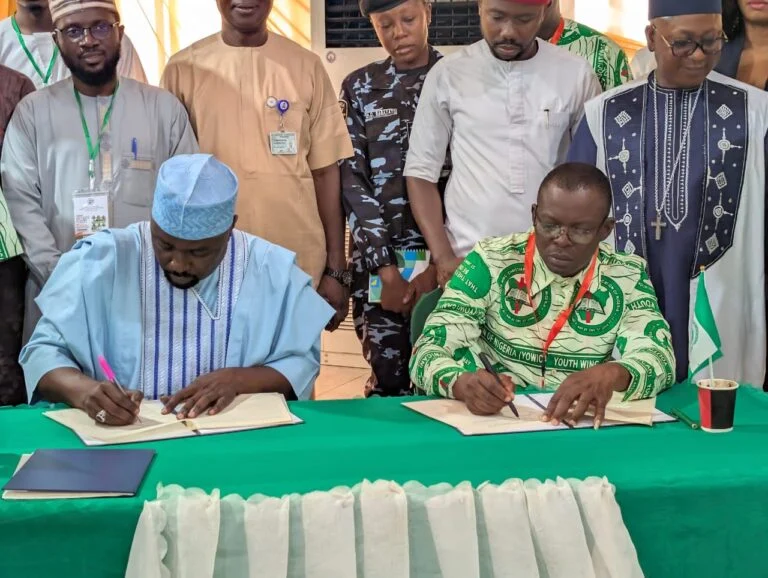
In a powerful display of interfaith solidarity that transcended decades of religious suspicion, the Youth Wing of the Christian Association of Nigeria (YOWICAN) and the National Council of Muslim Youth Organisations (NACOMYO) signed a landmark peace accord in Abuja on Friday, pledging to resist political manipulation, reject violence, and work together to ensure a peaceful 2027 general election. The historic ceremony, held at the National Christian Centre in Abuja, unfolded against the backdrop of the 2026 National Christian Youth Security Summit and Thanksgiving Service, a three-day gathering themed “Empowered for Leadership, Service and Nation Building,” which brought together security officials, government representatives, church leaders, and youth delegates from all 36 states, the Federal Capital Territory, five CAN blocs, and six geopolitical zones.
The peace accord, which organisers described as a "covenant of hope" and a "declaration of unity," represents one of the most significant interfaith youth commitments in Nigeria's recent political history. It comes at a critical juncture, with the January 2027 presidential election looming and religious identity historically serving as a potent fault line in the nation's electoral politics. The agreement commits Christian and Muslim youths to foster religious tolerance, reject political violence, promote peaceful coexistence, and resist attempts by politicians to exploit faith-based divisions for electoral gain.
Delivering his welcome address, the National Chairman of YOWICAN, Ven. Evang. Ademola Arowolo, described the moment as a defining inflection point in Nigeria's journey toward national cohesion. "Today marks a defining moment in the history of youth engagement, faith-based leadership, national security advocacy, and interfaith collaboration in Nigeria," Arowolo declared. "This Peace Accord represents more than a document. It is a covenant of hope, a declaration of unity, and a collective commitment by Christian and Muslim youths to work together in promoting peace, justice, dialogue, tolerance, and national development."
Arowolo's message was unflinching in its moral clarity. He urged young Nigerians to reject political thuggery and vote-buying, warning that every life—whether Muslim, Christian, or any other faith—is sacred and must be protected from the violence that has too often marred Nigerian elections. "God Himself does not divide us; it is human beings that divide us in their own mindsets," he said. "An idle man is the devil's workshop, but as elections approach, if somebody meets you for any violence, tell them your children should not come. We cannot destroy our own land."
Corroborating the commitment, the National President of NACOMYO, Sani Sulaiman-Maigoro, stressed that interfaith solidarity remained the most viable weapon against both security threats and political manipulation. "First and foremost is for us to accept the reality that we are first Nigerians, and Nigeria is our country. Together we live and prosper, and when we are divided, we all suffer," Sulaiman-Maigoro said. "When we work together, we are able to defeat the negative narrative and those few people who choose to be evil and divide us along religious, ethnic, or sectional lines. Nigerian Muslim youths are here in solidarity with Christian youths to say we are together towards securing and making Nigeria a better place for all."
The presence of presidential representation underscored the political significance of the event. Bishop Stephen Adegbite, Executive Secretary of the Nigerian Christian Pilgrim Commission, who stood in for President Bola Tinubu and First Lady Senator Oluremi Tinubu, delivered a stern warning to young Nigerians against allowing themselves to be used as instruments of destruction by desperate politicians. "We are meeting at a very crucial time in the history of our great nation—a period when we are moving towards another election," Adegbite cautioned. "It should be a period that none of you will be used as a sacrificial lamb. We don't want any politician to use you and waste your life. The Muslim and the Christian in Nigeria must work together; we are brothers and sisters, and it is only when you have peace that you can talk of progress."
The President of the Christian Association of Nigeria, Most Rev. Daniel Okoh, represented by Rev. Simon Dolly-KIF, the Secretary-General of the Northern Christian Religious Leaders Assembly, also addressed the gathering, urging Christian youths to rise as nation-builders and moral exemplars. "The time has come for Nigerian Christian youths to rise beyond the limitations of yesterday and embrace the responsibility of building the Nigeria we desire to see tomorrow," Okoh said. "Let no Christian youth become an instrument of violence, hatred, manipulation, or destruction. We must refuse to be recruited into anything that destroys the lives and future of our fellow Nigerians. Nigeria is bigger than our ethnicity, denomination, and political differences."
The security dimension of the accord was reinforced by the Minister of Defence, retired General Christopher Musa, who was represented by Musa Likita, his Special Adviser on Security and Intelligence. Musa underscored the critical role of the youth in national development, arguing that peace was an essential prerequisite for productivity and innovation. "The youth are full of energy, creativity, and innovation, so they will thrive better when the environment is peaceful," Musa said. "Youths are implored to hold values where they will not allow themselves to be exploited by extremist forces or criminal elements."
The signing of the peace accord comes just months after another significant interfaith initiative in August 2026, when more than 50 Christian and Muslim leaders signed a separate peace accord in Abuja, organised by the Saudi-based Muslim World League. That agreement, which launched a new body to promote religious harmony across Nigeria, reflected growing international concern over the potential for religious conflict to destabilise Africa's most populous nation ahead of the 2027 elections. The youth accord, however, carries a distinct significance, targeting the demographic most vulnerable to political recruitment and most essential to the country's future stability.
Nigeria's electoral history is punctuated by episodes of violence, with religious and ethnic divisions often exploited by political actors to mobilise support or delegitimise opponents. The 2023 general elections, while largely peaceful, were not without incidents of violence and allegations of voter suppression. The 2027 elections are expected to be fiercely contested, with President Bola Tinubu seeking a second term against a coalition of opposition forces that includes former Vice President Atiku Abubakar and former Anbarra State Governor Peter Obi. The peace accord represents a pre-emptive effort to insulate the youth population from the toxic narratives that have historically fuelled electoral violence.
For the young signatories, the accord is not merely a symbolic gesture but a binding commitment to hold themselves and their peers accountable. The agreement includes provisions for grassroots sensitisation, community-level dialogue, and mechanisms for reporting and resolving interfaith conflicts before they escalate into violence. The organisers have pledged to extend the initiative to all 36 states, ensuring that the message of unity reaches the most volatile communities.
As Nigeria hurtles toward the 2027 elections, the Christian-Muslim youth peace accord offers a glimmer of hope in a political landscape often defined by cynicism and division. Whether this covenant of hope will withstand the pressures of political mobilisation remains to be seen. But for one day in Abuja, Christian and Muslim youths stood side by side, declaring that they are first Nigerians—and that their shared humanity matters more than the labels that have too often been used to tear them apart.
📩 Stone Reporters News | 🌍 stonereportersnews.com
✉️ info@stonereportersnews.com | 📘 Facebook: Stone Reporters News | 🐦 X (Twitter): @StoneReportNew | 📸 Instagram: @stonereportersnews
Add comment
Comments