

Reported by Ariajegbe Sylvia Esezobor
Nigeria’s headline inflation rate eased marginally to 15.39 per cent in August 2026, down from 15.43 per cent in July, according to the National Bureau of Statistics. The 0.04 percentage point decline extends a three-month disinflation trend and marks a significant moderation from the 23.14 per cent recorded in August 2025. On a month-on-month basis, the slowdown was more pronounced, with inflation falling sharply to 0.71 per cent from 1.57 per cent in July. The Consumer Price Index, which measures changes in the prices of goods and services consumed by households, rose to 146.3 points in August from 145.3 points in July, indicating that prices continued to rise, but at a slower pace. The latest Consumer Price Index report, released by the NBS on Monday, September 14, 2026, shows that while the direction of travel is positive, the cost-of-living crisis is far from over for millions of Nigerians.
The headline figure masks a more complex reality. Food inflation, the single largest driver of overall inflation, stood at 19.57 per cent year-on-year in August, meaning food prices remain nearly 20 per cent higher than they were a year ago. While this represents a decline from 20.31 per cent in July, it is the first drop in six months, ending five consecutive months of increases. More significantly, month-on-month food inflation slowed dramatically to 1.02 per cent from 5.56 per cent in July, a decline of 4.55 percentage points. The NBS attributed the moderation to changes in the average prices of palm oil, carrots, pepper, onions, cassava flour, beef, yam flour, water yam, melon, fresh ginger, fresh fish, Irish potatoes, wheat grain, frozen chicken and turkey meat. Food and non-alcoholic beverages remained the largest contributor to annual inflation, accounting for 6.16 percentage points, far ahead of restaurants and accommodation services at 1.99 points, transport at 1.64 points, and housing, water, electricity, gas and other fuels at 1.30 points.
Core inflation, which excludes volatile agricultural produce and energy prices, also moderated to 13.29 per cent year-on-year in August, compared with 22.93 per cent in August 2025. On a monthly basis, core inflation turned negative at -0.06 per cent, compared with 0.15 per cent in July. This suggests that underlying price pressures weakened during the month, providing some room for policymakers to look beyond emergency inflation management. However, the divergence between urban and rural consumers tells a different story. Urban inflation stood at 15.88 per cent year-on-year, while rural inflation was lower at 14.23 per cent. But the month-on-month figures reveal that urban inflation slowed to just 0.28 per cent from 1.90 per cent in July, while rural inflation accelerated to 1.79 per cent from 0.78 per cent. The contrasting movement is significant because rural households are generally more exposed to food and agricultural price movements.
The state-level data underscores the uneven nature of the inflation experience. Lagos recorded the highest year-on-year headline inflation at 23.68 per cent, followed by Zamfara at 22.56 per cent and Enugu at 22.06 per cent. Sokoto, Kebbi and Jigawa recorded the lowest rates at 2.11 per cent, 3.72 per cent and 3.81 per cent respectively. On food inflation, Adamawa recorded the highest year-on-year rate at 38.85 per cent, followed by Zamfara at 37.96 per cent and Bayelsa at 36.20 per cent. Borno recorded food deflation of -4.04 per cent, while Jigawa recorded -0.23 per cent. On a month-on-month basis, food inflation was highest in Katsina at 9.48 per cent, Rivers at 8.86 per cent and Osun at 8.32 per cent, while Taraba recorded the sharpest decline at -12.42 per cent. The NBS cautioned against direct comparisons of inflation rates across states because consumption patterns and the weights assigned to food and non-food items differ across locations.
The inflation figures landed with immediate political and economic significance. The Central Bank of Nigeria’s Monetary Policy Committee is scheduled to meet next week, and the unexpected easing has strengthened the case for a resumption of the easing cycle. The median estimate of three economists in a Bloomberg survey was 15.7 per cent, meaning the actual figure came in below expectations. The CBN has kept the Monetary Policy Rate at 26.5 per cent, balancing the need to control inflation against the pressure to stimulate credit and growth. A survey by the CBN showed that 60.9 per cent of respondents in its August 2026 Inflation Expectations Survey called for a rate cut amid continued concerns over the cost of doing business. The CBN’s Inflation Perception Index declined from 40 points in July to 39.6 points in August, suggesting that while Nigerians still feel the pinch, they perceive inflation as slightly less severe than before.
But the gap in how Nigerians experience inflation remains stark. According to the CBN’s latest inflation expectations survey, 68.4 per cent of Nigerians earning below N70,000 perceived inflation as high in August 2026, compared with just 30.8 per cent among households earning above N450,000. The N70,000 income threshold corresponds to Nigeria’s current minimum wage, suggesting that lower-income households continue to feel the impact of rising prices far more acutely than higher-income earners. Rural households reported stronger inflation pressure than their urban counterparts, with 65.7 per cent of rural respondents perceiving inflation as high, compared with 63.2 per cent in urban areas. Energy costs, insecurity, interest rates and exchange rates were identified as the major factors influencing inflation perception. A separate report noted that roughly 65.8 per cent of Nigerian households are unable to afford healthy, nutritious or preferred foods due to a lack of funds, while United Nations data shows that about 80 per cent of the population cannot afford a healthy diet.
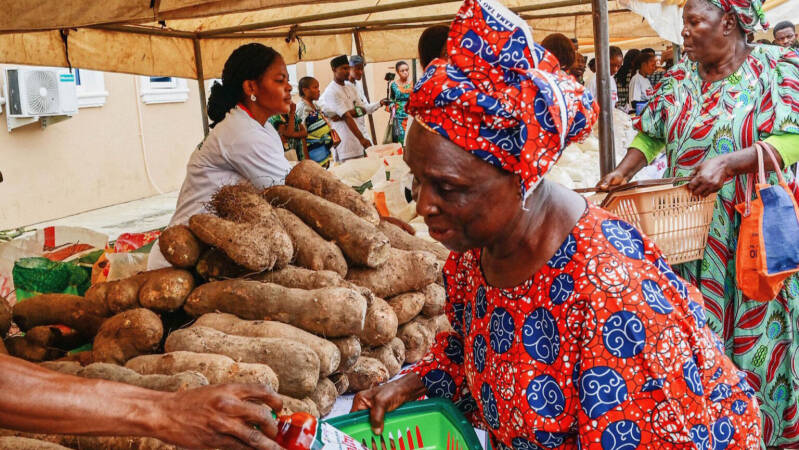
The human cost of these numbers is visible in households across the country. Mrs Alele Hamzat, a mother of four, told Vanguard that her family’s breakfast has shifted from fried eggs, tea with milk and sliced bread to plain boiled yam or cassava flakes soaked in water. “We only eat to survive, not to balance any diet,” she said. Mrs Dorathy Agbede, a restaurant owner, said she used to sell a bag of rice and half a bag of beans in a week, but now hardly sells two mudus of either. “Most times I give cooked food out to avoid it being wasted,” she said. The traditional three-square-meals model has dissolved for many families, replaced by coping mechanisms like the “0-1-1” or “1-0-1” formula, skipping breakfast or lunch entirely to stretch meagre resources.
President Bola Tinubu has acknowledged that macroeconomic success has yet to translate into tangible relief for ordinary Nigerians. Speaking at the Asiwaju Scorecard Series in Abuja, he said Nigeria’s gross external reserves had risen to about $52.7 billion by August 2026, real GDP grew by 4.43 per cent in the second quarter of 2026, and inflation had fallen significantly from its earlier peak. But he admitted that the ultimate test is when stability translates into cheaper food, more jobs, affordable credit, reliable electricity and greater purchasing power. “These figures do not mean that our economic challenges have disappeared,” he said, “but they demonstrate that the direction of travel has changed.” Opposition figures, including former Vice President Atiku Abubakar, have dismissed the government’s claims of economic prosperity, citing widespread industrial closures, rising food prices and the deepening cost-of-living crisis as evidence of failure. The Trade Union Congress has urged the Federal Government not to suspend food importation, warning that doing so would push the price of rice and other staples to unaffordable levels.
The August inflation data offers a nuanced picture. Headline inflation is falling, core inflation is moderating, and food inflation has slowed for the first time in six months. But food prices remain nearly 20 per cent higher than a year ago, and the monthly acceleration in rural inflation is a warning sign. For the CBN, the decision on interest rates next week will hinge on whether the current moderation is broad-based and sustainable, or whether renewed fuel-price pressures could reverse the gains. For households, a lower inflation rate does not mean prices are falling. It means they are rising more slowly. That distinction matters little to a family choosing between feeding their children and paying for transport to work. The coming months will show whether the disinflation trend holds and whether it finally translates into relief at the market stall.
📩 Stone Reporters News | 🌍 stonereportersnews.com
✉️ info@stonereportersnews.com | 📘 Facebook: Stone Reporters News | 🐦 X (Twitter): @StoneReportNew | 📸 Instagram: @stonereportersnews
Add comment
Comments