

Reported by: Ijeoma G | Edited by: Oravbiere Osayomore Promise.
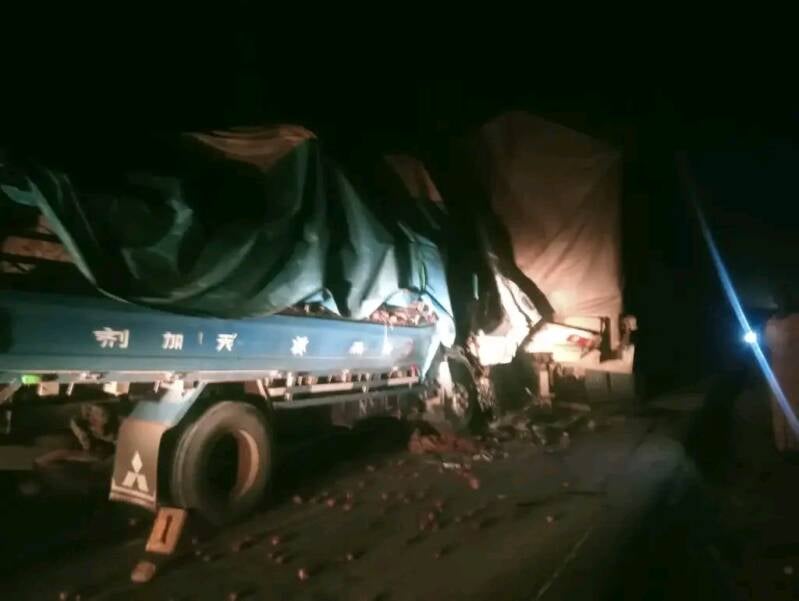
The crash happened at about 4 a.m. on Wednesday, September 16, 2026, around Straight Gate School, Ipara Remo, along the Lagos-Ibadan Expressway. A blue Mitsubishi Canter with registration number FGE 753 XA was travelling at high speed. An ash-coloured HOWO truck with registration number T-695 KT was moving ahead on the highway. The driver of the Canter attempted to overtake the truck. He rammed into it instead. The impact killed four people. All of them were male adults. One other male adult sustained injuries and was rushed to Victory Hospital in Ogere for medical attention. Three other persons escaped unhurt. The bodies of the deceased were deposited at the FOS Mortuary in Ipara.
The Federal Road Safety Corps, Ogun State Sector Command, confirmed the incident in a statement issued by its spokesperson, Chief Route Commander Afolabi Odunsi. According to Odunsi, eight persons were involved in the crash. Preliminary investigation identified speed violation and wrong overtaking as the primary causes. The driver of the Mitsubishi was travelling at high speed and rammed into the moving truck while attempting to overtake. Fatigue was also identified as a contributing factor. The driver was reportedly fatigued during the journey, a condition that likely impaired his judgment and reaction time. The FRSC rescue team received the report at 4:33 a.m. and arrived at the scene at 4:39 a.m., recording a response time of six minutes. The crashed vehicles were handed over to the Police Motor Traffic Division, Isara Division, for further investigation.
The Ogun State Sector Commander, Corps Commander Oludare Ogunjobi, urged motorists to avoid speeding, fatigue, and unsafe overtaking, especially during early-morning journeys. He advised drivers to take adequate rest before embarking on long-distance trips and to overtake only when it was safe and permissible to do so. The warning is a familiar one, repeated after every fatal crash on Nigeria's highways. Yet the crashes continue, and the death toll rises. The Lagos-Ibadan Expressway has become one of the deadliest roads in the country. In September alone, at least four separate fatal crashes have been recorded on the highway. On September 4, three people were killed and 10 injured in a multiple crash at the Long Bridge, opposite Mikano. On September 9, three people died in a crash involving a Nissan car and a Mack truck. On September 11, two people were killed and 15 injured when a Toyota Hiace bus crashed at Saapade. On September 12, four people died when a truck plunged into the lagoon on Kara Bridge. The pattern is relentless.
The tragedy at Straight Gate is not just another accident. It is the predictable consequence of a system that fails to enforce speed limits, regulate commercial drivers, and provide adequate rest stops for long-distance travellers. The driver of the Mitsubishi Canter was reportedly fatigued. Fatigue is not a mystery. It is a known risk factor that can be managed through enforced rest periods, regulated driving hours, and the installation of speed-limiting devices. Speed violation is not an accident. It is a choice, made by drivers who know they are unlikely to be caught and punished. Wrongful overtaking is not a mistake. It is a gamble, taken on a highway where the margin between life and death is measured in seconds.
The FRSC has identified the causes of the crash. It has issued the warnings. It has advised drivers to rest, to slow down, to overtake safely. But advice alone does not save lives. Enforcement does. Speed cameras, patrols, and penalties that are actually imposed would do more to reduce crashes than any public awareness campaign. The FRSC's response time of six minutes was commendable, but by the time the rescue team arrived, four people were already dead. The crash had happened. The lives had been lost. The response came too late.
For the families of the four men who died at Straight Gate, the pain is fresh. They were travelling to work, to markets, to destinations that will never be reached. They were fathers, brothers, sons, and friends. They were men who left home that morning with no expectation of dying. They were killed by speed, fatigue, and a driver's decision to overtake when he should have waited. The crash has been handed over to the police for further investigation. The investigation will determine whether anyone is charged, whether any lessons are learned, whether anything changes. But investigations do not bring back the dead.
The Lagos-Ibadan Expressway is a highway that connects two of Nigeria's largest cities. It is a road that millions of people travel every year. It is also a road that has become synonymous with death. The crashes are not isolated incidents. They are a pattern. They are a symptom of a transport system that prioritises speed over safety, profit over lives, and convenience over regulation. The crash at Straight Gate is the latest chapter in a story that has no end. The FRSC will continue to respond. The police will continue to investigate. The families will continue to mourn. And the highway will continue to claim more lives unless something fundamental changes.
The Ogun State Sector Commander has advised drivers to rest before long journeys. That advice must be enforced. The FRSC has identified speed and wrongful overtaking as the causes of the crash. Those violations must be punished. The highway has claimed another four lives. That should be enough to prompt action. But in Nigeria, it rarely is. The same warnings will be issued after the next crash. The same condolences will be offered. The same questions will be asked. And the answers will remain the same. Nothing changes. The dead are buried. The living move on. And the highway waits for its next victims.
📩 Stone Reporters News | 🌍 stonereportersnews.com
✉️ info@stonereportersnews.com | 📘 Facebook: Stone Reporters News | 🐦 X (Twitter): @StoneReportNew | 📸 Instagram: @stonereportersnews
Add comment
Comments