

Reported by Ariajegbe Sylvia Esezobor
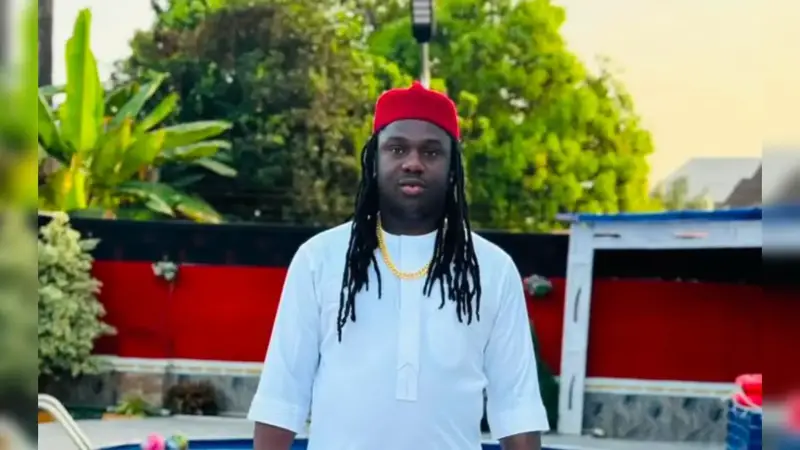
The Attorney General of Anambra State, Tobechukwu Nweke, has said the early release of Chidozie Nwangwu, the flamboyant native doctor widely known as Akwa Okuko Tiwara Aki, resulted from a combination of a plea bargain agreement and the governor’s exercise of the prerogative of mercy, offering the first detailed legal explanation of a decision that had generated widespread public debate since Nwangwu walked out of the Amawbia Correctional Centre on September 18.
In a statement issued on Friday and circulated by the Anambra State Ministry of Information and Value Reorientation, Nweke said the plea bargain Nwangwu entered into with the state government led the High Court to hand down a reduced sentence, taking into account his remorse and other circumstances. That reduced sentence, in turn, created the conditions for Governor Chukwuma Soludo to consider executive clemency, which resulted in the remission of the unserved portion of Nwangwu’s imprisonment. “The plea bargain indirectly paved the way for the prerogative of mercy, which we describe as a remote benefit of the plea bargain arrangement,” Nweke said.
The Attorney General explained that under plea bargain agreements, convicted persons may receive non-custodial sentences, while those receiving prison terms benefit from reduced incarceration periods. Such agreements also typically require restitution or compensation to victims of the offences. In Nwangwu’s case, the court sentenced him in February 2026 to eleven months imprisonment after he pleaded guilty to charges bordering on money rituals and the preparation of protective charms for criminals. The plea bargain had already shortened his sentence, and the governor’s subsequent decision to remit the remaining portion meant that he did not serve the full term.
Nweke framed the release as consistent with the plea bargain agreement itself. “As agreed under the plea bargain agreement, the early release of Akwa Okuko enables him to immediately join the State on the campaign on youth reformation and re-orientation,” he said. That campaign is central to the state’s broader efforts under the Anambra State Homeland Security Law 2025, which Governor Soludo signed in a bid to curb criminality linked to fraudulent spiritual practices. As part of the conditions attached to his sentence, Nwangwu was required to renounce his fetish practice and commit to supporting youth reformation. He was subsequently appointed Ambassador for Youth Reformation, a role the state described as correction and restoration rather than mere punishment.
The Attorney General also used the occasion to encourage other inmates standing trial in Anambra State to consider plea bargain arrangements where they are satisfied of their guilt. He cited Nwangwu’s case as an instructive example of how the process can work. According to Nweke, the Soludo administration prioritises decongesting correctional centres and is systematically mainstreaming plea bargaining as a judicial tool to reduce pre-trial detention and overcrowding. Since the State Ministry of Justice launched a public awareness campaign on plea bargaining two months ago, approximately 150 applications have been submitted to the Attorney General’s office and are currently under consideration.
The explanation adds legal context to a decision that had been announced without detailed justification when Soludo visited the Amawbia Correctional Centre on September 18. At that visit, the governor said the pardon was not only to free the native doctor but also to support the welfare and well-being of inmates. “I will sign the release papers immediately. Let’s focus on reforming Anambra,” Soludo said at the time. He also inspected the Waterside custodial facility in Onitsha as part of what his administration described as a broader review of correctional facilities in the state.
Nwangwu’s path to release began in February 2025, when he was arrested by operatives of the Agunechemba security outfit following the signing of the Homeland Security Law. He was among eight native doctors arrested that year and charged with involvement in the promotion of money rituals, quick wealth schemes, and the use of human parts for rituals. He was convicted on February 27, 2026, by the Anambra State High Court sitting in Awka. Justice Jude Obiorah sentenced him to two years imprisonment, ruling that part of the sentence would run concurrently with the period he had already spent in custody, leaving him with eleven months to serve. He was also fined sixty million naira, and the court ordered the demolition of his shrine in Oba, Idemili South Local Government Area, which the state government subsequently executed.
The case has drawn significant public attention because of Nwangwu’s prominence as one of Anambra’s most flamboyant and controversial native doctors. His arrest and conviction were presented by the Soludo administration as evidence of its determination to confront the criminal networks that had exploited popular beliefs in money rituals and supernatural wealth. His release and appointment as a youth ambassador, however, prompted questions about whether the crackdown on native doctors was driven by genuine security concerns or by political calculation. Traditional medicine practitioners had previously staged protests against what they described as selective justice and a witch-hunt by the Soludo administration, and the pardon was seen by some as an acknowledgment of the criticism.
For the state government, the legal sequence is straightforward: a plea bargain reduced the sentence, the governor exercised the prerogative of mercy, and the release serves a rehabilitative purpose consistent with the plea agreement. For critics, the explanation does little to dispel the impression that a high-profile convict received preferential treatment. What is not in dispute is that Nwangwu is now free and expected to take up a public role in the same campaign against the practices that landed him in prison. Whether his redemption will be accepted by the communities he is meant to influence, and whether the plea bargain mechanism the Attorney General has promoted will produce similar outcomes for less celebrated defendants, will determine whether the case is remembered as an example of judicial pragmatism or as another instance of the powerful escaping the full weight of the law.
📩 Stone Reporters News | 🌍 stonereportersnews.com
✉️ info@stonereportersnews.com | 📘 Facebook: Stone Reporters News | 🐦 X (Twitter): @StoneReportNew | 📸 Instagram: @stonereportersnews
Add comment
Comments