

Reported by Ariajegbe Sylvia Esezobor
The Allied Peoples Movement and its presidential candidate, Oyo State Governor Seyi Makinde, have filed a suit at the Abia State High Court challenging the N200 million campaign advertising permit fee imposed by the Abia State Government on presidential candidates seeking to display campaign materials in the state, arguing that the fee is unconstitutional and violates federal electoral law.
The suit, marked HC/214/2026 and filed on September 17 before the Umuahia Judicial Division of the Abia State High Court, was lodged through their counsel, Musibau Adetunbi, SAN, alongside Ire Egert-Olusesi, Ridwan Azeez, Oluwabusola Oluwaniyi and Joseph Lukman of Musibau Adetunbi, SAN & Co., Ibadan. Listed as defendants are Governor Alex Otti of Abia State, the state Attorney-General, the Abia State Signage and Advertisement Agency, and the Abia State House of Assembly. The plaintiffs have asked that all four be served within 30 days.
At the heart of the dispute is a fee schedule introduced by the Abia State Signage and Advertisement Agency in late July 2026, which set the cost of a political campaign advertising permit at N200 million for presidential candidates, N150 million for governorship candidates, N100 million for senatorial candidates, N50 million for House of Representatives candidates and N20 million for state House of Assembly candidates. The plaintiffs said they became aware of the fee while preparing to commence a nationwide campaign tour covering all 36 states and the Federal Capital Territory, according to a supporting affidavit deposed to by Aisha Abdullahi Abubakar, described as APM's National Welfare Officer. The affidavit stated that the claimants learnt of the fee during their preparations.
The plaintiffs' central argument is that the fee is twenty times what the Electoral Act 2026 allows a candidate to spend on billboards in any single state, and that it represents a backdoor attempt to shut out non-incumbent candidates from public view while making compliance with campaign spending limits impossible. They rely on Section 92 of the Electoral Act 2026, which caps total campaign expenditure for a presidential election at N10 billion nationwide. They argue that if every state and the Federal Capital Territory charged a similar fee, billboard charges alone would exceed 80 per cent of that ceiling, before accounting for travel, media buys, venue rentals, security and payments to agents across more than 176,000 polling units nationwide. The Electoral Act 2026, signed into law by President Bola Tinubu in February 2026, doubled the presidential campaign spending limit from N5 billion to N10 billion and raised the governorship ceiling to N3 billion.
The plaintiffs also contend that the fee breaches Section 99(2) of the Electoral Act 2026, which bars the use of state apparatus or regulatory bodies to the advantage or disadvantage of any political party or candidate at an election, and undermines the principle of a level playing field. They argue that by fixing an exorbitant fee, the defendants are using the Abia State Signage and Advertisement Agency to constructively exclude non-incumbent candidates from public visibility. They further contend that under Item F, Section 15(a) and (f) of the Third Schedule to the 1999 Constitution, as amended, and Section 9(1) of the Electoral Act 2026, the Independent National Electoral Commission is exclusively vested with the power to make rules and regulations on political campaigns for the purpose of elections.
The plaintiffs acknowledged that outdoor signage regulation falls under the Residual List and is a state matter, but insisted that states cannot exercise that power in a prohibitive or discriminatory manner that frustrates or overrides an Act of the National Assembly on campaigns. They cited Sections 1(3) and 4(5) of the Constitution on the supremacy of federal law, arguing that any state law, directive or regulation inconsistent with the Electoral Act is void to the extent of that inconsistency.
The plaintiffs have raised six questions for the court's determination and are asking for eight reliefs. Key among them are an order setting aside the regulations made by the Abia State Signage and Advertisement Agency in respect of political campaigns, including the N200 million fee or any other amount; an injunction restraining the defendants and their agents from enforcing the fee and from removing, defacing, destroying or obstructing the placement of their campaign billboards and outdoor advertisements within Abia State; a declaration that the N200 million fee schedule is inconsistent with federal legislation, unconstitutional, null and void; and a declaration that the fee breaches Section 99(2) of the Electoral Act 2026. The plaintiffs warned that unless the court intervenes swiftly, Makinde will suffer irreparable harm to his constitutional right to seek public office, and the principle of a level playing field will be badly compromised.
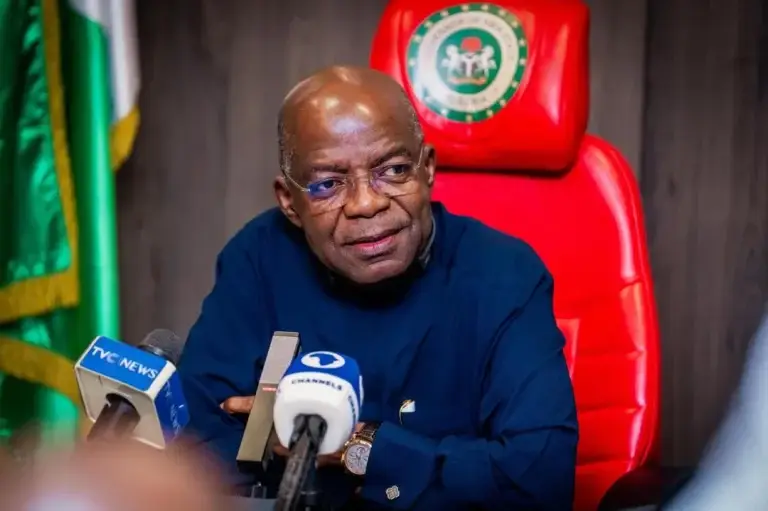
The suit comes amid a broader political confrontation over the Abia fee regime. When the fee schedule was announced in July 2026, the APC and the PDP in Abia State rejected the new campaign fees policy, describing it as targeted at opposition parties. The African Action Congress governorship candidate in the state also criticised the N150 million fee imposed on governorship candidates, questioning how opposition candidates could afford such amounts. The Abia State Government has defended the fees as a regulatory measure, though it has not publicly responded to the specific legal arguments raised in the Makinde suit.
The political stakes extend beyond the immediate dispute over billboard fees. Makinde is seeking the presidency on the platform of the APM, with former Director-General of the Department of State Services Lawal Daura as his running mate. He formally accepted the APM presidential ticket in Ibadan and has positioned his campaign around a "Reset Agenda" focused on security, the economy, the cost-of-living crisis and food security. The APM inaugurated its presidential campaign headquarters in Abuja in September 2026, declaring a mission to reset the country through the Makinde-Daura ticket. The 2027 presidential election is scheduled for January 16, with the governorship and state assembly elections following on February 6. As Makinde prepares to take his campaign across the country, the outcome of the Abia suit will determine whether he can display campaign materials in the state without paying a fee that his legal team argues is designed to make it impossible for non-incumbent candidates to compete. The court is yet to schedule a hearing date, and the defendants have not yet filed their responses. For now, the legal battle is joined, and the question of whether a state can impose a fee that effectively prices presidential candidates out of public visibility will be decided in the coming weeks.
📩 Stone Reporters News | 🌍 stonereportersnews.com
✉️ info@stonereportersnews.com | 📘 Facebook: Stone Reporters News | 🐦 X (Twitter): @StoneReportNew | 📸 Instagram: @stonereportersnews
Add comment
Comments