

Reported by: Ijeoma G | Edited by: Oravbiere Osayomore Promise.
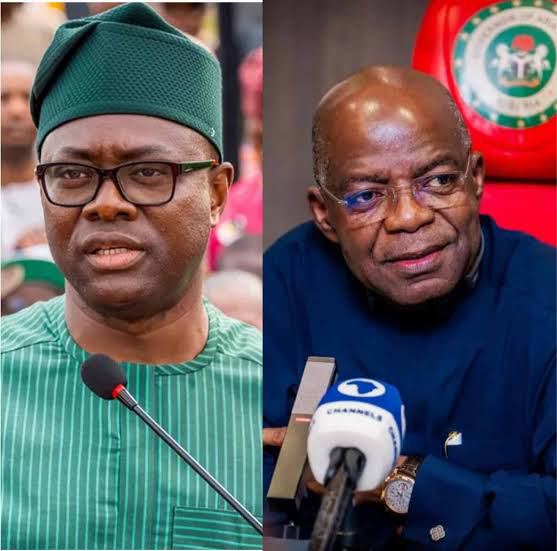
The presidential candidate of the Allied Peoples Movement and Governor of Oyo State, Seyi Makinde, has dragged the Abia State Government to court over an alleged N200 million mandatory campaign fee imposed on presidential candidates seeking to display campaign materials in any part of the state. The suit, marked HC/214/2026, was filed on September 17, 2026, before the Abia State High Court, Umuahia Judicial Division, by Makinde and the APM through their lead counsel, Musibau Adetunbi, a Senior Advocate of Nigeria. The plaintiffs joined Governor Alex Otti, the Abia State Attorney-General, the Abia State Signage and Advertisement Agency, and the Abia State House of Assembly as defendants.
At the heart of the dispute is a fee schedule introduced by the Abia State Signage and Advertisement Agency, which pegs the cost of outdoor campaign billboards at N200 million for presidential candidates and N150 million for governorship candidates. The plaintiffs argue that the fee is unconstitutional, violates the Electoral Act 2026, and is designed to shut non-incumbent candidates out of public visibility while giving an unfair advantage to the ruling party. Makinde and the APM say they became aware of the fee only while preparing for a nationwide campaign tour covering all 36 states and the Federal Capital Territory.
The plaintiffs contend that the fee is 20 times higher than what the Electoral Act 2026 permits a candidate to spend on billboards in any single state. Section 92 of the Electoral Act caps total campaign expenditure for a presidential election at N10 billion nationwide. Makinde and the APM argue that if every state and the FCT imposed a similar N200 million billboard fee, the charges alone would consume more than 80 per cent of that statutory ceiling, before accounting for travel, media buys, venue rentals, security, and payments to agents across more than 176,000 polling units. They warned that such a scenario would make it practically impossible for any presidential candidate to comply with the campaign funding limit imposed by law.
The suit raises six questions for the court's determination and seeks eight reliefs. Among them is an order setting aside the regulations made by the Abia State Signage and Advertisement Agency concerning political campaigns, including the N200 million fee or any other amount imposed under the regulations. The plaintiffs are also seeking an injunction restraining the defendants and their agents from enforcing the fee and from removing, defacing, destroying, or obstructing the placement of their campaign billboards and outdoor advertisements within Abia State. They further ask the court to declare the fee schedule inconsistent with the Constitution, the Electoral Act 2026, and other federal legislation, and therefore null and void from the outset.
The legal arguments advanced by Makinde and the APM rest on several pillars. They cite Item F, Section 15(a) and (f) of the Third Schedule to the 1999 Constitution, as well as Section 9(1) of the Electoral Act 2026, to argue that the Independent National Electoral Commission is the body exclusively vested with the power to make rules and regulations concerning political campaigns. They also rely on Section 99(2) of the Electoral Act, which prohibits the use of state apparatus or regulatory bodies to the advantage or disadvantage of any political party or candidate. According to the plaintiffs, by publicly fixing an exorbitant fee, the defendants are using the Abia State Signage and Advertisement Agency as a state apparatus to constructively exclude non-incumbent candidates from public visibility, contrary to the principle of a level playing field for all contestants.
The plaintiffs acknowledge that outdoor signage regulation falls within the residual legislative powers of the states. However, they argue that such powers cannot be exercised in a manner that is prohibitive or discriminatory, or that frustrates or overrides an Act of the National Assembly regulating electoral campaigns. They rely on Sections 1(3) and 4(5) of the Constitution, which establish the supremacy of federal law, and contend that any state law, directive, or regulation inconsistent with the Electoral Act is void to the extent of the inconsistency. The supporting affidavit was deposed to by Aisha Abdullahi Abubakar, the APM's National Welfare Officer, who stated that the claimants would suffer irreparable harm to their constitutional right to seek public office unless the court intervened urgently.
The dispute is part of a broader pattern of states imposing steep campaign signage fees ahead of the 2027 general elections. Cross River State has pegged its presidential campaign billboard fee at N150 million, while Kogi State has fixed a similar N150 million fee for presidential candidates. Abia State's N200 million fee is the highest among the states that have published their fee schedules. Critics have described the fees as an assault on democracy and a backdoor attempt to make it impossible for opposition candidates to compete. The ruling All Progressives Congress in Abia State has dismissed such claims, framing the fee as a legitimate regulatory measure. However, the plaintiffs argue that the fee is not about regulation at all. It is about money, access, and the power to decide who gets seen and who gets silenced.
The Abia State Government has not issued a public response to the lawsuit. Governor Otti's administration has previously defended its signage regulations as part of efforts to bring order to the state's advertising space. But the plaintiffs' argument is that order cannot come at the price of democracy. If the fee is allowed to stand, they say, it would hand an insurmountable advantage to the wealthiest candidates and the ruling party, turning the 2027 election into an auction rather than a contest of ideas. The case will be closely watched across the country, as other states consider similar fees and as political parties prepare for what promises to be a fiercely contested election season. For now, the matter rests with the Abia State High Court, which will determine whether the N200 million fee is a legitimate exercise of state regulatory power or an unconstitutional barrier to political participation.
📩 Stone Reporters News | 🌍 stonereportersnews.com
✉️ info@stonereportersnews.com | 📘 Facebook: Stone Reporters News | 🐦 X (Twitter): @StoneReportNew | 📸 Instagram: @stonereportersnews
Add comment
Comments