

Reported by: Oahimire Omone Precious | Edited by: Oravbiere Osayomore Promise.
A political storm is brewing in Kaduna State, and its epicentre is Southern Kaduna. Hon. Victor Mathew Bobai, Senior Special Adviser on Public Affairs to Governor Uba Sani and Convener of Friends of CG Musa, has declared that 12 local government areas in the region have been "sealed, dusted and delivered" for the APC ahead of the 2027 elections, describing the opposition as having "no marketplace to sell their products." Speaking on Invicta Radio in Kaduna over the weekend, Bobai listed Kaduna South, Chikun, Kajuru, Kachia, Kagarko, Kaura, Kauru, Sanga, Jema'a, Zangon Kataf, Lere and Jaba as territories where the APC has built sufficient grassroots structures to shut out the opposition.
The declaration is not mere campaign bravado. It is a calculated political statement backed by a confluence of factors that have reshaped the political calculus in one of Nigeria's most contested regions. At the centre of this strategy is the selection of Jerry Adams, the Executive Chairman of the Kaduna State Internal Revenue Service, as Governor Uba Sani's running mate for the 2027 governorship election. Adams' nomination, announced in July 2026, marked the first time in seven years that the APC has fielded a Christian deputy governorship candidate in Kaduna State, a move widely interpreted as a strategic bid to consolidate support in Southern Kaduna, a region historically aligned with the opposition. Bobai described Adams as the person the party "wanted" as running mate, praising his "energy" and grassroots appeal.
But the selection of Adams is only one pillar of a broader strategy. Bobai's declaration points to a web of federal and state interventions that the APC is leveraging to make inroads into Southern Kaduna. Among the federal projects cited are the approval of the Federal University of Applied Sciences in Kachia, a 270-hectare educational and economic asset, and the establishment of the Federal Medical Centre in Kafanchan. President Tinubu also approved over N1.17 trillion for light rail and road projects in Kaduna, including N100 billion for the Kaduna Light Rail and a 50-kilometre internal light rail valued at $868 million. The 122-kilometre Kaduna-Birnin Gwari Road reconstruction is also part of the federal government's infrastructure push in the state.
At the state level, Governor Uba Sani's administration has implemented what Bobai described as more than 78 road projects covering approximately 775 kilometres, with a focus on rural connectivity. The 23-kilometre Madauchi to Kafanchan via Madakiya road in Southern Kaduna has been completed and commissioned, while the Jaba-Kwoi road was flagged off as a "lifeline" for the region. The state government is also upgrading 255 healthcare centres and 15 general hospitals, including the Kachia General Hospital, and has completed 62 new secondary schools.
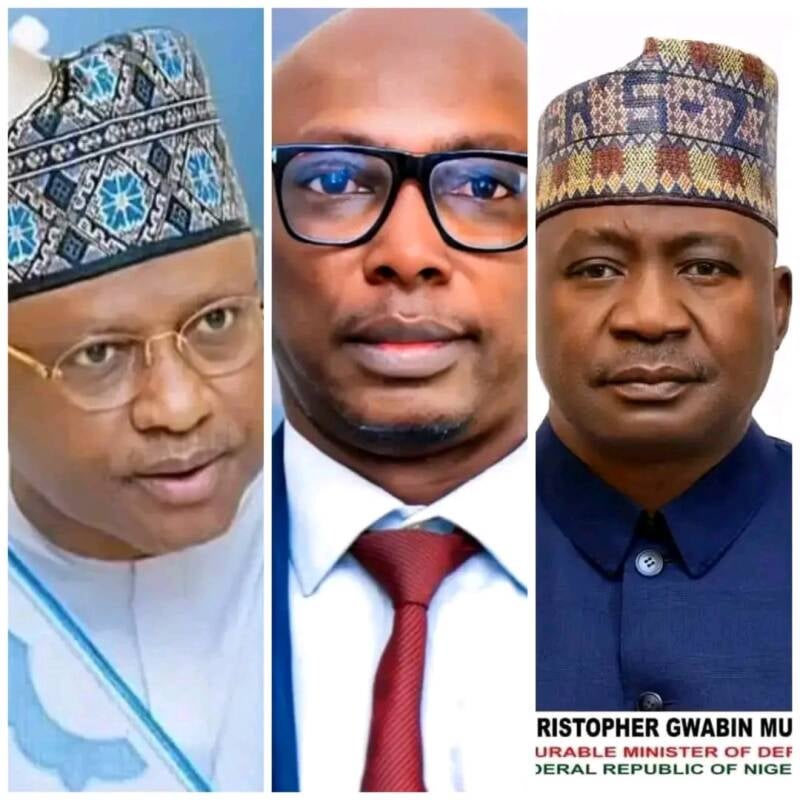
The third and perhaps most significant pillar of the strategy is the entry of General Christopher Gwabin Musa (retd.), the Minister of Defence, into the political mobilisation arena. Bobai described the "CG Musa factor" as a "game-changer," highlighting the general's non-kinetic approach to security, which includes military-led community investments in schools, clinics and boreholes in conflict-affected areas of Southern Kaduna. The Infantry Model Command Day Secondary School was commissioned as a "beautiful edifice," with a proposed Command Science Secondary School in Kaduna featuring a modern ICT centre. Military engineers have also been involved in sinking boreholes, rehabilitating schools and convening peace dialogues in areas like Kaura and Kauru.
The general's political machinery operates through the Musawah for Youth and Development Initiative, a socio-political platform that has established structures across all 23 local government areas of Kaduna State. The initiative has inaugurated 92 local government officials, with 2,295 ward mobilisers and over 24,000 polling unit officials mobilised across the state. The group claims to have registered 266 support groups, cutting across farmers' associations, student unions, women's groups, artisans and faith-based organisations. The initiative was renamed CGMUSAWAH for PBAT 2027 to mobilise one million women, with a door-to-door campaign covering the North-West.
Bobai also highlighted the Kaduna State Government's plans to recruit 7,000 youths into the Kaduna State Vigilance Service, a move that aligns with General Musa's push for community-driven policing and security reforms. The state has already recruited and trained over 1,000 forest guards, distributed 150 Hilux patrol vehicles and 500 motorcycles to security agencies.
The scale of this political machinery is formidable. But it is not without opposition. The African Democratic Congress, under the leadership of governorship candidate Isa Ashiru Kudan, has been actively mobilising in Kaduna State, with support from former Governor Nasir El-Rufai, who has emerged as a vocal critic of the APC-led administration. In September 2026, the ADC accused security operatives of attacking its members during a solidarity walk in Kaduna, an allegation the police denied, stating that tear gas was used to disperse supporters who blocked a major road. The ADC has warned that political thuggery could undermine the 2027 electoral process.
The Peoples Democratic Party has also fielded a governorship candidate, Rt. Hon. Usman Shehu Bawa, who has vowed to unseat Governor Uba Sani. The Nigeria Democratic Congress, the party of Peter Obi and Rabiu Kwankwaso, is also competing for the same political space. The Inter-Party Advisory Council in Kaduna has urged parties to shun violence and embrace issue-based campaigns, proposing a peace accord among candidates.
Bobai's declaration that Southern Kaduna is "bolted, locked and the key thrown into River Kaduna" is a bold claim. Whether it reflects political reality or campaign hyperbole remains to be seen. The region has historically voted for the PDP, and the APC's inroads, while significant, are not guaranteed to translate into electoral victory. But the combination of federal projects, state infrastructure, the Jerry Adams factor, and the MUSAWAH political machine represents the most concerted effort by the APC to flip Southern Kaduna since the return of democracy in 1999.
For the opposition, the challenge is clear. The APC has deployed a multi-pronged strategy that combines development projects, religious inclusion, youth mobilisation and security reforms to win over a region that has long been a stronghold of the opposition. The coming months will determine whether Bobai's boast becomes a self-fulfilling prophecy or a premature declaration of victory in a battle that is far from over.
📩 Stone Reporters News | 🌍 stonereportersnews.com
✉️ info@stonereportersnews.com | 📘 Facebook: Stone Reporters News | 🐦 X (Twitter): @StoneReportNew | 📸 Instagram: @stonereportersnews
Add comment
Comments