

Reported by: Ijeoma G | Edited by: Oravbiere Osayomore Promise.
A Kenyan court has ordered a halt to construction activities at the site of Aliko Dangote's proposed $16 billion oil refinery in Lamu County, throwing the future of one of East Africa's most ambitious industrial projects into uncertainty just days before its scheduled groundbreaking ceremony. The Malindi Environment and Land Court, presided over by Justice Jane Onyango, issued the order on Friday, September 25, 2026, directing that the prevailing status quo be maintained on the disputed parcel of land pending further directions on October 14, 2026. The ruling followed a petition by 133 farmers and residents who claim the project will forcibly evict them from their ancestral land without adequate compensation or resettlement plans.
The petitioners, led by Salim Tima Swale, filed the case as urgent, seeking to restrain the Office of the President, Dangote Industries, the Lamu County Government, and other respondents from proceeding with the groundbreaking ceremony scheduled for Wednesday, September 30, 2026. Justice Onyango certified the petition as urgent and issued interim orders barring the respondents from clearing, excavating, fencing, demolishing, constructing on, transferring, or otherwise interfering with the portions of land occupied by the petitioners. The judge directed that the status quo be maintained until the court reconvenes on October 14 for further directions. George Wakahiu, the lawyer representing the petitioners, said the ruling means construction activities at the project site cannot begin before the October 14 hearing.
The petitioners' case rests on three interconnected claims. First, they allege that the project involves the "forceful eviction of the plaintiffs from their lands, damage and destruction of their properties and yet there is no resettlement plan for them." The residents describe themselves as long-standing occupants, cultivators, and farmers who have established homes and farms on the land, with crops, trees, and other developments. They argue that their interests in the land are not based solely on formal registration but arise from their actual occupation, possession, use, cultivation, and development of the property over many years. Second, they allege that Dangote and Kenyan authorities have not complied with Kenya's environmental code, which requires a mandatory environmental impact assessment before the implementation of any major project. Third, they claim the project fails to comply with Kenya's constitution, which requires that necessary public participation be conducted before such a large-scale development proceeds.
Dangote Group, however, has insisted that the court order will not halt the groundbreaking ceremony. In a statement reported by Reuters, the company said the court had not stopped the planned ceremony at this stage. "The court has not halted the groundbreaking ceremony of the refinery at this stage," the statement read. "However, activities at the site may be affected by the ruling, as both parties are required not to carry out activities until the case is heard on 14th October." The company's position reflects a narrow reading of the court's directive, focusing on the distinction between a ceremonial event and physical construction work. Whether the groundbreaking will proceed as planned remains uncertain, particularly given the court's explicit prohibition on site activities.
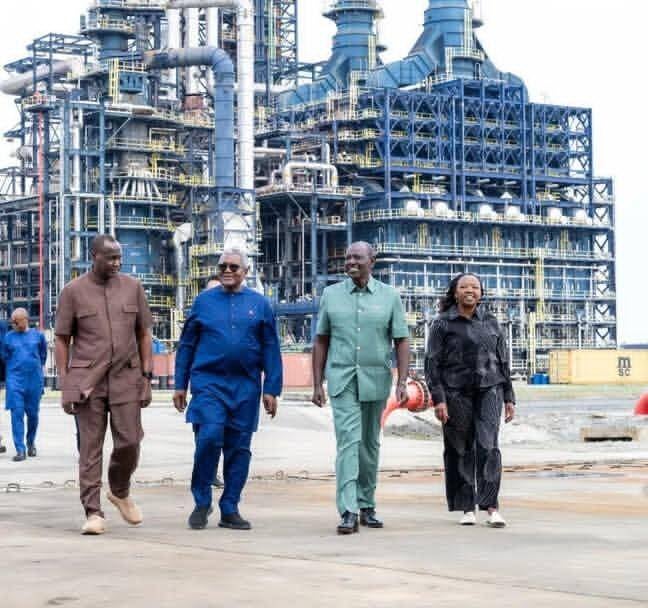
The proposed refinery is planned for Lamu County on Kenya's northeastern coast and is expected to have a capacity of 700,000 barrels per day. Kenyan President William Ruto had earlier said his government was fast-tracking administrative processes for the project to prevent delays in its construction and operation. Ruto made the statement during a visit to the Dangote Petroleum Refinery in Lekki, Lagos, ahead of the planned September 30 groundbreaking ceremony in Kenya. He said the Kenyan government had secured the land for the project and was working on other requirements to remove bureaucratic delays. Ruto described the refinery as a regional project that would support industrial activities in East Africa, create jobs, and improve technical skills in the region. Dangote Group founder Aliko Dangote had also said the proposed Kenyan refinery would be bigger than the existing Dangote refinery in Nigeria.
The planned refinery is part of a multibillion-dollar infrastructure project known as the Lamu Port-South Sudan-Ethiopia transport corridor, which includes railways, pipelines, a power plant, roads, and airports. The LAPSSET corridor is designed to connect Kenya's Lamu port to South Sudan and Ethiopia, opening up trade routes and economic opportunities across the region. The refinery is expected to reduce eastern Africa's dependence on imported refined petroleum products, a goal that has gained urgency as the region grapples with high fuel costs and supply chain disruptions. For Kenya, the project represents a significant opportunity to strengthen its position as an industrial and energy hub in East Africa. For Dangote, it is an opportunity to expand his refining empire beyond Nigeria and establish a presence in a market of over 300 million people.
But the land dispute has cast a shadow over the project's future. The 133 petitioners are not opposed to development in principle. Their grievance is specific: they say the project will displace them from land they have occupied and cultivated for years without adequate compensation or a resettlement plan. Their claim of long-standing occupation and cultivation raises complex questions about land tenure in Kenya, where customary land rights often coexist uneasily with formal title systems. The court will have to determine whether the petitioners' interests in the land are legally recognisable and, if so, what remedies are appropriate. The October 14 hearing will be the first opportunity for the court to examine the merits of their claims.
The timing of the court order is awkward for both Dangote and the Kenyan government. The groundbreaking ceremony had been planned as a major event, with President Ruto expected to attend alongside Dangote and other dignitaries. The ceremony was intended to signal the project's official launch and attract further investment. If it goes ahead despite the court order, it risks being seen as a defiant gesture that disregards the judiciary and the concerns of local residents. If it is cancelled or postponed, it will be a setback for a project that has been presented as a flagship of Kenya's industrialisation agenda. The company's decision to proceed with the ceremony, even as site activities are frozen, suggests it is trying to have it both ways: maintaining the symbolic momentum of the project while respecting the letter of the court order.
For the people of Lamu, the court order is a victory, albeit a temporary one. It gives them an opportunity to present their case before any irreversible damage is done to their land. For Dangote, it is a reminder that even the most ambitious projects cannot proceed without addressing the legitimate concerns of local communities. For the Kenyan government, it is a test of its commitment to the rule of law and the rights of its citizens. The October 14 hearing will determine whether the project proceeds as planned or whether the concerns of the 133 petitioners are sufficient to force a reconsideration of the project's design, compensation arrangements, and environmental safeguards. Until then, the land remains frozen, the groundbreaking remains uncertain, and the future of the $16 billion refinery hangs in the balance.
📩 Stone Reporters News | 🌍 stonereportersnews.com
✉️ info@stonereportersnews.com | 📘 Facebook: Stone Reporters News | 🐦 X (Twitter): @StoneReportNew | 📸 Instagram: @stonereportersnews
Add comment
Comments