

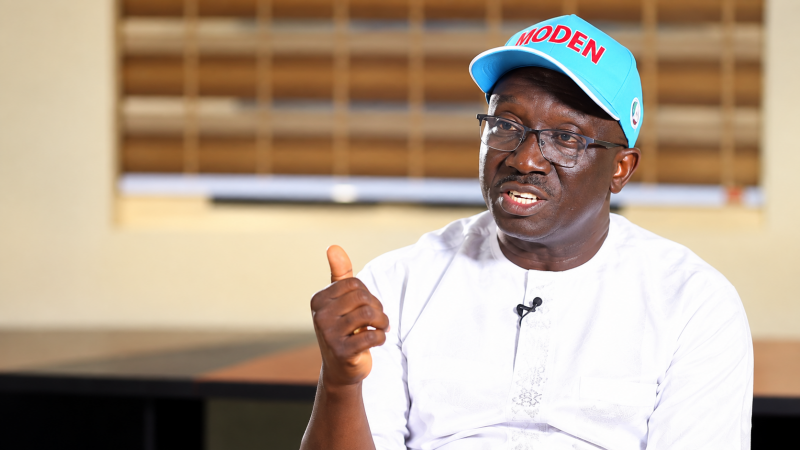
Edo State Governor Monday Okpebholo has said his administration inherited many roads in poor condition, insisting that the infrastructure problems currently confronting residents did not begin under his government while promising that his administration would work to make roads across the state motorable.
Okpebholo made the remarks on Monday, September 28, 2026, during a ward-to-ward mobilisation exercise in Egor and Oredo Local Government Areas of Edo State. The governor was accompanied by Deputy Governor Dennis Idahosa, Edo State All Progressives Congress Chairman Jarrett Tenebe, government officials and other party leaders.
“The bad roads in the State didn’t happen today, but the roads have been there before we came to power,” Okpebholo said.
He added that his government was working to address the situation.
“We would work to ensure all roads in the State are motorable. This is the reason why you voted for us,” the governor said.
His latest comments repeat an argument he has made since taking office in November 2024 — that his administration inherited significant infrastructure problems from the government of former Governor Godwin Obaseki.
During an inspection of failed roads in Edo Central in August 2025, Okpebholo made the allegation more directly, saying bad roads across Edo were among the problems inherited from Obaseki and the Peoples Democratic Party, which governed the state for eight years.
“Bad roads across Edo State are one of the things I inherited from former governor Obaseki and the PDP, for eight years they were in power,” Okpebholo said at the time.
The governor made those earlier comments while inspecting roads including the Onewa-Udomi-Ibhiolulu-Afada-Idumoza-Eko-Uwaya-Ewora corridor as well as failed sections of New Agbor Road and Illushin Road in Uromi, Esan North-East Local Government Area.
At Illushin Road, Okpebholo described the route as important because it connects different parts of the country and said his administration intended to intervene.
He also highlighted New Agbor Road in Uromi, describing it as an important economic route linking Edo with Agbor, Asaba, Onitsha and other parts of southern Nigeria.
Okpebholo’s claim about inherited infrastructure has, however, been part of an ongoing political disagreement between the APC administration and the opposition PDP in Edo.
The PDP has rejected attempts to place responsibility for the condition of roads entirely on the former Obaseki administration.
One example is the Benin-Asaba Expressway, where the PDP argued that the previous government had already initiated arrangements for reconstruction before leaving office.
The party said Obaseki signed a ₦228 billion concession agreement in January 2024 involving Triple A Infrastructure Nigeria Limited, InfraCorp and Africa Plus Partners for redevelopment of the expressway under the Federal Government’s Highway Development and Management Initiative.
That response demonstrates why Okpebholo’s statement that his government inherited bad roads should be presented as the governor’s assessment rather than an independent finding that the previous administration alone caused Edo’s road problems.
Road infrastructure develops over many years and can deteriorate because of construction quality, inadequate maintenance, drainage failures, heavy traffic, flooding and other factors.
Responsibility can also be divided between different levels of government because not every major road passing through Edo State belongs to the state government.
Some important highways are federal roads, meaning responsibility for their construction and major rehabilitation primarily rests with the Federal Government, although state governments sometimes intervene because residents depend on them.
Since assuming office, Okpebholo has made road construction and rehabilitation a prominent part of his administration’s SHINE Agenda.
In May 2026, the governor inspected several projects across Edo South, including the Ekiuwa-University of Benin Road, popularly called the Temboga Road Extension; Oba Erediauwa Road off Upper Mission Road; the Ikpoba Hill Flyover and erosion-control project; and the Adesuwa Flyover on Sapele Road.
Okpebholo said during that inspection that his government had made progress and expressed confidence that continued infrastructure investment would modernise the state before the completion of his first term.
Work has also continued on the Ramat Park Flyover, one of the administration’s major infrastructure projects in Benin City.
The project has been accompanied by road and drainage works around the Ikpoba Hill corridor. In June, project officials said the flyover had reached more than 95 percent completion, with streetlights, road markings, painting and junction expansion among the remaining works.
Other ongoing projects monitored by state officials in August included the Adesuwa Flyover, rehabilitation of the Benin-Sapele Road, the Benin-Sapele stormwater project, Evbukhu and Old Road construction, Ramat Park and Oghgeghe Road.
More recently, Okpebholo approved the revocation and re-award of the contract for the failed section of the Benin-Abraka Road at Ikpe Waterside in Orhionmwon Local Government Area.
The intervention followed protests by residents and youth leaders over the condition of the road. Deputy Governor Idahosa said the government had decided to act after the community raised concerns about difficulties experienced by motorists.
For Edo residents, however, arguments over which administration created or inherited a particular road problem are less consequential than whether those roads become safe and usable.
Bad roads affect more than driving comfort.
They can increase journey times, damage vehicles, raise transportation costs and make it more expensive for businesses to move goods. Rural communities can face additional difficulties transporting agricultural produce to markets, while poor drainage around damaged roads can worsen flooding during heavy rainfall.
The condition of roads can therefore directly affect household expenses and local economic activity.
Okpebholo’s administration says it recognises that challenge and has pledged to complete road projects within its tenure. His Special Adviser on Projects Implementation and Monitoring, Phoebe Williams-Bello, said in August that contractors remained on several sites despite difficulties created by the rainy season.
The administration has also recently blamed some road failures on what it described as substandard construction under the previous government and promised extensive repairs during the dry season. That remains the current government's assessment, and the allegation of poor-quality work should not be treated as established for every affected road without technical evidence identifying the causes of individual failures.
The political setting of Okpebholo’s latest statement is equally relevant.
He was speaking during APC mobilisation ahead of the 2027 general election and urged residents of Egor and Oredo to support APC candidates.
Okpebholo also said he was mobilising support for President Bola Tinubu’s re-election and stated that his party was working towards delivering 2.5 million votes for the president in Edo State. That figure is a political target announced by the governor, not an election forecast.
As campaigning intensifies, road infrastructure is likely to remain part of the political debate in Edo.
The governor can point to projects initiated or continued under his administration, while opposition parties can scrutinise their costs, completion rates and the government’s claims concerning infrastructure inherited from previous administrations.
For residents, a more practical assessment will be based on roads they use every day.
Okpebholo has acknowledged that many remain in poor condition and has promised that his administration will fix them. The effectiveness of that commitment can ultimately be measured through completed projects, construction quality, drainage, maintenance and whether previously difficult routes become reliably motorable.
The governor’s latest message is therefore twofold: he says his administration did not create Edo’s longstanding road problems, but he also accepts that fixing them is now the responsibility of the government he leads.
📩 Stone Reporters News | 🌍 stonereportersnews.com
✉️ info@stonereportersnews.com | 📘 Facebook: Stone Reporters News | 🐦 X (Twitter): @StoneReportNew | 📸 Instagram: @stonereportersnews
Add comment
Comments