

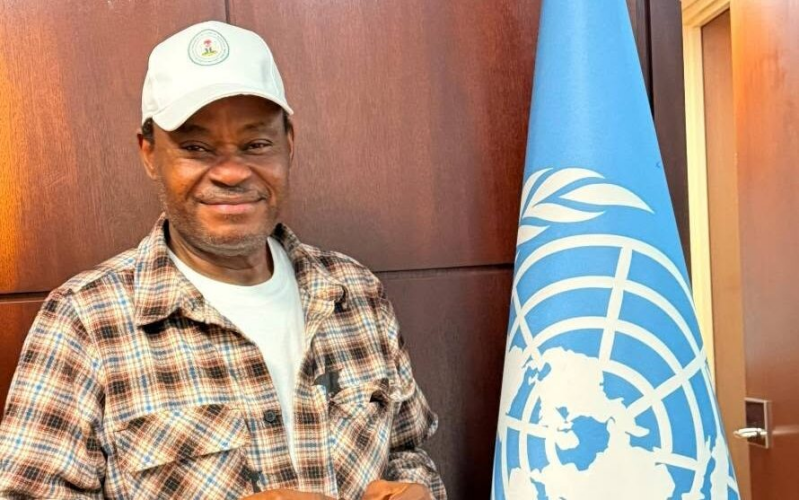
Nigeria’s Permanent Representative to the United Nations, Ambassador Jimoh Ibrahim, has defended President Bola Tinubu’s absence from the 81st United Nations General Assembly in New York, arguing that it would have been unnecessary for the President to travel for an address lasting about 15 minutes when many countries were represented by vice presidents and foreign ministers.
Ibrahim made the argument while discussing Nigeria’s participation at the UN gathering, where Vice President Kashim Shettima represented Tinubu and delivered Nigeria’s national statement. The envoy said more than 60 per cent of officials on the speaking list were being represented by vice presidents or foreign ministers rather than their presidents.
“What do you think President Tinubu is coming to do?” Ibrahim asked during an appearance on TVC’s Beyond The Headline.
“The presidents are allowed in the UN under UNGA for 15 minutes. Is that the reason why he should board the flight and be here for 15 minutes?”
Ibrahim argued that the quality of Nigeria’s diplomatic participation should not be measured solely by whether the President was physically present.
He said Shettima participated in high-level engagements and interacted with Nigerians in the diaspora, while other senior Nigerian officials were also involved in diplomatic activities surrounding the General Assembly.
The ambassador went further by saying that, had he been required to advise Tinubu shortly before the President travelled to New York, he would have considered the level of attendance by other heads of government.
According to him, the calculation would have been different if about 90 presidents were scheduled to participate personally.
He questioned the necessity of Nigeria’s President attending when many countries were represented by officials below presidential level.
Ibrahim said the presidents of several major countries were also absent from the gathering, citing South Africa, China and Russia while defending Nigeria’s decision to send Shettima.
His explanation is, however, different from saying the 15-minute speaking period was the Presidency’s original or sole official reason for Tinubu’s absence.
Before Ibrahim’s remarks, the Presidency had already explained that Tinubu was on annual leave and had mandated Shettima to lead Nigeria’s delegation.
Presidential aide Ademola Osodi also said Tinubu was concentrating on domestic concerns, including the economy and security, as well as other international engagements.
Osodi argued that the President’s absence from UNGA would not diminish Nigeria’s diplomatic standing.
The distinction is important because Ibrahim’s comments were primarily a defence of why presidential attendance was not necessary, rather than evidence that the United Nations’ speaking limit alone caused Tinubu to cancel his participation.
Tinubu had initially been expected to attend the General Assembly.
Earlier preparations and public comments had indicated that the President would travel to New York, with Ibrahim himself previously saying Tinubu had given assurances that he would attend.
The Presidency later confirmed that Shettima would represent him instead.
Tinubu's absence attracted criticism from opposition politicians, particularly former Vice President Atiku Abubakar and Peter Obi.
Atiku questioned why Tinubu had stayed away from the UNGA high-level gathering for a third consecutive year, arguing that presidential participation provides opportunities for bilateral discussions, investment negotiations and diplomatic engagements that extend beyond delivering Nigeria’s national statement.
He also raised questions about whether Tinubu’s absence had any connection with his past legal history in the United States.
The Presidency rejected that suggestion.
Osodi said there was “absolutely no impediment” preventing Tinubu from travelling to the United States and recalled previous occasions when the President had travelled through or visited the country.
Tinubu personally attended the 78th UN General Assembly in 2023 but did not attend the high-level sessions in 2024, 2025 or 2026. Shettima represented him on those three occasions.
Ibrahim dismissed suggestions that the latest absence weakened Nigeria’s presence at the United Nations.
He pointed instead to Nigeria’s seating position at the General Assembly, saying the country had secured a prominent front-row position.
“I promise that Nigeria will be on the front-row seat at UNGA. Are we not on the front-row seat?” Ibrahim said while defending the country's diplomatic standing.
The ambassador argued that Nigeria’s influence should be assessed through its participation in UN structures, negotiations and diplomatic engagements rather than the physical presence of one individual.
He also highlighted his role in the UN’s budget and administrative work, where he has been selected to chair the Fifth Committee for the 81st session.
Ibrahim said Nigeria intended to push reforms concerning how United Nations resources are distributed between the organisation's headquarters and member states.
His broader argument was that effective diplomacy involves continuous negotiation and institutional participation rather than simply appearing for a national speech during the annual General Debate.
The opposition argument focuses on a different aspect of UNGA.
Critics say the importance of the annual gathering extends beyond the limited time allocated for a national address.
Presidents and prime ministers commonly use the gathering to conduct bilateral meetings, meet investors, negotiate partnerships and engage directly with other world leaders.
Atiku therefore argued that Shettima's ability to represent Nigeria constitutionally and diplomatically did not necessarily eliminate the potential value of Tinubu’s personal participation.
Those competing positions form the central debate surrounding Tinubu's absence.
Ibrahim's argument is that Nigeria was adequately represented and that requiring the President to travel simply because UNGA was taking place would not automatically produce additional diplomatic benefits.
Critics argue that presidential attendance offers opportunities extending considerably beyond the formal speech.
Shettima nevertheless carried Nigeria’s mandate at the gathering.
Nigeria’s delegation used the session to articulate the country's positions on international security, economic development, climate issues, reform of global financial institutions and other international priorities.
The controversy also followed earlier attention surrounding Nigeria’s seating arrangements at the General Assembly.
Ibrahim had previously spoken about securing a prominent position for Nigeria and suggested that Tinubu would be seated close to United States President Donald Trump.
When Tinubu eventually did not attend, questions were raised about the relevance of that earlier claim.
Ibrahim responded that the important achievement was securing Nigeria’s position rather than determining which Nigerian official ultimately occupied the seat.
He maintained that Nigeria’s diplomatic status remained intact despite Tinubu’s absence.
For Nigerians assessing the competing explanations, one point is particularly important: there is no verified evidence that Tinubu stayed away because he was legally prevented from entering the United States.
The Presidency has expressly denied such claims, and no evidence establishing a US travel restriction against the President has been presented.
There are instead several publicly stated explanations.
The Federal Government said Tinubu was on annual or working leave; his foreign-affairs aide pointed to domestic priorities and other engagements; and Ibrahim argued that presidential attendance was unnecessary when Shettima could represent Nigeria and many other countries had also delegated their participation.
Ibrahim’s reference to a 15-minute speech should therefore be understood within that broader explanation.
He was not arguing that the UN General Assembly itself lacked importance. Rather, his position was that Nigeria did not require Tinubu’s physical presence to participate effectively when the Vice President and diplomatic delegation were already carrying the country's mandate.
Whether Nigerians find that explanation satisfactory remains part of the political debate.
What is established is that Shettima represented Tinubu, Nigeria participated in the 81st General Assembly, and Ibrahim maintains that the President's absence did not reduce the country's diplomatic standing.
His central defence was straightforward: with most delegations not necessarily being led by presidents and Nigeria already represented at senior level, he saw little justification for Tinubu to undertake the journey principally to deliver a speech lasting approximately 15 minutes.
📩 Stone Reporters News | 🌍 stonereportersnews.com
✉️ info@stonereportersnews.com | 📘 Facebook: Stone Reporters News | 🐦 X (Twitter): @StoneReportNew | 📸 Instagram: @stonereportersnews
Add comment
Comments