

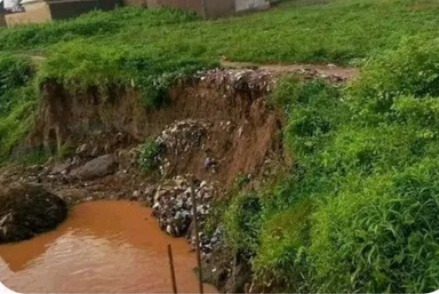
Residents of several communities in Kaduna State continue to face severe erosion, flooding and damaged access infrastructure, raising questions about how quickly government environmental investments are reaching vulnerable rural areas despite billions of naira committed to flood and erosion-control projects.
The problem cuts across different parts of the state, where damaged bridges, waterlogged roads, expanding erosion channels and inadequate drainage have disrupted movement to farms, schools, hospitals and markets, particularly during the rainy season.
One of the clearest examples is the Kibangari Bridge on River Kabene in Kauru Local Government Area, whose collapse cut off about 20 communities and exposed residents to dangerous river crossings.
The bridge, reportedly constructed during the administration of former President Shehu Shagari, had served communities in Kumana District for more than four decades before deteriorating and eventually collapsing.
Residents told the International Centre for Investigative Reporting that pedestrians, children, women and motorcyclists now require assistance to cross the damaged structure, with local youths charging between ₦100 and ₦500 depending on the load and water level.
Residents also reported previous deaths involving people attempting to cross the river during periods of high water.
For predominantly farming communities, the consequences extend beyond transportation.
Poor access can prevent farmers from moving produce to markets, make healthcare facilities harder to reach and force residents to travel considerably longer distances to conduct ordinary activities.
Bako Musa, a local government worker interviewed during the investigation, described travelling more than 60 kilometres while commuting between Geshere and Kauru because of poor road conditions.
Residents also complained about inadequate electricity, safe drinking water and healthcare services.
The situation illustrates how a damaged bridge can become more than an infrastructure problem: once a community's main connection fails, education, healthcare, agriculture and trade can all suffer simultaneously.
Similar concerns have emerged in Chikun Local Government Area.
Residents of Ligari and Agwa in Kudenda New Extension recently called for government intervention over a flooded route connecting their communities.
Footage circulated in September showing residents navigating a waterlogged crossing as schools prepared to reopen.
Available reporting did not establish that a formally designated “Ligari Bridge” had collapsed, but residents have previously requested an Agwa-Ligari link bridge, and the flooded route demonstrates the access difficulties communities experience during heavy rainfall.
Erosion itself remains another significant threat.
Residents of Rigasa have described years of flooding and gully erosion damaging homes and access roads.
Community members have attempted basic interventions themselves, including clearing drainage channels, removing refuse from waterways and filling developing erosion paths.
But residents acknowledge that the scale of the environmental problem has grown beyond what community action alone can control.
The Kaduna State Government has, however, begun major interventions that complicate any suggestion that authorities have simply failed to allocate significant resources to flood control.
In May 2026, the government, through the World Bank-supported Agro-Climatic Resilience in Semi-Arid Landscapes project, signed contracts worth more than ₦50 billion for flood and gully erosion-control projects.
The projects cover Rigasa/Tudun Wada, Kawo and Zaria township.
Three companies—Mothercat Nigeria Limited, CGC Nigeria Limited and Spectrum Engineering Limited—were announced as contractors following a procurement process the government described as competitive and transparent.
The largest publicly detailed intervention is the Rigasa–Tudun Wada Flood and Gully Erosion Control Project.
Governor Uba Sani formally launched the project in July.
The approximately 17.8-kilometre intervention costs more than ₦34 billion and stretches from Rigasa in Igabi Local Government Area to Tudun Wada in Kaduna South.
The state government said about ₦2 billion had also been paid in compensation to nearly 1,000 residents whose properties would be affected by construction.
According to the government, the project is intended to confront environmental problems that residents have experienced for approximately four decades.
Those figures mean it would be misleading to conclude solely from damaged bridges or continuing erosion that Kaduna has allocated little money to environmental intervention.
The more important questions concern where resources are targeted, how quickly projects are completed and whether communities outside the major intervention corridors receive adequate protection.
Kaduna's environmental challenge is geographically extensive.
A large project in Rigasa may substantially improve conditions there without immediately solving a collapsed bridge in Kauru or a flooded community route in Chikun.
The difference between statewide spending and local experience is therefore important when assessing government performance.
Kaduna has also recorded progress on some bridge projects.
In Giwa Local Government Area, the state government reconstructed the Store Bridge along the Marabar Yakawada–Kaya Road after residents had experienced access problems for more than two decades.
Residents said the reconstructed bridge restored access to farms, healthcare facilities and markets and reduced the isolation communities previously experienced during the rainy season.
Communities in Zaria and Sabon Gari have similarly praised the construction of the Anguwar Jaba–Kakiyayi Bridge.
Residents said the intervention addressed a problem that had existed for about four decades and had repeatedly isolated farming communities during rainy periods.
These completed projects demonstrate that Kaduna's infrastructure situation is not uniform.
Some communities are receiving new bridges and erosion-control infrastructure, while others continue to wait for interventions.
There are also older federal projects whose implementation history raises separate questions.
The Federal Government's Eyemark platform lists an emergency project for reinstatement of a washed-out bridge along the Kaduna-Mararraba-Saminaka-Jos Road.
The project carries a 2021 appropriation of ₦175 million but is currently listed on the platform as “Not Started,” with no amount shown as released or spent.
That is a federal project rather than a Kaduna State Government expenditure and should not be attributed to Governor Uba Sani's administration.
Another federal intervention was announced in 2022 for communities between Kibori and Kigudu Sabon Kaura in Zangon Kataf Local Government Area.
The Federal Government, through the Ecological Project Office, awarded a contract involving a bridge and erosion and flood-control works across River Kaduna intended to connect Zangon Kataf and Kauru local government areas.
Taken together, the records demonstrate why environmental infrastructure accountability requires more than quoting one budget figure.
A project may be budgeted without receiving full funding.
Money may be released without the project being completed.
A contract may be signed while construction remains ongoing.
Conversely, a community may continue experiencing erosion even while major interventions are underway elsewhere in the same state.
Residents therefore have legitimate reasons to ask not only how much government announces for flood control but where projects are located, how much money has actually been released, what percentage of construction has been completed and when vulnerable communities will see measurable results.
Kaduna's flood risk also remains significant.
Seasonal rainfall repeatedly places pressure on drainage systems, rivers, bridges and communities occupying vulnerable terrain.
Climate advocates in Kaduna have recently identified seasonal flooding, soil erosion, deforestation and poor waste management among environmental challenges requiring stronger government and community responses.
For affected residents, however, environmental policy becomes meaningful only when it produces practical protection.
A farmer whose bridge has collapsed needs a safe route to market.
A child should not have to negotiate a flooded crossing to reach school.
An ambulance should be able to enter a rural community during the rainy season, and residents should not risk drowning because a bridge connecting them to neighbouring communities has remained unusable.
The Kaduna government can point to more than ₦50 billion in recently contracted erosion and flood-control projects and completed bridges as evidence that significant intervention is underway.
Communities still living with collapsed infrastructure can equally point to conditions on the ground as evidence that substantial gaps remain.
The central accountability question is therefore not simply whether Kaduna is “spending” on flood control.
It is whether announced investments are being converted quickly, transparently and equitably into functioning drainage systems, protected communities, restored roads and safe bridges across the areas that need them most.
As another rainy season exposes weak infrastructure, residents in affected communities are asking for that difference between government investment and everyday experience to become increasingly visible on the ground.
📩 Stone Reporters News | 🌍 stonereportersnews.com
✉️ info@stonereportersnews.com | 📘 Facebook: Stone Reporters News | 🐦 X (Twitter): @StoneReportNew | 📸 Instagram: @stonereportersnews
Add comment
Comments