

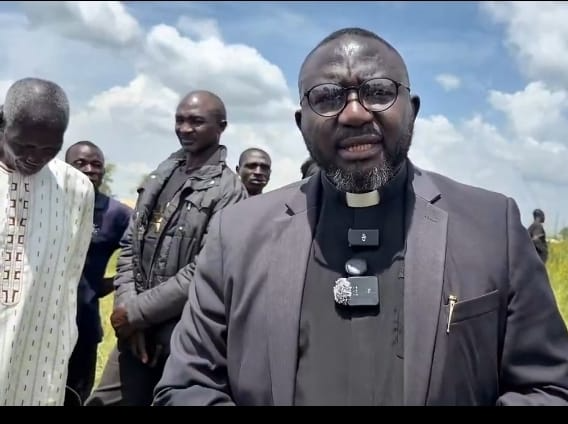
A senior leader of the Church of Christ in Nations has raised fresh concerns over attacks on Christian communities in Nigeria, saying years of violence have resulted in the destruction of villages, displacement of worshippers and the disappearance of entire church congregations in parts of the country's Middle Belt and North.
The remarks come amid continuing debate over how Nigeria's long-running insecurity should be characterised, particularly in Plateau State and other parts of the Middle Belt where communities have suffered repeated killings, displacement, destruction of homes and attacks on places of worship.
The church leader argued that the violence affecting Christian communities should not be dismissed simply as ordinary farmer-herder conflict or competition over land and natural resources.
“We've lost entire villages and congregations,” he said, portraying the crisis as part of a prolonged pattern of attacks against Christian communities.
Such claims remain politically and socially contested in Nigeria.
Christian organisations and some community leaders have repeatedly described attacks in parts of Plateau, Benue and other Middle Belt states as religious persecution, with some going further by alleging an organised campaign to eliminate predominantly Christian communities.
The Nigerian government has rejected broad claims that it supports or deliberately ignores the killing of Christians, maintaining that terrorism, banditry and communal violence affect Nigerians of different religions.
Independent research shows that Nigeria's security crisis cannot be explained by a single cause.
Boko Haram and Islamic State West Africa Province have carried out explicitly Islamist attacks, including attacks on churches and Christian communities, while also killing large numbers of Muslims, security personnel and other civilians.
Middle Belt violence has additional dimensions involving land, grazing routes, farming, ethnicity, organised criminality, displacement, revenge attacks and weak law enforcement.
The experience of the Church of Christ in Nations, commonly known as COCIN, nevertheless demonstrates that Christian institutions have suffered serious attacks.
On February 26, 2012, a suicide bomber attacked COCIN's headquarters in Jos, Plateau State, during Sunday worship.
Contemporary reports said at least three people were killed and dozens injured.
Boko Haram claimed responsibility for the bombing, according to Christian Solidarity Worldwide, while other contemporary reporting also connected the attack to the Islamist insurgency then carrying out increasingly deadly operations across northern Nigeria.
The attack occurred during an especially violent period.
An International Crisis Group report documented three suicide bombings in Jos between December 2011 and March 2012 and identified COCIN headquarters and St Finbarr's Catholic Church among the religious institutions targeted.
The violence contributed to heightened security measures and fears among worshippers across Plateau State.
Human Rights Watch also documented the February 2012 COCIN bombing as part of a wider series of attacks on religious institutions during the Boko Haram insurgency.
In April that year, gunmen attacked Christian worship services at Bayero University in Kano, while another attack on a COCIN church in Maiduguri reportedly killed the pastor and four other people.
More than a decade later, COCIN leaders continue to complain that Christian communities remain vulnerable.
Rev. Ezekiel Dachomo, a prominent COCIN regional leader in Plateau State, has become one of the most outspoken religious figures making that argument.
Dachomo has accused Nigerian authorities of failing to properly acknowledge the scale and religious dimension of killings affecting Christian communities.
He has said he is compiling evidence involving victims, survivors, destroyed communities and mass burials for possible submission to international institutions.
Those allegations are Dachomo's position and have not themselves established that the Nigerian government is legally responsible for the attacks or that every incident he cites was motivated solely by religion.
The distinction matters because Plateau's violence has involved different perpetrators, motives and victims over many years.
Religious identity frequently overlaps with ethnic and occupational identities: many farming communities are predominantly Christian, while many Fulani pastoralists are Muslim.
Consequently, an attack connected to land, cattle, revenge or organised crime can also acquire an ethnic or religious dimension.
That complexity has produced competing descriptions of the crisis.
Christian leaders have argued that focusing primarily on “farmer-herder clashes” can obscure cases in which churches or overwhelmingly Christian communities appear to have been deliberately targeted.
Others caution against treating Fulani people generally as responsible for attacks committed by armed groups, pointing out that Fulani civilians have themselves been killed, displaced or victimised by criminal organisations.
The distinction between identifying particular perpetrators and assigning collective responsibility to an ethnic or religious population remains essential.
Rev. Sylvester Dachomo, who was elected COCIN Deputy General Secretary in September 2026, has himself publicly addressed Plateau's religious divisions.
At a Plateau Peace Architecture Forum in Jos in August, he said human life must be protected and called for religious tolerance and peaceful coexistence.
He acknowledged that Plateau had experienced different forms of conflict but argued that citizens should live together despite religious differences.
The forum brought Christian and Muslim leaders together to discuss religious freedom and preventing the manipulation of young people for violence ahead of the 2027 elections.
Sylvester Dachomo's election as COCIN Deputy General Secretary came during an emergency General Church Council meeting at the denomination's headquarters in Jos.
He received 161 votes out of 305 delegates, defeating Rev. James Ayizeh, who received 118, and Rev. Associate Professor Caleb Dami, who received 26.
COCIN has repeatedly called on the Federal Government to strengthen security.
The denomination's leadership has condemned attacks on churches and communities as well as increasing kidnapping, while urging members to remain vigilant and work toward peace rather than inflaming religious tensions.
That position illustrates the difficult balance facing religious leaders in Plateau.
They are expected to speak for communities that have experienced genuine killings and displacement while avoiding rhetoric that could assign collective guilt to another ethnic or religious population and contribute to retaliatory violence.
The debate over whether Christians are specifically being persecuted in Nigeria therefore cannot be resolved simply by denying that religiously motivated attacks occur or by treating every violent incident as evidence of one nationwide religious campaign.
Boko Haram's history provides documented examples of an Islamist organisation deliberately attacking churches, Christian worshippers and other targets.
At the same time, the insurgency has also killed Muslims and attacked mosques and predominantly Muslim communities.
Violence in Plateau presents an additional layer of complexity because longstanding disputes over land, political representation, farming, grazing, ethnicity and displacement operate alongside religious identity.
What is beyond dispute is the human cost.
Families have been killed, villages abandoned, churches destroyed, livelihoods lost and thousands of people displaced during years of insecurity in Plateau and other affected states.
Determining who carried out individual attacks and why remains the responsibility of security agencies and courts.
For affected communities, however, repeated violence without arrests or successful prosecutions can create the perception that their suffering is being ignored.
That makes transparent investigation particularly important.
Where evidence establishes that an attack was motivated by religious hatred, authorities should acknowledge that dimension.
Where evidence demonstrates that an attack resulted from organised crime, land disputes, revenge or another motive, that should similarly be reported accurately.
The government's credibility ultimately depends less on the terminology used to describe Nigeria's insecurity than on whether perpetrators are identified, victims are protected, displaced people can safely return home and those responsible for killings are prosecuted.
For COCIN and other churches that have buried members and rebuilt after attacks, the memories of incidents such as the 2012 bombing in Jos remain part of their understanding of today's insecurity.
The continuing disagreement is over how those documented attacks connect to the broader violence that has followed.
Resolving that disagreement requires evidence rather than generalisation — while recognising that behind arguments over words such as terrorism, persecution, communal conflict and genocide are communities that have experienced real deaths, destruction and displacement.
📩 Stone Reporters News | 🌍 stonereportersnews.com
✉️ info@stonereportersnews.com | 📘 Facebook: Stone Reporters News | 🐦 X (Twitter): @StoneReportNew | 📸 Instagram: @stonereportersnews
Add comment
Comments