

Reported by Ariajegbe Sylvia Esezobor
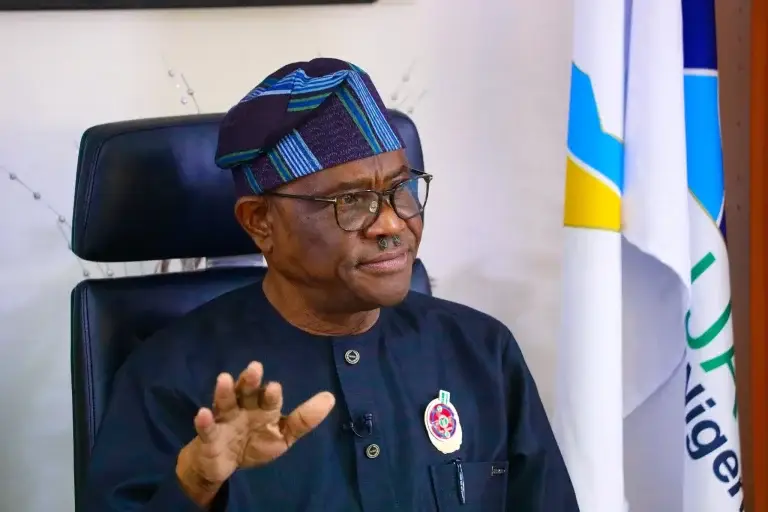
The Minister of the Federal Capital Territory, Nyesom Wike, has declared that he will step down from his cabinet position if President Bola Ahmed Tinubu fails to secure victory in both the Federal Capital Territory and Rivers State in the 2027 presidential election, setting a specific timeline for his resignation in what amounts to the most direct personal stake any minister has placed on the President’s re-election bid.
Wike made the declaration on Tuesday during an engagement with the leadership and members of the Apo Mechanics and Traders Association in Abuja, where the association had sought the FCT Administration’s intervention over plans to relocate their workshop to the Wasa District. According to a statement issued on Wednesday by his Senior Special Assistant on Public Communication and Social Media, Lere Olayinka, Wike said his continued tenure as a cabinet minister was directly tied to his ability to deliver political results for the President in the territories where he exercises primary political influence. “If I cannot deliver where I work, then I’m not worthy to be here,” Wike said. “If I lose FCT, I’m not supposed to be FCT Minister. By January 17, 2027, I will announce my resignation as FCT Minister should the President lose in Rivers State and the FCT”. He described Rivers State as his home and Abuja as his place of work, saying he could not afford to lose in both.
The declaration came with a detailed outline of Wike’s political strategy for the FCT, where he said the administration was building a multi-party coalition to secure victory across various elective offices. He explicitly endorsed candidates across legislative tiers while reiterating total support for the President’s re-election bid. “Let us be clear on direction: for the Presidency, it is Bola Ahmed Tinubu! For the Senate, Philip Aduda is a man of the people, unlike those who only appear on television. The two House of Representatives candidates we are supporting are also here. They are former Area Council chairmen,” Wike said. “In the FCT, we are running a unified coalition across parties to deliver results. If I cannot deliver FCT as Minister, then I am not qualified to hold this office. We have a firm agreement, and today is the final affirmation”.
The statement marked the latest and most dramatic expression of a role Wike has been consolidating for months. On September 25, he announced that he would personally inaugurate and lead Tinubu’s campaign machinery in both the FCT and Rivers State, saying the machinery was ready and would be fully activated shortly. “For us who are supporting Mr President from different political platforms, we have put our machinery ready to kickstart fully. Very soon, I will inaugurate the campaign team for Tinubu in the FCT and Rivers State, which I will lead,” he said at the time. He has consistently linked his support for the President to the infrastructure delivery agenda in the FCT, arguing that visible development projects would translate directly into votes. “This is governance, and this is what people expect. It will translate directly into actual votes,” he said. He has also dismissed the possibility of electoral malpractice in the FCT, saying, “Nobody will be able to claim rigging in the FCT. The ‘rigging’ is the projects we are delivering”.
Wike’s political position is one of the most unusual in Nigeria’s current configuration. He remains a card-carrying member of the opposition Peoples Democratic Party while serving as a minister in a federal government led by the All Progressives Congress, a contradiction that has drawn scrutiny from across the political spectrum. His involvement in the 2023 election, when he and the other members of the G5 governors withheld support from the PDP’s presidential candidate, Atiku Abubakar, was widely credited with helping Tinubu secure victory in Rivers State and other parts of the South-South. In September, Wike publicly disclosed that the G5 governors deliberately allowed Peter Obi to win in Edo and Cross River states to deny Atiku votes, but deliberately prevented Obi from winning in Rivers because it would have sent what he described as a “wrong signal”. The disclosure prompted civil society organisations to demand an investigation, with the Resource Centre for Human Rights and Civic Education saying it raised serious questions about the role of powerful political actors in shaping electoral outcomes.
Wike’s relationship with the APC governors has also been strained by his Rainbow Coalition, a cross-party movement he founded to mobilise support for Tinubu’s re-election while allowing politicians to contest other elections under different party platforms. The Progressive Governors’ Forum, led by Imo State Governor Hope Uzodimma, rejected the coalition, describing it as a political arrangement capable of undermining the party and its candidates, and accused Wike of deploying it to support politicians who lost APC primaries. Wike responded by describing the governors as “politically lazy” and insisting the coalition was not an APC structure but a vehicle for Tinubu’s re-election. In September, he also warned that Rivers State Governor Siminalayi Fubara would not get a second term, saying his political career would come to an end if Fubara secured re-election in 2027.
The resignation pledge carries both political and personal significance. By staking his ministerial position on the outcome of the presidential vote in two specific territories, Wike is presenting himself as a leader who accepts accountability for results rather than merely claiming credit for proximity to power. It is a high-risk strategy: the FCT and Rivers State are two of the most complex political battlegrounds in the country, and victory in both is not guaranteed. Rivers State, in particular, has been the scene of a bitter political feud between Wike and Fubara that has split the state’s political establishment and complicated the APC’s prospects. The FCT, while traditionally favourable to the ruling party, has a diverse electorate that includes civil servants, traders and residents from across Nigeria whose voting patterns are difficult to predict.
The declaration also places additional pressure on President Tinubu’s campaign in the South-South and the FCT, and it raises the stakes for Wike’s own political future. If Tinubu wins both territories, Wike will have delivered on his promise and consolidated his position as one of the most consequential political operators in the country. If he loses either, he will be bound by his own words to resign, an outcome that would remove him from the cabinet and potentially diminish his influence ahead of the 2027 governorship and state assembly elections. Whether Wike’s resignation pledge is a calculated bet on an outcome he believes is inevitable or a genuine expression of accountability will be tested when Nigerians go to the polls on January 16, 2027. For now, he has made his position unambiguous: if he cannot deliver where he works, he is not worthy to be there.
📩 Stone Reporters News | 🌍 stonereportersnews.com
✉️ info@stonereportersnews.com | 📘 Facebook: Stone Reporters News | 🐦 X (Twitter): @StoneReportNew | 📸 Instagram: @stonereportersnews
Add comment
Comments