

Reported by: Ijeoma G | Edited by: Oravbiere Osayomore Promise.
Vice President Kashim Shettima said President Bola Ahmed Tinubu’s reforms saved Nigeria from collapse, arguing that the administration inherited a country facing severe fiscal pressures and had to take difficult decisions to prevent a deeper crisis.
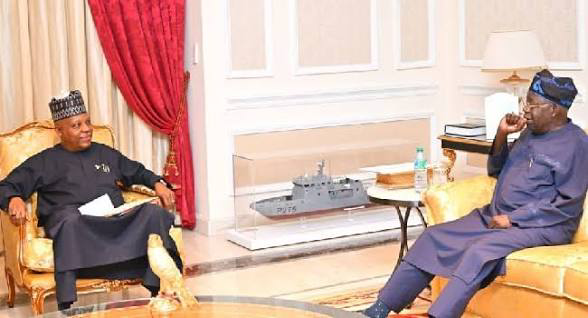
Shettima made the remarks on Saturday, October 3, 2026, after meeting Tinubu at the President’s residence in Lagos. The meeting came days after Tinubu returned to Nigeria from his annual vacation in Europe and resumed public engagements.
Defending the administration’s economic record, Shettima said Nigeria’s foreign reserves were below $3.9 billion when Tinubu assumed office in May 2023. He argued that the figure was insufficient to cover even one month of fuel imports and reflected the severity of the economic situation inherited by the government.
According to the Vice President, Tinubu’s decision to remove the petrol subsidy and change the multiple foreign exchange rate system were among the most consequential steps taken by the administration. Shettima described the decisions as painful but necessary measures that, in his assessment, prevented the economy from moving towards a much more severe breakdown.
“The economy was actually teetering on the verge of collapse; he saved the economy,” Shettima said, adding that Nigeria had been “on the road to Caracas” before the reforms were implemented. He said Tinubu had the courage and conviction to make decisions that previous administrations had avoided.
The Vice President’s comments echoed a broader defence of the administration’s economic programme. Tinubu himself said in May that the removal of the fuel subsidy had saved Nigeria from imminent bankruptcy, arguing that the policy had become financially unsustainable and was consuming resources that could otherwise have been directed towards development.
The Tinubu administration removed the petrol subsidy shortly after taking office in May 2023, while subsequent reforms changed the way foreign exchange was managed. The measures contributed to major changes in fuel prices, transport costs and the value of the naira, producing significant pressure on households and businesses.
Shettima acknowledged the hardship associated with the reforms and said the government was aware of the difficulties faced by Nigerians. He appealed for patience, arguing that the immediate pain should be considered alongside the administration’s stated objective of creating a more sustainable economy.
“We appreciate the pains Nigerians are going through, but tough times do not last forever; tough people do,” he said.
The Vice President said the Federal Government was preparing additional measures intended to reduce the impact of high transportation costs and other economic pressures. Among the initiatives he announced was an e-logistics programme expected to be launched in the North-East in the coming weeks.
Shettima said the programme would include 10,600 electric tricycles, as well as 300 buses and electric taxis. He said the initiative was designed to ease transportation difficulties and reduce some of the burden created by rising mobility costs.
Shettima also pointed to the Nigerian Education Loan Fund as another intervention intended to support Nigerians affected by economic pressures. He said the administration remained concerned about ensuring that students from families with limited resources were not prevented from obtaining tertiary education because of financial difficulties.
The Vice President described Tinubu as a leader who has empathy for ordinary Nigerians and said the government would continue to introduce programmes aimed at cushioning the effects of its reforms. He maintained that the administration’s economic strategy should be assessed in the context of the conditions it inherited in 2023.
Government officials have cited macroeconomic indicators as evidence that the reforms are beginning to produce results. In October 2025, Shettima said Nigeria’s external reserves had risen to about $43 billion, while the debt-service-to-revenue ratio had fallen below 50 per cent. He also said GDP growth had reached 4.23 per cent.
In May 2026, the Presidency again defended the reforms, saying they had rescued Nigeria from looming fiscal collapse. The government cited increased revenue, changes in fiscal management and improved capacity at the state level as evidence of progress.
However, the administration’s assessment remains contested by opposition politicians and other critics, who have focused on the impact of inflation, food prices, unemployment, insecurity and the broader cost-of-living crisis. The debate reflects a central tension surrounding Tinubu’s economic programme: whether the short-term hardships associated with the reforms are being sufficiently offset by improvements in fiscal stability and economic growth.
Opposition figures have argued that economic gains cited by the government have not translated quickly enough into improved living conditions for many Nigerians. The government, for its part, has maintained that reforms require time to deliver broad-based benefits and that reversing them could recreate the fiscal problems it says necessitated the policies in the first place.
Shettima’s latest remarks therefore represent another effort by the administration to frame the reforms as measures of economic rescue rather than simply austerity policies. His argument is that Nigeria faced a serious fiscal threat in 2023 and that decisive action was required to prevent a larger crisis.
The Vice President also said Tinubu and he remained in regular contact during the President’s recent stay abroad, dismissing concerns that the President’s absence had disrupted government business. According to Shettima, technological advances allowed the President to remain engaged with developments in Nigeria.
He said Tinubu’s return would allow the administration to focus further on governance even as political activity intensifies ahead of the 2027 general elections. Shettima said the government would combine political activities with its responsibilities to Nigerians.
For the administration, the immediate challenge is to translate the claimed gains from economic reforms into tangible improvements in household welfare while maintaining the fiscal changes it says were necessary. For Nigerians, the continuing debate is likely to centre on whether the promised benefits of the reforms can be felt more widely and quickly.
Shettima’s declaration that Tinubu saved the economy from collapse is ultimately the government’s assessment of the reforms and their consequences. It comes as the administration seeks to defend its economic record while acknowledging that millions of Nigerians continue to experience significant financial pressure.
The Federal Government has promised that more interventions will follow, including transportation initiatives and other programmes designed to ease the cost of living. Whether those measures can provide meaningful relief while sustaining the government’s strategy will remain an important test of the administration’s reform agenda as it moves towards the final years of Tinubu’s first term.
📩 Stone Reporters News | 🌍 stonereportersnews.com
✉️ info@stonereportersnews.com | 📘 Facebook: Stone Reporters News | 🐦 X (Twitter): @StoneReportNew | 📸 Instagram: @stonereportersnews
Add comment
Comments