

Reported by Ariajegbe Sylvia Esezobor
The Nigerian Economic Society has urged governments at all levels to prioritise credible budgeting, sustainable revenue generation and transparent public spending to ensure that the benefits of the country's economic reforms translate into improved living conditions for ordinary Nigerians, warning that borrowing must be tied to productive investments so that future generations inherit valuable assets rather than unsustainable liabilities.
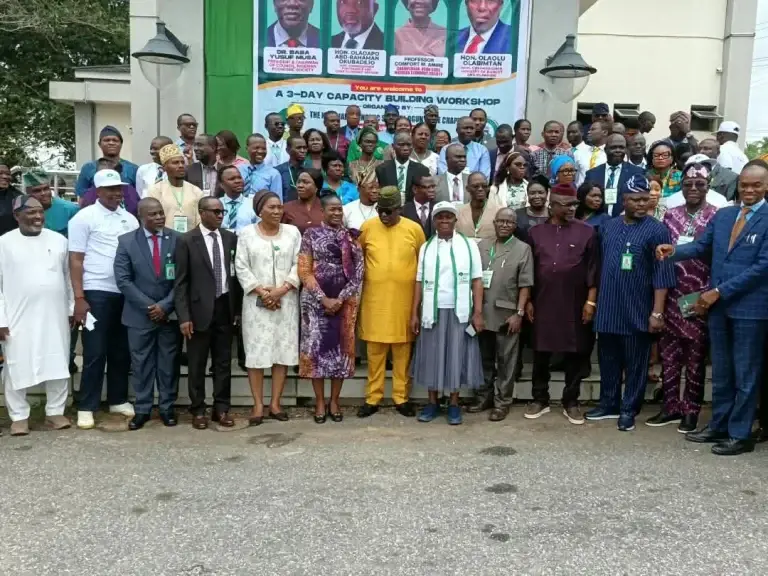
The call was made by the President of the NES, Dr Baba Musa, who was represented by the Chairperson of the Ogun State chapter of the association, Professor Comfort M. Amire, during a three-day capacity-building workshop organised by the society in collaboration with the Ogun State Ministry of Budget and Planning. The workshop, themed "Framework for Fiscal Management, Effective Governance and Sustainable Development in Ogun State," was held at MITROS Residence, Ibara GRA, Abeokuta, and brought together public servants, policymakers and economic experts to strengthen the capacity of institutions responsible for fiscal management in the state. Musa described the workshop as timely, noting that effective fiscal management was critical to ensuring that the gains of Nigeria's ongoing economic reforms translated into tangible benefits for citizens.
At the heart of the society's message was a simple but consequential proposition: the size of a budget matters far less than its credibility. "A budget is not a wish list; it is a promise to the people," Musa said. "The measure of a good budget is not its size but its credibility." He called on governments to pay particular attention to realistic revenue forecasting, disciplined budget execution and honest mid-year performance reviews to ensure that budgetary commitments were met. The society noted that although reforms including changes to fuel subsidies and foreign exchange management had created opportunities for stabilisation, their sustainability depended largely on prudent fiscal management by federal and state governments. "Monetary policy alone cannot deliver the infrastructure, education, healthcare, water supply and employment opportunities needed to improve citizens' welfare," Musa said. "This is where fiscal management becomes decisive." He emphasised that the efficient planning, spending and accounting of public resources would determine whether ordinary Nigerians felt the benefits of economic reforms in their daily lives.
On revenue generation, the NES president urged the Ogun State Government to strengthen its internally generated revenue through efficient, fair and technology-driven tax administration rather than imposing multiple levies that could discourage investment. He also defended responsible borrowing, arguing that loans could support development when invested in productive infrastructure capable of generating economic returns. "Borrowing is not wrong in itself. Debt that finances productive infrastructure can pay for itself many times over. But it must be matched to projects with clear returns, kept within sustainable limits and reported transparently," Musa said. "Future generations should inherit assets from us, not only liabilities." The society further stressed the importance of transparency in public financial management, arguing that the timely publication of budget performance reports, debt statistics and procurement information would strengthen public confidence and attract investors and development partners. Musa urged public servants responsible for preparing budgets, monitoring projects and advising decision-makers to uphold professionalism and integrity, noting that the success of government programmes depended significantly on their competence and commitment.
The NES assured the Ogun State Government of its readiness to provide technical support in areas including evidence-based research, fiscal framework reviews, budget analysis, debt sustainability assessments, revenue studies and further capacity-building programmes. Musa said the society hoped the collaboration would become an enduring partnership and serve as a model for cooperation between professional bodies and state governments across the country.
The context of the society's intervention is the fiscal transformation that has reshaped Nigeria's subnational finances since the removal of the petrol subsidy in May 2023. Federation revenues rose by 69 per cent in real terms between 2023 and 2025, with states emerging as the largest beneficiaries, according to the World Bank's October 2026 Nigeria Development Update. Aggregate state revenues increased by approximately 93 per cent in real terms, while capital spending rose by 151 per cent. Twenty-nine of 33 states shifted spending towards economic infrastructure, and internally generated revenue grew in real terms in 31 of 35 states. Yet the World Bank also found that while spending on health, education and social protection rose substantially, it grew more slowly than spending on economic infrastructure, and education's share of total expenditure declined. The World Bank's Country Director for Nigeria, Mathew Verghis, said strengthening spending efficiency, accountability and service delivery would be essential to ensuring that public resources improved the lives of Nigerians.
The NES intervention also comes amid broader concerns about fiscal transparency in Nigeria. The country failed to meet the United States' minimum fiscal transparency requirements for the second consecutive year, according to the 2026 Fiscal Transparency Report, which identified approximately two per cent of GDP in unrecorded, off-budget public spending. The Budget Office of the Federation has acknowledged that approved budgets do not always translate into performance, as fund releases can be opaque and untraceable. Civil society organisations, including BudgIT, have called for states to publish complete and timely budget implementation reports using a standard reporting format, and for social sector spending to be protected during fiscal shocks. The Minister of Finance and Coordinating Minister of the Economy, Taiwo Oyedele, has also urged state governments to strengthen their internally generated revenue, attract investments and create jobs rather than rely heavily on federal allocations, while advocating prudent borrowing and greater transparency in public finance.
The political context of the society's message is significant. The 2027 general elections are less than four months away, with the presidential and National Assembly elections scheduled for January 16, and the governorship and state assembly elections for February 6. President Bola Ahmed Tinubu is seeking a second term on the All Progressives Congress platform, while former Vice President Atiku Abubakar of the African Democratic Congress, former Anambra Governor Peter Obi of the Nigeria Democratic Congress and Oyo State Governor Seyi Makinde of the Allied Peoples Movement are among the major challengers. The economy and the cost of living have emerged as the central issues in the campaign, and the NES intervention places pressure on both federal and state governments to demonstrate that the increased revenues flowing to them are being managed prudently and transparently. As Musa put it, a budget is not a wish list but a promise to the people, and the measure of a good budget is not its size but its credibility.
📩 Stone Reporters News | 🌍 stonereportersnews.com
✉️ info@stonereportersnews.com | 📘 Facebook: Stone Reporters News | 🐦 X (Twitter): @StoneReportNew | 📸 Instagram: @stonereportersnews
Add comment
Comments