

Reported by Ariajegbe Sylvia Esezobor
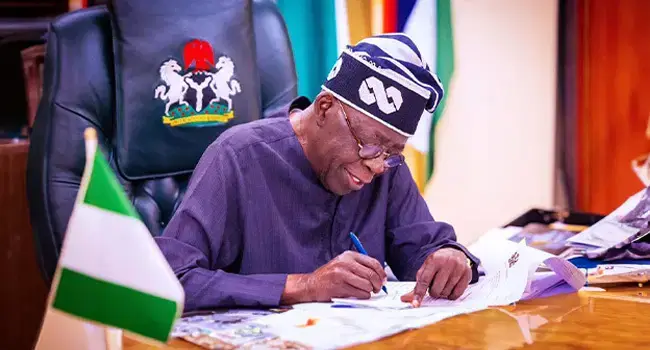
President Bola Ahmed Tinubu has transmitted five executive communications to the Senate for consideration, including proposed legislation to reform the National Drug Law Enforcement Agency, expand the mandate of the Nigerian Safety Investigation Bureau, and establish a National School of Government, in a broad legislative package that touches on drug enforcement, transport safety, public sector training and international humanitarian law.
The communications were conveyed in separate letters read on Tuesday by the Senate President, Godswill Akpabio, during plenary, in accordance with the provisions of the 1999 Constitution, as amended. Akpabio subsequently referred the bills to the Senate Committee on Rules and Business for further legislative action.
The first proposal, the National Drug Law Enforcement Agency Bill 2026, seeks to repeal the existing NDLEA Act and the Indian Hemp Act, both contained in the Laws of the Federation of Nigeria 2004, and establish a consolidated legal framework for combating the cultivation, processing, sale, trafficking and use of illicit drugs. The bill is also designed to strengthen the agency's powers, including its capacity to investigate individuals suspected of involvement in drug-related activities. "The National Drug Law Enforcement Agency Bill 2026 seeks to repeal the National Drug Law Enforcement Agency Act, Cap. N30, and the Indian Hemp Act, Cap. I16, Laws of the Federation of Nigeria 2004, and to enact a consolidated framework to enforce the law against the cultivation, processing, sale, trafficking and use of hard drugs," Tinubu stated in the letter. The President urged the Senate to give the bill expeditious consideration.
The second proposal, the Nigerian Safety Investigation Bureau Amendment Bill 2026, seeks to amend the Nigerian Safety Investigation Bureau (Establishment) Act No. 35 of 2022 to reposition the bureau as an independent, multimodal safety investigation authority. The amendment would expand the bureau's mandate beyond aviation accidents to cover occurrences involving rail, maritime and other modes of transportation. It also proposes transferring supervisory oversight of the bureau to the Presidency and strengthening its institutional, operational, administrative and constitutional framework. The proposed expansion comes amid renewed attention to transport safety following the October 5, 2026 crash of a Nigerian Air Force ATR-42 aircraft near Igbokoda in Ondo State, which killed 32 people. The Senate has since called for a comprehensive investigation into the crash and an audit of military aircraft serviceability and maintenance funding.
The third proposal, the National School of Government Bill 2026, seeks to repeal the Administrative Staff College of Nigeria Act and establish a National School of Government. The proposed institution is intended to serve as a national centre for governance training, public sector capacity development, leadership development, policy delivery and institutional strengthening. The bill reflects an effort to modernise the training of public servants and strengthen the capacity of government institutions to deliver on their mandates.
The fourth proposal, the Geneva Conventions and Additional Protocols Bill, seeks to repeal the existing Geneva Conventions Act and give effect in Nigeria to the four Geneva Conventions of 1949 and their two Additional Protocols of 1977, which provide for the protection of victims of armed conflict. The fifth proposal, the Rome Statute of the International Criminal Court (Enforcement) Bill, seeks to domesticate the Rome Statute and establish a framework for the enforcement and punishment of genocide, crimes against humanity, war crimes and related offences. It also provides for Nigeria's cooperation with the International Criminal Court in the performance of its functions.
In addition to the five bills, the Senate received notification of President Tinubu's assent to two amendment bills providing for the inclusion of federal universities in Yaba, Lagos, and Kaduna in the relevant laws governing federal universities of technology. Akpabio said the Federal University of Technology Amendment No. 2 Bill, 2026, provides for the inclusion of the Federal University of Technology and Vocational Studies in Yaba in the relevant Act, while the Federal University of Technology Amendment Bill, 2026, seeks to amend the Federal Universities of Technology Act to include the Federal University of Technology and Vocational Studies in Kaduna. The documents were referred to the Clerk to the National Assembly for further action, and Akpabio commended Tinubu for assenting to the bills, describing the development as an important step towards promoting education in Nigeria.
The legislative package comes amid a broader context of security and institutional reform. Nigeria remains a source, transit and destination country for illicit drugs, with trafficking networks dealing in substances ranging from cannabis and cocaine to methamphetamine and other synthetic drugs. The United Nations Office on Drugs and Crime reported in its 2025 assessment that methamphetamine production capacity in Nigeria had increased by more than 40 per cent since 2020, and highlighted rising seizures of synthetic drugs across West Africa and the region's continuing role as a transit corridor for cocaine trafficking between Latin America and Europe. The NDLEA has said it arrested more than 18,500 suspected drug offenders and seized over 2.6 million kilogrammes of illicit substances in 2024. The proposed legislation is intended to strengthen the legal framework for enforcement and investigation.
The political context of the legislative push is significant. The 2027 general elections are less than four months away, with the presidential and National Assembly elections scheduled for January 16, and the governorship and state assembly elections for February 6. President Tinubu is seeking a second term on the All Progressives Congress platform, while former Vice President Atiku Abubakar of the African Democratic Congress, former Anambra Governor Peter Obi of the Nigeria Democratic Congress and Oyo State Governor Seyi Makinde of the Allied Peoples Movement are among the major challengers. The bills transmitted to the Senate form part of the administration's legislative agenda and will require consideration and passage by the National Assembly before they can become law. For Nigerians, the proposed reforms to drug enforcement and transport safety investigations could have direct implications for public safety and the integrity of critical institutions. The coming weeks will determine whether the Senate prioritises the bills and how quickly they move through the legislative process.
📩 Stone Reporters News | 🌍 stonereportersnews.com
✉️ info@stonereportersnews.com | 📘 Facebook: Stone Reporters News | 🐦 X (Twitter): @StoneReportNew | 📸 Instagram: @stonereportersnews
Add comment
Comments