

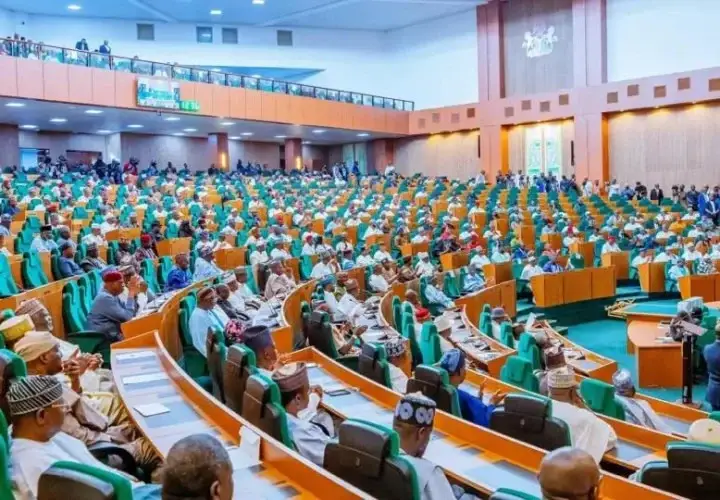
Nigeria's lawmakers have delivered a blunt message to the country's regulator of computer professionals: do not count on government money alone.
The House of Representatives Committee on Federal Polytechnics and Higher Technical Education urged the Computer Professionals Registration Council of Nigeria, known as CPN, to deepen its partnerships with public institutions and private-sector organisations. The aim, the committee said, is to strengthen the council's operations and reduce its dependence on government funding.
The advice was delivered on Wednesday during an oversight visit to the council's headquarters in Abuja. Committee chairman Fuad Laguda told the council's Registrar and Chief Executive, Adebayo Adegbiji, that limited funding could constrain the agency's ability to carry out its regulatory responsibilities, and urged him to explore legitimate alternative sources of revenue.
"You have to go into more synergy and private partnerships," Laguda said. "Depending solely on government funding will not be enough."
The chairman did not come only with criticism. The committee acknowledged the efforts of Adegbiji, who took office in December 2025, to raise the council's profile, promote global information technology standards and curb quackery in Nigeria's information and communications technology sector. Laguda nonetheless said the council needed a sustainable funding strategy that matches the scale of its mandate.
Adegbiji, for his part, laid out a funding history that he said had left the council in a difficult position. He told lawmakers that an earlier government policy had removed regulatory councils from the list of agencies eligible for government funding. That position, he said, changed when funding was restored through the 2026 Appropriation Act under President Bola Tinubu's administration.
According to the registrar, the restoration has improved the council's capacity to perform its statutory functions and to work more effectively with government institutions. "Our feasibility index has increased, and our engagement with various government agencies has also increased and improved," he said.
He named a number of institutions working with CPN on technology-related programmes. They include the Bureau of Public Service Reforms, the Bureau of Public Procurement, the Nigerian Communications Commission, the Teachers Registration Council of Nigeria, the Council for the Regulation of Engineering in Nigeria, the National Board for Technical Education, the Office of the National Security Adviser and the National Information Technology Development Agency. The registrar said these engagements have widened the council's involvement in the technology components of public-sector operations.
Alongside its advice on funding, the committee asked for documents. It directed CPN to submit detailed records of its internally generated revenue, insurance coverage and other major expenditures to the committee's secretariat for scrutiny. Laguda said lawmakers would keep watching. "We will always carry out oversight functions on you from time to time," he said, adding that the committee would continue to support efforts to improve the council's performance.
Adegbiji also used the occasion to thank Education Minister Maruf Tunji Alausa, who has approved the development of 10 additional National Occupational Standards for information and communications technology under the National Skills Qualification Framework. The standards are meant to widen the range of ICT skills available to Nigerians under the national skills qualification initiative.
The visit was not the first time this year that the committee had examined the council's structure. During budget defence sessions in early March, Laguda questioned how CPN manages eight regional offices with a staff of only 58 people. Adegbiji responded then that the council had the capacity to regulate and accredit the ICT sector effectively. He promised full cooperation and said the council would provide the documentation lawmakers needed within the stipulated timeframe.
To understand why the exchange matters, it helps to know what the council does. CPN was established by Act No. 49 of 1993 and operates under the supervision of the Federal Ministry of Education, with the National Assembly performing oversight functions. It is charged with regulating, controlling and supervising the computing profession and practice in Nigeria. Its responsibilities include determining academic and professional standards in fields such as computer science, computer engineering and information technology, and publishing the register of computer professionals. Under the Act, individuals and organisations engaged in IT training, the sale or use of computing facilities, and the provision of professional computing services are required to be registered and licensed by the council.
Enforcement has been a recurring theme. Earlier this year, the council announced plans to intensify registration and certification requirements, expand monitoring of organisations that employ IT personnel, and take disciplinary action against individuals and firms operating without proper credentials. The stated goal is to reduce quackery and ensure that only qualified professionals provide IT services in areas with significant economic and security implications.
Funding questions have also surfaced before. In 2016, then council president Vincent Asor argued that CPN could raise more than N4.5 billion a year for the federal government if all unregistered practitioners were brought into the system, a figure he tied to registration dues and other charges. That claim was his own, and it was made under a different leadership. It does show that how the council earns money, and from whom, has long been part of the debate around the body.
The committee's intervention arrives as demand for digital skills grows and as public institutions and private businesses rely more heavily on technology to deliver services. Adequate funding, stronger institutional partnerships and effective regulation are central to the council's ability to promote professional standards and tackle the practice of ICT-related activities by unqualified persons.
What happens next will be measured in paperwork and follow-up visits. The council now has to produce the financial records lawmakers asked for, while Laguda's committee has promised continued monitoring. Accounts of the visit available at the time of writing do not give a deadline for submitting those records. Reports of the visit do not say which private partners CPN might approach or what new revenue streams might be explored, and no details of any such arrangement have been made public.
For now, the message from the Green Chamber is plain. Government funding, newly restored, is welcome, but lawmakers want the council to build something sturdier around it.
📩 Stone Reporters News | 🌍 stonereportersnews.com
✉️ info@stonereportersnews.com | 📘 Facebook: Stone Reporters News | 🐦 X (Twitter): @StoneReportNew | 📸 Instagram: @stonereportersnews
Add comment
Comments