

Reported by Ariajegbe Sylvia Esezobor
Nigeria’s Senate has sent a strong message to the Federal Government, urging it to complete abandoned and long-delayed road projects before committing more public money to new construction. The lawmakers’ demand comes amid growing concerns about deteriorating highways, rising transportation costs and the difficulties faced by motorists, traders and communities struggling with damaged roads across the country.
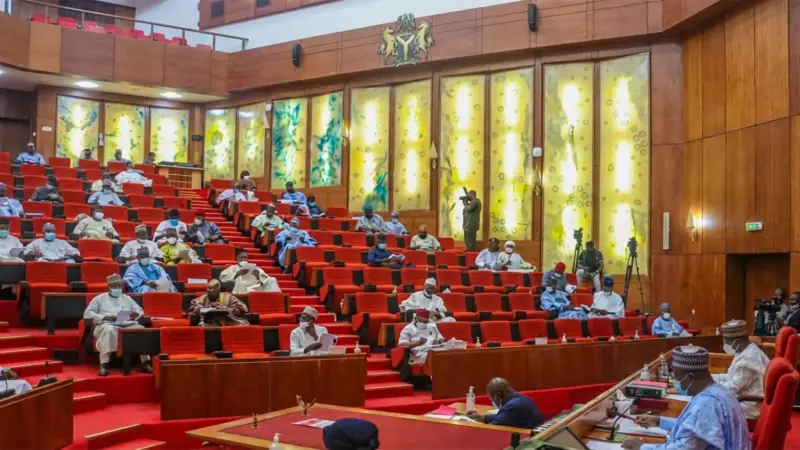
The call was reinforced during plenary on Wednesday, October 14, 2026, when senators considered concerns over failed roads and the government’s infrastructure priorities. The debate highlighted a familiar challenge in Nigeria: while new road projects are announced and launched, several existing projects remain unfinished, leaving communities to endure poor transportation links and uncertain completion timelines.
Senator Adams Oshiomhole, representing Edo North, argued that greater attention should be given to roads that have already received government funding but remain incomplete or have deteriorated. He identified the Benin–Asaba, Benin–Warri and Auchi–Abuja highways among the important routes requiring urgent attention.
Oshiomhole proposed preventing the Minister of Works, David Umahi, from beginning new road projects until existing ones had been completed. However, the Senate did not adopt that proposal in its original form. Instead, lawmakers accepted a recommendation by former Senate President Ahmad Lawan, representing Yobe North, urging the minister to prioritise older and abandoned projects.
The distinction is important. The Senate’s position was a call to change priorities rather than an outright prohibition on new construction. The resolution placed emphasis on completing existing commitments while allowing the government to determine how best to manage its wider infrastructure programme.
The debate also coincided with a separate intervention concerning the Onitsha–Iyiowa–Odekpe–Atani–Ogwuikpele–Ndoni Federal Highway, which links Anambra and Rivers states. Senator Tony Nwoye, representing Anambra North, sponsored a motion seeking urgent rehabilitation and reconstruction of the road, describing it as an important transport corridor connecting Nigeria’s South-East and South-South regions.
Nwoye told lawmakers that sections of the highway, some constructed in the late 1980s, had suffered prolonged neglect without major rehabilitation. According to his presentation, ageing infrastructure, increasing traffic and inadequate routine maintenance had contributed to extensive pavement failures, deep potholes and severe erosion.
The senator warned that the road’s condition had created difficulties for commuters and threatened the movement of goods and people. A journey of approximately 70 kilometres from Onitsha through Ogbaru to Ndoni, which would ordinarily take about an hour, could take nearly two hours under the conditions he described.
Longer journeys can increase transport fares, fuel consumption and the cost of moving agricultural produce and other goods. For businesses operating along the route, delays can affect delivery schedules and reduce the time available for productive work. For residents, poor road conditions can make access to essential services more difficult.
Nwoye also raised concerns about vehicle breakdowns, accident risks and the security challenges faced by motorists who become stranded on damaged sections. He highlighted the road’s economic significance, particularly its connection to commercial activities and oil and gas operations in the Ogbaru oil belt.
Following consideration of the motion, the Senate called on the Federal Government, the Federal Roads Maintenance Agency and the South-East Development Commission to undertake emergency repairs on failed sections of the highway. It also urged the Federal Ministry of Works to begin rehabilitation and reconstruction through a special intervention programme or other suitable funding arrangements.
The Senate mandated its Committee on Works to conduct an on-the-spot assessment, consult relevant stakeholders and submit recommendations within four weeks. It also directed the Senate Committees on Works and Appropriations to ensure adequate budgetary provision for comprehensive rehabilitation and reconstruction.
These steps establish a process for further scrutiny, but they do not by themselves confirm when construction will begin or when the highway will be completed. Those details will depend on subsequent assessments, funding decisions and implementation by the responsible authorities.
The wider concern over abandoned roads comes as the Federal Government continues to pursue an extensive infrastructure programme. On October 13, Umahi said the administration was executing approximately 5,500 kilometres of new and ongoing road projects nationwide. The announcement came during the flag-off of reconstruction and dualisation work on the Lambata–Bida–Mokwa–Makera–Kontagora Federal Highway in Niger State.
The scale of the programme illustrates the government’s infrastructure ambitions, but the Senate’s intervention raises a practical question about how limited public resources should be allocated. Starting new projects can improve connectivity and open up underserved areas. However, unfinished projects can continue to impose economic costs when they remain unusable or deteriorate while awaiting completion.
The challenge is particularly significant in a country where roads serve as the principal links between many communities, markets and production centres. Damaged highways can slow the distribution of food, increase the cost of commercial transport and complicate access to schools, hospitals and other public services.
Abandonment can also create financial problems. Where partially completed roads deteriorate, previously executed work may require additional repairs before construction can continue. Delays can therefore increase the eventual cost of delivering infrastructure, although the financial consequences vary according to each project’s condition, contract terms and funding arrangements.
The Senate’s demand also places attention on accountability. Public projects require effective planning, realistic budgets, timely payments and consistent monitoring to ensure that contractors deliver the work for which they have been engaged. Where projects stall, Nigerians need clear information about the reasons for delays, the funds already spent and the steps being taken to finish the work.
Nevertheless, prioritising abandoned roads does not automatically mean that every new project should be suspended. Some new roads may be essential for economic development, public safety or access to previously underserved areas. The central issue raised by lawmakers is whether government decisions adequately balance these needs against existing commitments and the public costs of unfinished infrastructure.
For the Federal Government, the next test will be translating the Senate’s recommendations into measurable progress. That means identifying priority projects, providing appropriate funding, resolving implementation obstacles and communicating credible timelines to affected communities. Emergency repairs may offer temporary relief, but badly damaged highways can require comprehensive reconstruction to provide lasting improvements.
The Senate has made its position clear: existing road projects deserve greater attention before additional commitments place further demands on public resources. Whether the intervention produces meaningful change will depend on the government’s response, the availability of funding and the effectiveness of oversight.
For motorists and communities living with deteriorating roads, the most important outcome will not be another announcement but visible work, safer journeys and projects completed within credible timelines. Nigerians will be watching to see whether the latest demand leads to lasting improvements in the country’s road network.
📩 Stone Reporters News | 🌍 stonereportersnews.com
✉️ info@stonereportersnews.com | 📘 Facebook: Stone Reporters News | 🐦 X (Twitter): @StoneReportNew | 📸 Instagram: @stonereportersnews
Add comment
Comments