

Reported by Ariajegbe Sylvia Esezobor
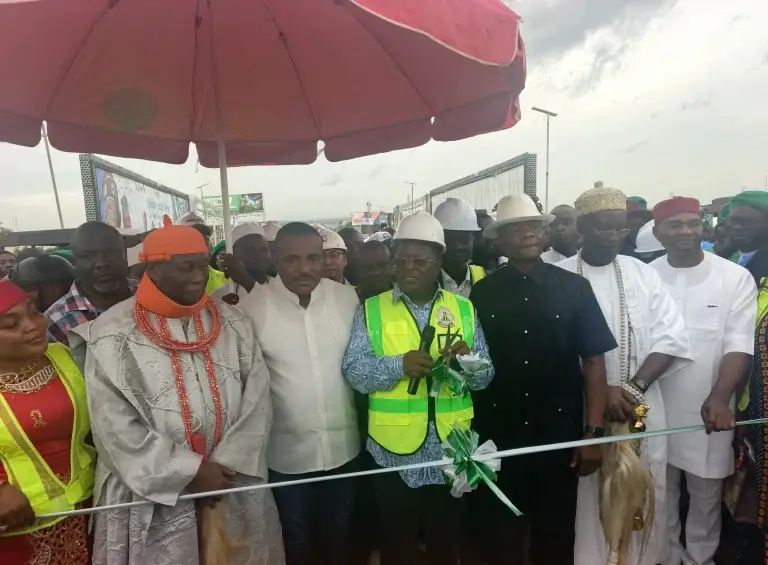
The Federal Government on Thursday, October 15, 2026, reopened the First Niger Bridge, restoring a critical transport link between Onitsha in Anambra State and Asaba in Delta State after approximately 38 days of closure for emergency rehabilitation works. The Minister of Works, David Umahi, presided over the reopening ceremony at the Onitsha end of the bridge, flanked by federal and state representatives, including traditional rulers from both states. The reopening brings relief to thousands of motorists and commuters who had endured weeks of detours, gridlock, and inflated transport costs since the bridge was shut to traffic on September 7, 2026.
The closure was prompted by the discovery of vandalised structural components, including steelwork around the bridge's expansion joints. The Federal Ministry of Works had initially scheduled the closure to last from September 7 to September 21, but the reopening was extended indefinitely following persistent rainfall and other unforeseen circumstances that delayed the rehabilitation work. Contractors required at least three consecutive dry days before resuming asphalt work, and the torrential rains that swept through the region in late September stripped away freshly laid materials and left paving machines idle. The extended closure compounded the hardship for commuters, who faced journeys that stretched from under an hour to over four hours on alternative routes, particularly the badly deteriorated Onitsha-Owerri Road.
The rehabilitation work, carried out by contractor Messrs SKECC, which was already handling the Onitsha-Enugu Dual Carriageway project, involved the complete milling of the degraded carriageway, laying of a fresh 40mm asphalt wearing course, structural welding, and the resetting of missing steel hardware. The vandalised bolts, nuts, and expansion joints, some of which had to be flown in from outside the country, were replaced. Closed-circuit television cameras were installed at various sections of the bridge to deter further vandalism, solar-powered streetlights were added, and the road markings were repainted. The bridge's railings were also repainted, with painters still carrying out finishing touches at the time of the reopening.
Speaking at the ceremony, Umahi commended the contractor for what he described as excellent work, though he acknowledged that the project was not yet one hundred per cent complete. “We must commend the contractors, SKCC, very, very highly; they have worked very well,” he said. He said the repairs were intended to improve traffic flow and ensure the safety of road users. The minister also commended the governors of Anambra and Delta states for their roles in facilitating the project. The reopening ceremony was marked by the display of photographs of President Bola Tinubu, Vice-President Kashim Shettima, and Anambra State Governor Chukwuma Soludo, alongside banners placed on the bridge railings. Umahi had, during an earlier inspection in September, directed that illegal advertisements be removed from the bridge and that the President's photographs be displayed following the completion of the rehabilitation, saying the display was intended to recognise what he described as the President's contributions to infrastructure development in the South-East.
The minister used the occasion to appeal to residents of the South-East and South-South to support President Tinubu's re-election bid, citing the Federal Government's infrastructure projects in the regions. “We have no regret supporting President Bola Tinubu. Let me declare, in opening this bridge, that I have no regret supporting Mr President,” Umahi said. “I am very, very proud for him to be my boss. He is the most qualified and eminently qualified to lead this country.” He also criticised the Labour Party's 2023 presidential candidate, Peter Obi, and the Obidient Movement, while expressing confidence in the All Progressives Congress ahead of the 2027 elections. “I am not into regional politics; I am following who is performing. Can anybody give us the alternative to Tinubu, President Tinubu, who has salvaged the country from a catastrophic situation? Can Peter Obi do what Tinubu is doing?” he asked. He said the projects being executed by the Federal Government would soon be extended to other parts of Anambra State, including the dualisation of the Oba-Okigwe Expressway, which he said the President had approved.
The reopening was also marked by some controversy over a newly installed traffic demarcation on the bridge. The demarcation, introduced during the rehabilitation, had sparked public debate and criticism over reduced carriageway space, traffic flow, and emergency access. Rumours spread on social media that the demarcation had been demolished following public outcry. The Federal Controller of Works for Anambra State, Timothy Emenike, dismissed the rumours as false, clarifying that the ministry had only created openings around some sections of the demarcation to enable vehicles to make U-turns in emergencies and to allow the Federal Road Safety Corps, the fire service, and other traffic agencies to carry out emergency duties on the bridge. “The demarcation was not destroyed,” Emenike said. “What we simply did was create room for vehicles to make U-turns and for emergency purposes.” The demarcation had drawn mixed reactions, with some road users welcoming the separation of traffic moving in opposite directions, while others raised concerns about the reduced carriageway space and the ability of emergency vehicles to manoeuvre effectively.
The First Niger Bridge, completed in December 1965 at a cost of approximately £6.75 million and commissioned by then Prime Minister Alhaji Tafawa Balewa, is one of Nigeria's most historically significant infrastructure assets. Built by French construction giant Dumez, it was the first bridge to connect Eastern and Western Nigeria across the River Niger, replacing an arduous ferry crossing. For over six decades, it has served as a vital artery for commerce, connecting Onitsha, one of West Africa's largest commercial hubs, to Asaba and the broader South-South and South-East regions. The bridge's condition had deteriorated over the years, with decades of neglect and unchecked scrap metal theft stripping it of structural hardware. Thieves had stolen heavy iron railings, cut out steel truss nuts, and removed critical expansion joint fittings, prompting the emergency rehabilitation that began in September 2026.
The economic impact of the closure was severe. Regional logistics analysts estimated that the commercial ecosystem linking the South-East to Western and Northern consumer belts lost between N1.8 billion and N2.4 billion every single day when the corridor suffered systemic gridlock. Traders in Onitsha, which serves as a major distribution centre for goods moving across the region, faced delays in receiving inventory, workers arrived late to jobs, and transportation costs climbed for everyone. Journeys that once took ten minutes across the bridge stretched to over forty minutes via alternative routes, translating into higher fuel consumption, increased vehicle wear, and a tangible rise in the cost of moving goods such as yams and other agricultural produce. The reopening is expected to significantly reduce travel time and logistics costs for businesses operating within the South-East and South-South geopolitical zones, and market analysts suggest the improved condition of the bridge will have a direct impact on transport inflation and trade efficiency.
For the communities that depend on the bridge, Thursday's reopening brought a mixture of relief and cautious optimism. Motorists who had been diverted to the Second Niger Bridge and other alternative routes expressed satisfaction with the rehabilitation work and looked forward to smoother journeys. The reopening means that two bridges will now share the traffic load across the River Niger, reducing congestion and creating backup options if either route requires future maintenance. However, the closure also exposed the fragile state of federal road maintenance and the broader infrastructure deficit in the region. The Onitsha-Owerri Road, a critical alternative route during the closure, remains in deplorable condition, a fact that the Onitsha Chamber of Commerce, Industry, Mines and Agriculture highlighted in the days leading up to the reopening. The chamber called for clarification on the status and expected reopening dates of other critical infrastructure, including the Opi Bridge along the 3-3 Road, to enable road users and businesses to plan their movements.
The rehabilitation also raises questions about the sustainability of Nigeria's aging infrastructure. The First Niger Bridge is now sixty-one years old, and while the emergency repairs have restored it to a safer and more durable condition, the long-term structural integrity of the bridge will require continued monitoring and investment. The installation of CCTV cameras and solar streetlights represents an improvement, but the vandalism that necessitated the emergency closure in the first place speaks to deeper issues of security and public stewardship of national assets. The minister himself acknowledged that the work was not entirely finished and that further interventions would be needed. For now, the reopening of the First Niger Bridge restores a vital link that sustains livelihoods, facilitates trade, and connects millions of Nigerians. The relief is real, but so is the reminder that the bridge, like much of the nation's infrastructure, stands on decades of deferred maintenance.
📩 Stone Reporters News | 🌍 stonereportersnews.com
✉️ info@stonereportersnews.com | 📘 Facebook: Stone Reporters News | 🐦 X (Twitter): @StoneReportNew | 📸 Instagram: @stonereportersnews
Add comment
Comments