

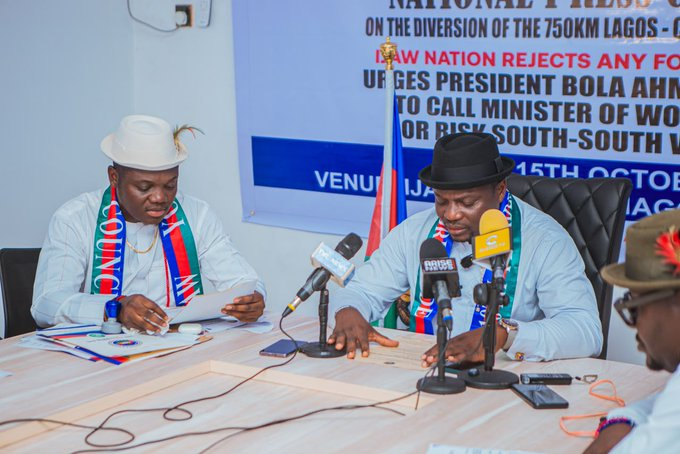
The Ijaw Youth Council (IYC) Worldwide has warned President Bola Tinubu and the ruling All Progressives Congress (APC) that any decision to divert the Lagos-Calabar Coastal Highway away from its proposed coastal alignment could damage their political support in Nigeria's South-South region ahead of the 2027 general elections.
The warning was issued on Thursday, October 15, 2026, during a press conference at Ijaw House in Yenagoa, Bayelsa State. IYC National President Doubra Collins Okotete, speaking on behalf of the council's national leadership, demanded that the Federal Government retain the original highway route through Edo, Delta, Bayelsa and Rivers states.
The council expressed concern over statements attributed to Minister of Works David Umahi suggesting that sections of the proposed highway could be redirected towards the existing East-West Road.
It argued that such a decision would deprive several coastal communities of the economic benefits anticipated when the project was announced.
“You cannot seek our votes while taking away our roads,” the council declared, linking its infrastructure demands to political accountability.
The IYC maintained that the proposed 750-kilometre highway should follow the coastal alignment it said had received Federal Executive Council approval.
According to Okotete, any departure from that arrangement would undermine public confidence in the administration's commitment to developing the Niger Delta.
The council described explanations involving difficult terrain and construction costs as unacceptable, arguing that similar geographical challenges had not prevented major infrastructure development elsewhere.
It questioned why communities responsible for substantial petroleum production should face possible exclusion from a project intended to improve transportation across southern Nigeria.
The IYC argued that the region's contribution to national revenue justified greater investment in roads, bridges and other public infrastructure.
However, its assertions about the region's share of national wealth were presented as part of its advocacy and were not independently assessed.
The council also referred to political developments involving governors from Bayelsa, Delta and Rivers states, claiming that expectations of federal infrastructure investment had influenced regional support for the APC.
It named Governors Douye Diri, Sheriff Oborevwori and Siminalayi Fubara while discussing the political implications of the proposed route.
Those assertions reflected the council's interpretation of political events rather than independently established explanations for individual decisions.
The controversy intensified after reports emerged that Umahi had discussed using the existing East-West Road instead of constructing a new alignment through difficult terrain.
On October 12, TheCable reported the minister as saying President Tinubu had directed that the highway be routed through the existing road corridor.
Umahi cited engineering difficulties and flooding concerns, particularly along sections of the East-West Road affected by changing environmental conditions.
However, the minister subsequently rejected suggestions that the coastal highway had been abandoned or permanently replaced.
Following discussions with Tinubu, Umahi stated that the original 750-kilometre project remained intact and that reconstruction of approximately 400 kilometres of the East-West Road would constitute an additional intervention.
He maintained that surveying and design work for the remaining coastal sections was continuing.
The clarification introduced an important distinction between abandoning the coastal highway and undertaking improvements to another major transport corridor.
Nevertheless, the IYC said the minister's explanation had failed to resolve its concerns about the eventual alignment.
The council demanded publication of the approved engineering drawings and complete route plans, arguing that public access to the documents would establish which communities were expected to benefit.
It also requested simultaneous construction across the Edo, Delta, Bayelsa and Rivers sections rather than concentrating activity elsewhere.
To challenge arguments about difficult terrain, the organisation identified infrastructure projects already being undertaken across the Niger Delta.
Among them was the Nembe-Brass Road in Bayelsa, which the council said involved more than 15 bridges across challenging coastal terrain.
It also cited the Yenagoa-Oporoma-Ukubie Road, including a bridge crossing the Nun River, as evidence that substantial engineering works could be undertaken in swampy areas.
Other examples included the Trans-Kalabari Road in Rivers State and projects associated with the Niger Delta Development Commission.
The council mentioned the Port Harcourt-Okrika Road, Bonny Ring Road and Gbaregolor-Ogolaha Road as further examples of infrastructure development in difficult environments.
These projects, it argued, demonstrated that geographical challenges should be addressed through engineering solutions rather than the exclusion of communities.
The existence of such projects does not independently establish the comparative cost, feasibility or environmental implications of every possible coastal highway alignment.
Those questions require detailed engineering studies, financial assessments and environmental reviews.
The IYC also criticised former Cross River State Governor Donald Duke over reported remarks questioning the feasibility of constructing sections of the highway through challenging terrain.
It offered to sponsor an inspection visit to Bayelsa and other South-South states to demonstrate the infrastructure projects cited in its argument.
Beyond engineering considerations, the dispute concerns the economic purpose of the coastal highway.
The Federal Government has presented the project as a major transport investment intended to improve connectivity, encourage commerce and support development along Nigeria's southern corridor.
Coastal communities expect improved access to markets, ports, employment opportunities and essential services.
Stakeholders opposing a revised alignment argue that connecting existing highways cannot necessarily provide the same benefits as constructing roads through previously underserved coastal settlements.
Conversely, improvements to the East-West Road could address existing transport problems, including flooding, deteriorating pavement and difficult journeys between major communities.
The economic consequences of either approach would depend on the final design, access arrangements, construction costs and communities served.
The council's warning adds political pressure to a debate already involving federal officials, regional organisations and communities seeking clarity about the project.
Its prediction of electoral consequences remains a political warning, not an established forecast of voting behaviour.
No evidence presented establishes how individual South-South voters would respond to a final route decision.
The immediate question is whether the government will publish sufficient technical information to reconcile its assurances with the concerns expressed by affected communities.
For the IYC, maintaining the original coastal route remains its central demand.
For the Federal Government, the challenge is to clarify the highway's approved alignment while explaining how construction and reconstruction plans will serve the wider region.
Until those details are publicly established, disagreement over the project's future is likely to remain a significant issue in discussions about infrastructure development across the Niger Delta.
📩 Stone Reporters News | 🌍 stonereportersnews.com
✉️ info@stonereportersnews.com | 📘 Facebook: Stone Reporters News | 🐦 X (Twitter): @StoneReportNew | 📸 Instagram: @stonereportersnews
Add comment
Comments