

A private jet operated by Triton Aviation made an emergency landing at Nnamdi Azikiwe International Airport, Abuja, after losing a door shortly after take-off for Lagos. The crew declared an aviation emergency, prompting air traffic controllers to direct the aircraft back to the airport while fire, rescue and medical personnel were placed on standby.
The incident occurred on Thursday, October 15, 2026, involving a CL60 aircraft registered T7-SEI and operating as flight DWC052. According to an air traffic control incident report obtained by Nigerian news organisations, the aircraft departed Abuja's Runway 22 at 4:17 p.m. Coordinated Universal Time (UTC), heading for Murtala Muhammed Airport in Lagos.
Three minutes after departure, at approximately 4:20 p.m. UTC, the aircraft was about three nautical miles from Abuja airport and climbing through 3,000 feet when the crew transmitted a Mayday distress call.
The pilots informed air traffic controllers that a door had opened during the flight. Abuja Approach Radar subsequently directed the aircraft to return to the airport for an emergency landing.
Mayday is the internationally recognised distress signal used by aircraft crews when reporting an emergency requiring immediate attention.
At 4:22 p.m. UTC, the airport's fire watch room and medical team were alerted and instructed to remain on standby.
Fire and rescue personnel were also directed to designated positions identified as A4 and A5 in preparation for the aircraft's return.
The incident report recorded further communication between the pilots and Abuja Control Tower at approximately 4:29 p.m. UTC.
During that exchange, the crew asked whether air traffic controllers could visually determine the condition of the aircraft's door.
The duty air traffic controller attempted to examine the aircraft using binoculars but could not confirm the door's condition because of the aircraft's position.
The controller subsequently informed the crew that a visual confirmation was not possible.
Despite the emergency, the pilots continued their return to Abuja, where the aircraft landed safely on Runway 22 at approximately 4:34 p.m. UTC.
The landing occurred about 14 minutes after the distress call and 17 minutes after the aircraft's departure.
Following touchdown, the duty air traffic controller observed that the door was missing from the aircraft's fuselage.
The aircraft was subsequently directed to the international apron extension, where it was parked with the assistance of an airport marshaller.
At approximately 4:40 p.m. UTC, the crew reported having the marshaller in sight before completing the parking procedure.
The successful landing brought the immediate airborne emergency to an end, although the circumstances surrounding the loss of the door remained under investigation.
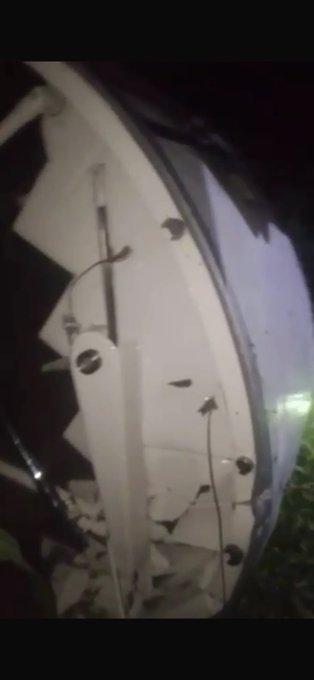
Separate footage circulating online showed what appeared to be the detached aircraft door lying on farmland in the Abuja area.
In the recording, a man speaking from the location said the object had been discovered by farmers returning from their farm.
The speaker's identity was not established, and the precise location where the object was found was not independently confirmed in the initial reports.
The footage was published by several Nigerian news organisations, including The Guardian and PUNCH, alongside accounts of the aviation incident.
The Nigerian Civil Aviation Authority confirmed that the incident had occurred but referred questions about its investigation to the Nigerian Safety Investigation Bureau.
Michael Achimugu, the NCAA's Director of Public Affairs and Consumer Protection, told The Guardian that the matter fell within the investigative responsibility of the safety bureau.
The Nigerian Safety Investigation Bureau also confirmed the occurrence and said investigators had been deployed to examine the incident.
Its media representatives indicated that an official statement would be issued following further inquiries.
The bureau is responsible for investigating aviation accidents and serious incidents in Nigeria, including establishing circumstances relevant to flight safety.
Such investigations are intended to identify safety concerns and support measures aimed at preventing similar occurrences.
As of the initial reports published on Friday, October 16, the bureau had not publicly announced a finding explaining why the aircraft's door became detached.
No evidence had been released establishing whether the incident resulted from a mechanical fault, a maintenance issue, a door-securing problem or another cause.
Those possibilities cannot be presented as findings without evidence from the investigation.
The number of passengers aboard the aircraft was also not immediately established in the reports reviewed.
There was no confirmed information identifying the passengers or specifying whether anyone required medical treatment following the emergency landing.
PUNCH and The Guardian reported that efforts to obtain comments from Triton Aviation, the aircraft's operator, were unsuccessful before publication.
Consequently, the company's explanation of the incident and any maintenance information it may provide had not been publicly established.
The aircraft was identified in the incident documentation by its registration number and flight identification, enabling the occurrence to be distinguished from other aviation emergencies.
The reported departure, distress call, emergency response and landing times were consistent across accounts published by PUNCH, The Guardian, Vanguard and Leadership.
Those reports also agreed that the pilots initially described an open door, while the complete loss of the door became visually apparent to the tower controller after landing.
That sequence is significant because the crew's initial report did not establish, by itself, that the door had already separated from the aircraft.
The later observation provided confirmation that the door was missing when the aircraft returned.
The recovery footage provides additional reported evidence of a detached aircraft component, although its identification and recovery circumstances remain matters for investigators.
The incident has drawn attention to aviation safety procedures, particularly the response to unexpected problems immediately after departure.
In this case, the documented response involved communication between the flight crew and air traffic controllers, the aircraft's return to the departure airport and the activation of emergency support personnel.
The available records establish that the aircraft landed safely and was moved to a parking position following the emergency.
They do not establish the technical cause of the occurrence or provide sufficient information to assess the aircraft's maintenance history.
The Nigerian Safety Investigation Bureau's findings will therefore be central to establishing the circumstances surrounding the door's detachment.
Further information is also expected to clarify the aircraft's occupancy and whether any additional safety measures were required after landing.
For now, the confirmed developments are the emergency declaration, the aircraft's safe return to Abuja, the missing door and the commencement of an official safety investigation.
The investigation remains ongoing, with the cause of the incident yet to be determined.
📩 Stone Reporters News | 🌍 stonereportersnews.com
✉️ info@stonereportersnews.com | 📘 Facebook: Stone Reporters News | 🐦 X (Twitter): @StoneReportNew | 📸 Instagram: @stonereportersnews
Add comment
Comments