

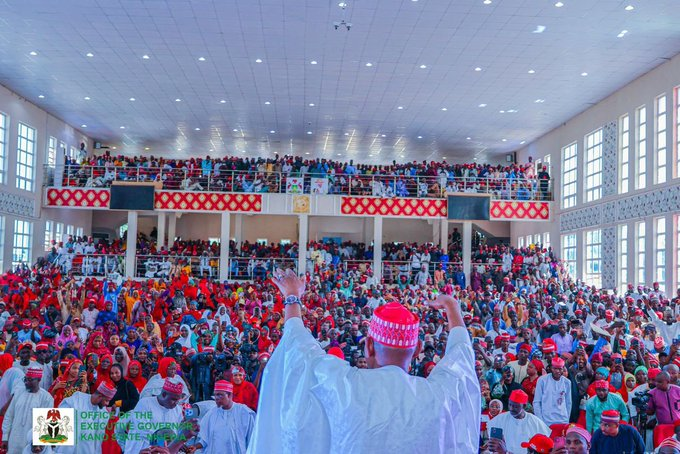
The New Nigeria Peoples Party (NNPP) has challenged the validity of the resignations of Kano State Governor Abba Kabir Yusuf and 45 lawmakers elected on its platform in the 2023 general elections, insisting that the affected politicians failed to comply with the party's constitutional procedures for terminating their membership.
The party communicated its position to the Independent National Electoral Commission (INEC) in a letter dated Monday, October 19, 2026, jointly signed by its National Chairman, Dr Agbo Major, and National Secretary-General, Oginni Olaposi.
The affected legislators comprise 18 members of the House of Representatives and 27 members of the Kano State House of Assembly who secured their mandates on the NNPP platform.
The development represents another stage in the political disagreement arising from Governor Yusuf's defection to the All Progressives Congress (APC), which has reshaped party alignments in Kano ahead of the 2027 general elections.
In the letter, the NNPP maintained that although members have the right to change their political affiliation, the process must comply with the party's constitution and applicable electoral legislation.
The correspondence, titled Purported Resignation of Membership of the NNPP by Certain Elected Public Office Holders — Formal Notice of Non-Compliance with the Party Constitution and Applicable Electoral Laws, formally disputed the membership status claimed by the affected officeholders.
According to the party, the politicians had publicly indicated their intention to leave the NNPP or participated in activities associated with other political parties without completing the procedures required to terminate their membership.
The NNPP argued that political declarations and participation in another party's activities were insufficient to establish that a member had legally withdrawn from the organisation.
It cited provisions of its 2023 constitution, as amended, alongside the Electoral Act, 2026, as amended, as the legal framework governing the issues raised in its petition.
The party maintained that its membership records had not been lawfully altered to reflect the departure of the affected politicians.
Consequently, it asked INEC not to accept the reported resignations as conclusively established without examining the party's official records and relevant legal requirements.
The NNPP further objected to any attempt by the affected officeholders to rely on what it described as incomplete resignations to secure membership, nomination or sponsorship from another political party for the 2027 elections.
The party's position is that elected officials who obtained their mandates through its platform must comply with the prescribed resignation procedures before their departure can be formally recognised.
However, the NNPP's assertion represents its interpretation of its constitution and electoral law. It does not, by itself, amount to a judicial determination that the governor or lawmakers remain members of the party.
The party also argued that the authority to confirm membership status to INEC rests with its national chairman and national secretary-general, who are responsible for the organisation's official membership records.
It maintained that the affected politicians continued to appear in its records unless their resignations had been properly processed and their names formally removed.
The letter referred to a judgment delivered by an Abia State High Court sitting in Uzuakoli, although the precise legal effect of that judgment on the individual resignations would depend on its terms and any subsequent court decisions.
The NNPP urged INEC to take its objection into account when considering correspondence, party membership documentation and nomination processes involving the affected politicians.
It also warned against simultaneous membership of two political parties for electoral purposes, arguing that such an arrangement could raise questions under applicable electoral laws and guidelines.
The party said it would pursue available legal remedies, including court proceedings, if necessary to protect its interests and challenge actions it considered inconsistent with its constitution.
The controversy follows Governor Yusuf's earlier decision to leave the NNPP for the APC, a development that generated significant political reactions in Kano State.
Yusuf was elected governor in 2023 on the NNPP platform, benefiting from the political structure associated with former Kano State Governor and NNPP presidential candidate Rabiu Musa Kwankwaso.
His subsequent movement to the APC altered the political relationship between the governor and the Kwankwasiyya movement, which had been instrumental in his electoral victory.
The defection was followed by political realignments involving members of the Kano State House of Assembly and other elected officials.
While supporters of the governor have presented the move as a political decision intended to advance the state's interests, the NNPP has continued to question aspects of the departure of elected officials from its platform.
The latest petition introduces a separate legal question concerning whether the affected politicians fulfilled the internal procedures required by the party's constitution.
That question is distinct from the constitutional consequences that may arise when legislators defect from the political parties on whose platforms they were elected.
Under Sections 68(1)(g) and 109(1)(g) of the 1999 Constitution, as amended, members of the National Assembly and state Houses of Assembly may face consequences for changing political parties before the expiration of their terms, subject to specified constitutional exceptions.
Those provisions address legislative seats and are different from the legal framework governing the office of a state governor.
The NNPP's current petition, however, principally concerns the validity of membership resignations and the implications for future party nominations.
The existence of the petition does not automatically invalidate the governor's office, remove any lawmaker from office or prevent the affected politicians from contesting future elections.
Any binding determination on disputed constitutional or legal rights would depend on the applicable law and the decisions of competent authorities or courts.
The disagreement could nevertheless become relevant to preparations for the 2027 general elections, particularly if questions about party membership arise during candidate nomination and sponsorship processes.
Political parties are responsible for conducting primaries and submitting candidates in accordance with electoral requirements, while INEC performs statutory functions relating to election administration and compliance.
The commission's response to the NNPP's letter had not been established in the reports available at the time of publication.
Similarly, no fresh response from Governor Yusuf or the 45 affected lawmakers to the specific allegations contained in the October 19 petition had been independently confirmed.
Their positions will be relevant to establishing whether they dispute the NNPP's interpretation of its constitution or maintain that their resignations were properly completed.
The development comes amid continuing political realignments in Kano, one of Nigeria's most electorally significant states, as political parties prepare for the 2027 elections.
For the NNPP, the petition is an attempt to secure recognition of its membership procedures and protect its interests in the electoral process.
For the affected politicians, the dispute raises questions about how their resignations were communicated, documented and processed.
The matter may ultimately require legal interpretation if the parties fail to reach an agreement on the status of the disputed memberships.
Until then, the NNPP's claim that Governor Yusuf and the 45 lawmakers remain its members should be understood as a contested party position rather than an established judicial finding.
📩 Stone Reporters News | 🌍 stonereportersnews.com
✉️ info@stonereportersnews.com | 📘 Facebook: Stone Reporters News | 🐦 X (Twitter): @StoneReportNew | 📸 Instagram: @stonereportersnews
Add comment
Comments