

Reported By Mary Udezue | Edited by: Oravbiere Osayomore Promise.
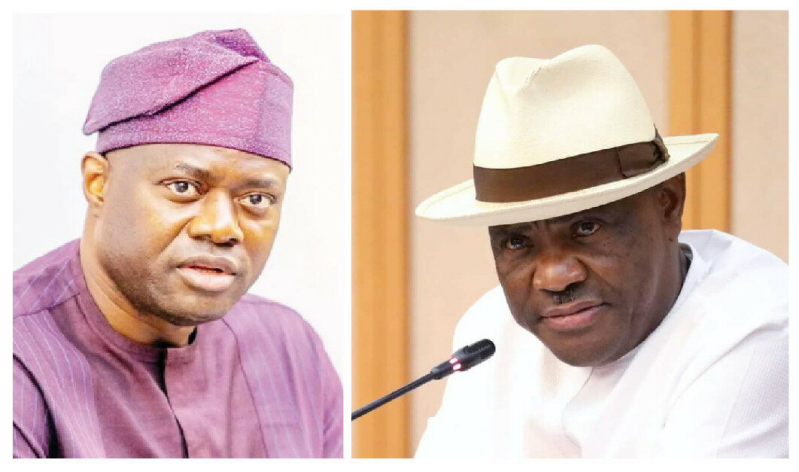
Nigeria’s main opposition party, the Peoples Democratic Party (PDP), is engulfed in one of its deepest crises in recent history as rival factions battle for control of the party ahead of the 2027 general elections. At the core of the leadership struggle are two influential figures: Nyesom Wike, the Minister of the Federal Capital Territory (FCT), and Seyi Makinde, Governor of Oyo State. Their power struggle has ignited legal confrontations, competing conventions, expulsions of leading members, defections to other parties and intense jockeying for influence — developments with profound implications for Nigeria’s democratic landscape.
The latest twist in the long‑running crisis came with a judgment from the Abuja Division of the Court of Appeal on March 9, 2026, which upheld a Federal High Court decision that effectively voided the PDP national convention held in Ibadan, Oyo State, on November 15–16, 2025. The appellate court ruled that the party failed to comply with key constitutional and statutory provisions regulating political party conventions. In particular, the judges found that the PDP did not issue valid notices of the convention to the Independent National Electoral Commission (INEC), and that valid state congresses were not held in many states, undermining the legitimacy of the entire process. Consequently, the court barred INEC from recognising the outcomes of the convention, including the leadership elected there.
The ruling cited the 1999 Constitution, the Electoral Act 2022, and the PDP’s own constitution in its judgment, stressing that internal party affairs must still respect the rule of law. The court rejected the argument that such matters are purely internal, saying statutory compliance is essential for democratic governance. The implication of this verdict has extended beyond procedural technicalities to the very heart of the party’s ability to function as a unified political force.
Following the judgment, Nyesom Wike described the appellate court’s decision as a victory for the rule of law and an opportunity for PDP members to repair divisions and rebuild unity. Wike told journalists in Abuja that the Ibadan convention was fundamentally flawed and that the leadership structure it produced could no longer be recognised. He reaffirmed plans by the party’s National Caretaker Committee, led by Abdulrahman Mohammed, to organise a fresh national convention scheduled for March 29–30, 2026, at the Velodrome of the Moshood Abiola National Stadium in Abuja. Wike stressed that the caretaker committee, recognised by earlier court orders, would legitimate the process ahead of new elections for the party’s national leadership.
Wike also warned that taking the dispute to the Supreme Court might harm the party’s chances of resolving its problems quickly, but indicated that his faction was prepared for any legal escalation, noting that they had “won all nine appeals” on points raised by opponents. His rhetoric emphasised both a commitment to legal process and a push to establish his faction’s ascendancy within the party apparatus.
In stark contrast, Governor Seyi Makinde has adopted a measured tone, acknowledging the difficulties facing the PDP while expressing optimism that “this period will also go away.” Speaking at an expanded meeting of the party’s Board of Trustees (BoT) in Abuja, Makinde described the situation as a challenging moment for both the PDP and Nigerian democracy. His remarks came soon after Dauda Lawal, Governor of Zamfara State, announced his defection from the PDP, leaving Makinde and Bala Mohammed of Bauchi State as the only remaining PDP governors in Nigeria at that time.
Makinde quoted scripture to convey his belief that bleak political periods are temporary, saying “weeping may endure for the night, but in the morning, joy cometh.” He urged party members to focus on unity and the broader struggle for democratic consolidation, even as internal divisions persist. His emphasis has been on reconciliation and avoiding actions that could further fragment the party.
The rift within the PDP has deep structural roots. In late 2025, a faction aligned with Wike announced the expulsion of Governor Makinde, Governor Bala Mohammed and other prominent leaders. Those expulsions were justified by claims that the targeted members repeatedly failed to comply with court orders, a decision that further strained relations and fuelled defections. The internal breach was exacerbated by competing claims to legitimacy, with both camps accusing each other of undermining the party’s constitution and democratic norms.
Opponents within the party have not acquiesced to the Court of Appeal’s verdict and are preparing to take the matter to the Supreme Court, arguing that operationalising the ruling could impose hardship on party members and create further uncertainty. Leaders in this faction have called for a final legal determination to clarify the dispute, believing that only the apex court can bring definitive closure to the crisis.
Adding to the upheaval, blocs loyal to both Wike and Makinde have reportedly been exploring alliances with other parties such as the All Progressives Congress (APC) and the African Democratic Congress (ADC) as alternative platforms for aspirants uncertain of the PDP’s ability to field candidates due to the ongoing legal entanglements. In one such development, the ADC publicly indicated openness to welcome defectors and disaffected PDP members. Such realignments underscore how the crisis has weakened the party’s cohesion and driven some politicians to hedge their bets.
The crisis has had substantial consequence beyond internal party rivalry. INEC reportedly rejected paperwork for the PDP’s Ekiti governorship candidate, Wole Oluyede, due to the legitimacy questions around the factional primary that nominated him, underscoring the electoral risks posed by these disputes. Observers also note that the ruling APC has gained ground in several states as the PDP’s internal discord deepens, altering Nigeria’s political balance with defections of key leaders such as Sheriff Oborevwori, Umo Eno, Peter Mbah, Douye Diri and Siminalayi Fubara to the APC over the past year. Others, including the Osun State Governor, joined the Accord Party, further reducing the PDP’s influence.
Analysts warn that if the PDP fails to reconcile its factions and restore a unified leadership ahead of party primaries scheduled for April–May 2026, it could be severely handicapped in the 2027 general elections, jeopardising its capacity to present united candidates for presidential, legislative and governorship races. With the party’s fortunes already weakened in many states, the spectre of a fractured opposition has become a central concern for proponents of a robust multiparty democracy in Nigeria.
The PDP’s crisis reflects bigger challenges in Nigeria’s political system: disputes over internal democracy, legal interpretations of party processes, and the struggle to balance powerful personalities with institutional norms. Both camps, while sharply divided, acknowledge the need for a stronger opposition to the ruling APC and agree that the PDP remains a central platform in Nigeria’s multiparty landscape. How the conflict is resolved — whether through internal compromise, judicial settlement at the Supreme Court, or potential shifting allegiances — will shape the party’s future and influence the wider political terrain in Nigeria as the 2027 elections draw nearer.
📩 Stone Reporters News | 🌍 stonereportersnews.com
✉️ info@stonereportersnews.com | 📘 Facebook: Stone Reporters | 🐦 X (Twitter): @StoneReportNew | 📸 Instagram: @stonereportersnews
Add comment
Comments